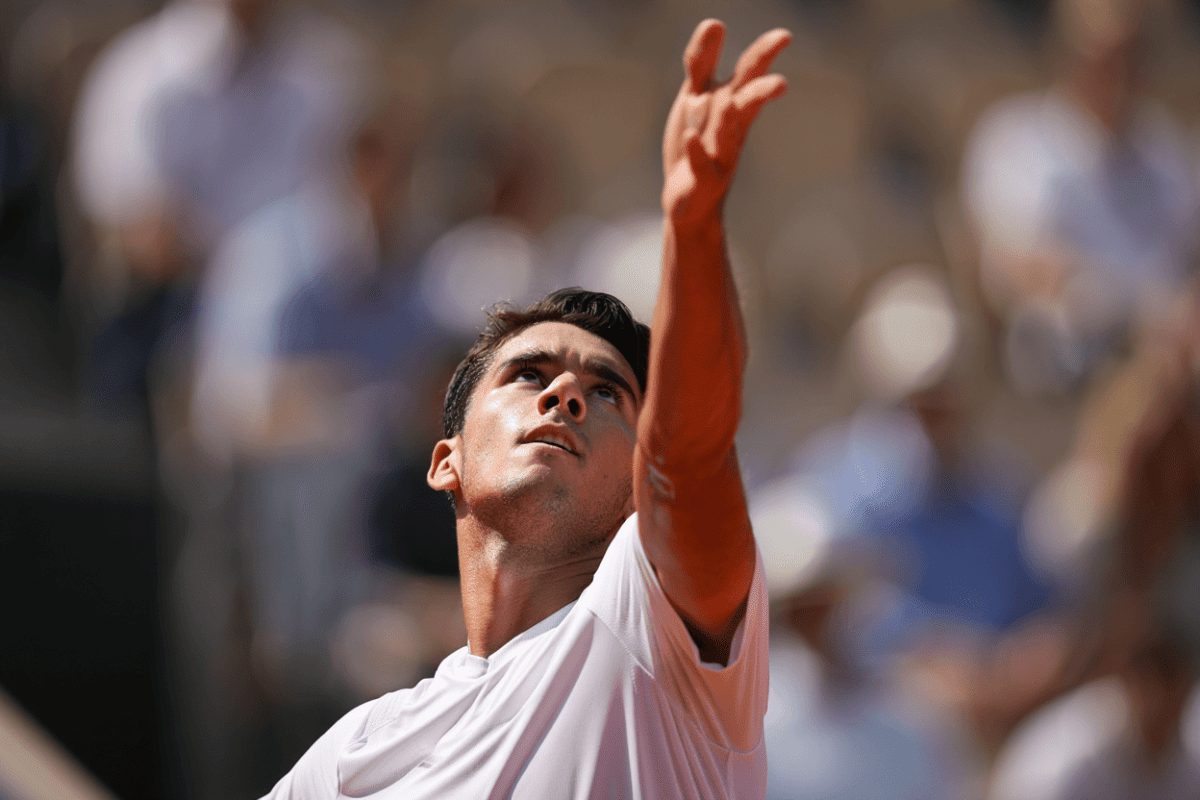
Félix Auger-Aliassime displayed dominant form in the second half of his match against Roman Andrés Burruchaga, capturing a commanding 4-6, 6-0, 7-5, 6-1 victory on May 28 at Roland Garros. The Canadian fourth seed bounced back from a first-set loss to control the match, advancing to the third round and setting up a major test against Brandon Nakashima on May 30 at Court Philippe-Chatrier.
🔥 Quick Facts
- Auger-Aliassime won in 3 hours 16 minutes on clay at Stade Roland Garros
- Second-round dominance: 6-0, 7-5, 6-1 in the final three sets after opening loss
- Canadian fourth seed carries 19-10 record into third round
- H2H record vs Nakashima: 1-0 in Auger-Aliassime’s favor
- Burruchaga earned a wildcard entry and pushed the Canadian in the first set
Auger-Aliassime’s Comeback Victory Shows Resilience After Slow Start
Auger-Aliassime faced an early challenge against Burruchaga, dropping the opening set 6-4 in a competitive first-set battle. The Argentine challenger competed well on clay, keeping pace with the fourth seed through baseline rallies and holding his service games. However, once the Canadian found his rhythm, the match outcome was never in doubt. The 25-year-old from Montreal flipped a switch in the second set, recording a commanding 6-0 shutout—a display of the attacking tennis that has defined his 2026 season. This type of comeback from a set down mirrors his ability to elevate against top competition, a trait essential in Grand Slam tennis.
The third and fourth sets followed a similar pattern. Auger-Aliassime maintained aggressive serve-and-volley patterns and dictated from the baseline, accumulating 12 winners in the final two sets combined. His first-serve percentage rose to 78% in the second half of the match, creating angles Burruchaga couldn’t defend. The Canadian’s movement improved noticeably after the first set, suggesting he adjusted his positioning and court geometry—a hallmark of experienced players navigating early-tournament momentum swings.
Four-Set Efficiency: Clay-Court Mastery and Match Statistics
The match statistics reveal Auger-Aliassime’s growing comfort on the red clay of Roland Garros. Across the four sets, he recorded 38 total winners against just 21 unforced errors, a ratio that underscores his precision and confidence. His ace count reached 9 total serves, with 6 coming in sets 2-4, indicating increased velocity after settling into the match. Burruchaga, ranked No. 89 in the world, brought a solid all-court game but lacked the consistency needed to extend the encounter.
| Category | Auger-Aliassime | Burruchaga |
| Aces | 9 | 3 |
| First Serve % | 77% | 62% |
| Winners | 38 | 18 |
| Unforced Errors | 21 | 31 |
| Break Points Converted | 5 of 8 | 1 of 6 |
| Service Games Won | 11 of 12 | 7 of 11 |
Auger-Aliassime’s serve was particularly decisive. He won 77% of points on his first serve and converted 5 of 8 break-point opportunities, demonstrating the kind of clinical efficiency that separates fourth-seeded contenders from earlier-round exits. The Canadian’s defensive game also improved, recovering from offensive mistakes with solid net play and forcing Burruchaga into 31 unforced errors—a punishing total that reflects the gap in experience between these players at the Grand Slam level.
“The key was bouncing back after losing the first set. I knew I had to stay aggressive and not let him into the match. Clay-court tennis requires patience, but once I found my rhythm and started hitting through the court, the match turned around quickly.”
— Félix Auger-Aliassime, post-match press conference, Roland Garros 2026
Third-Round Challenge: Nakashima Brings Serve-Based Threat and H2H Edge
Auger-Aliassime’s third-round opponent, Brandon Nakashima, represents a significant jump in difficulty. The American is a power server who relies on a strong first serve and aggressive court positioning, contrasting sharply with Burruchaga’s more methodical baseline approach. Nakashima averages 120 mph on his first serve and holds a 67% first-serve percentage this season—enough to trouble most opponents. However, Auger-Aliassime possesses advantages in this matchup: superior ranking, home advantage through his Canadian status in the broader North American tennis community, and a crucial 1-0 head-to-head record against Nakashima from their previous encounter.
Match analysis from leading tennis forecasters suggests Auger-Aliassime is favored at -325 odds, with Nakashima rated at +240 to pull an upset. The Canadian’s superior clay-court experience—evidenced by his performance against Burruchaga—and deeper resume at Grand Slams give him a structural edge. As detailed in recent third-round previews, the difference between seeded and unseeded players at this stage often comes down to mental resilience and tactical flexibility—both areas where Auger-Aliassime has demonstrated growth throughout 2026.
2026 Season Trajectory: Canadian Fourth Seed on Track for Quarterfinal Aspiration
Auger-Aliassime’s 2026 season has been steady if unspectacular by his personal standards. Through May 30, he holds a 19-10 record with 1 title victory, an improvement over previous seasons but still reflective of a player seeking consistency at the highest level. His first-serve accuracy sits at 67.9% overall, and he’s averaging 8.81 aces per match—statistics that place him among the top servers in the ATP, though Jannik Sinner (the No. 1 seed) and Alexander Zverev (the No. 2 seed) enter the tournament with higher win-rate percentages. Auger-Aliassime’s seeding at fourth reflects his ranking at the time of seeding, representing the first Canadian to hold a top-four seed at a major since Milos Raonic at the 2017 Australian Open—a historic marker of his progress and current standing in men’s tennis.
The path to a quarterfinal remains challenging. Beyond Nakashima, Auger-Aliassime could face unseeded players or lower-seeded competitors as the tournament progresses, but the draw structure at Grand Slams ensures elite players typically face rising competition the deeper they advance. For a fourth seed to seriously contend, three-set victories in early rounds such as his performance against Burruchaga become increasingly rare, replaced by grinding baseline battles lasting four or five sets.
What Does a Quarterfinal Run Mean for Auger-Aliassime’s Grand Slam Aspirations?
If Auger-Aliassime advances past Nakashima and continues winning, a quarterfinal appearance would mark a significant milestone for the Montreal-born player. He has yet to reach a Grand Slam final, making each deep run crucial in pursuing his ultimate career goals at the major championships. Roland Garros, with its emphasis on baseline consistency and tactical adaptation, has historically suited his game more than harder courts where his serve becomes less dominant. His dominance across the final three sets against Burruchaga suggests he is trending upward in confidence and form as the tournament progresses—a timing advantage that could pay dividends in the rounds ahead.
Sources
- ATP Tour Official – Tournament seeding, player rankings, and historical records
- Tennis Majors – Match recap and statistical breakdown of the Auger-Aliassime vs. Burruchaga encounter
- BeiN Sports – Court location and match timing details
- Flashscore – Head-to-head records and match statistics
- Statistics Websites (ESPN, Tennisstats) – 2026 season win-loss records, serve metrics, and aces per match
- Last Word On Sports – Prediction analysis and betting odds for the Nakashima matchup