Ewan McGregor leads David Robert Mitchell‘s ambitious sci-fi thriller “The End of Oak Street,” arriving in theaters August 14, 2026. The film marks a significant creative departure for the “It Follows” director, blending cosmic horror with suburban Americana to explore how ordinary families respond when their world fundamentally changes.
🔥 Quick Facts
- Release Date: August 14, 2026 via Warner Bros. Pictures
- Director/Writer: David Robert Mitchell (It Follows, Under the Silver Lake)
- Cast: Ewan McGregor, Anne Hathaway, Maisy Stella, Christian Convery, P.J. Byrne
- Genre: Science fiction survival thriller with cosmic horror elements
- Plot Concept: A suburban block transported to an unknown dimension where prehistoric threats await
David Robert Mitchell’s Evolution: From Dread to Discovery
David Robert Mitchell has built his directorial reputation on slow-burn suspense and atmospheric unease. His 2014 breakout film “It Follows” redefined indie horror by transforming a simple concept—an inescapable curse following a teenager—into a meditation on teenage vulnerability and existential dread. The film’s $1.3 million budget grossed over $100 million worldwide, establishing Mitchell as a visionary capable of distilling primal fear into intimate character moments.
“The End of Oak Street” represents Mitchell’s most ambitious project yet, expanding from supernatural horror into science fiction territory. Rather than relying on the unseen menace formula that defined his earlier work, Mitchell constructs an entire alternate world—one where the familiar American suburb becomes alien and hostile. The Twilight Zone comparisons are apt: the film operates as modern speculative fiction, asking “what if” questions about community, family resilience, and adaptation under extreme circumstances.
The Plot: Suburban Displacement as Metaphor
The narrative follows the Platt family living on Oak Street in the 1980s. Life proceeds normally until a cosmic event—the film’s central mystery—tears their entire neighborhood from suburbia and transports it to an unknown dimension. Unlike films that treat displacement as mere spectacle, Mitchell’s approach emphasizes human adaptation. The community must not only survive physically but navigate the psychological disruption of losing everything familiar.
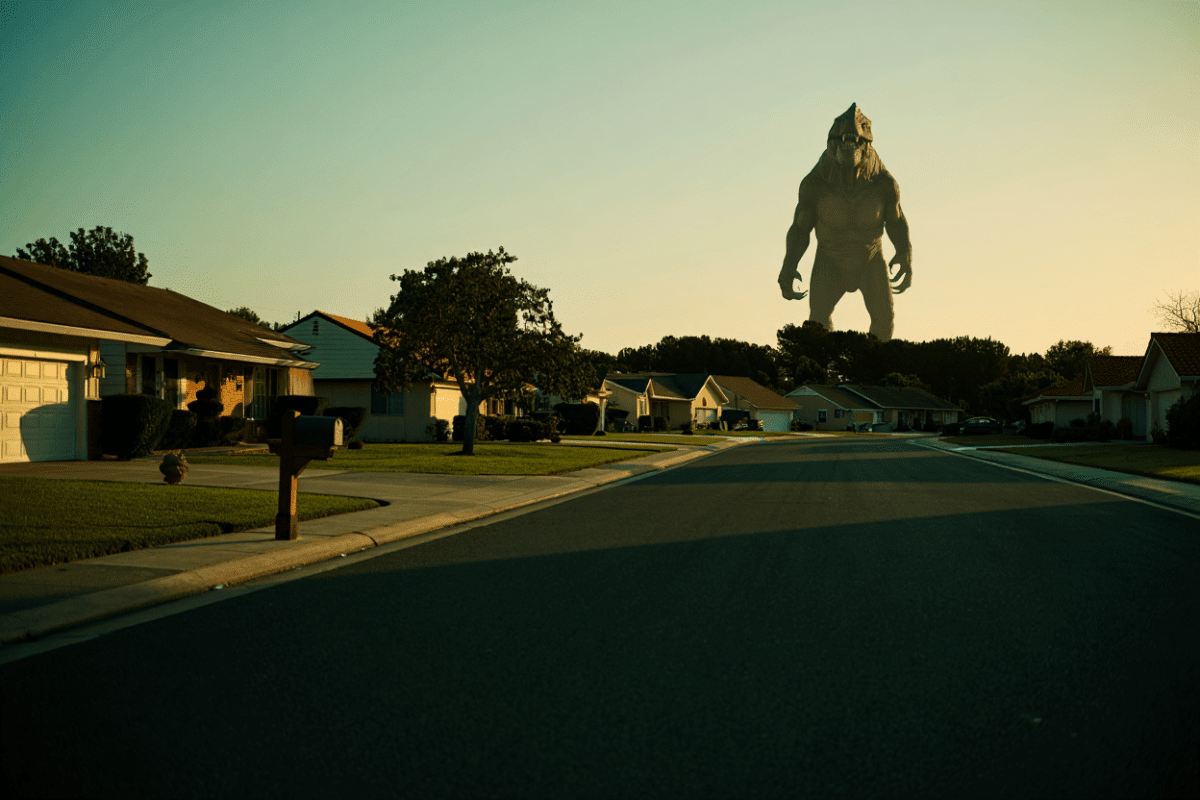
What distinguishes this premise is the introduction of prehistoric creatures—dinosaurs that inhabit this strange realm. The juxtaposition of 1980s American suburban life against ancient predators creates visual and thematic tension. Early imagery reveals the creatures in high detail, suggesting Mitchell invested heavily in creature design and practical effects rather than relying solely on CGI spectacle. This grounding approach maintains the intimate tone Mitchell perfected in “It Follows.”
Cast Expertise: McGregor and Hathaway’s Range
Ewan McGregor, known for action-driven roles in the Star Wars franchise and dramas like “Trainspotting,” brings a different skillset to “The End of Oak Street.” McGregor’s filmography shows his capacity for quieter, character-focused work—evident in films like “A Life Less Ordinary” and television series “A Gentleman in Moscow.” His presence here suggests Mitchell sought an actor capable of portraying a father figure dealing with catastrophic upheaval rather than a hero who defeats the threat.
| Actor | Role | Notable Credits |
| Ewan McGregor | Patriarch Figure | Star Wars, Trainspotting, A Gentleman in Moscow |
| Anne Hathaway | Family Anchor | The Dark Knight Rises, Les Misérables, Interstellar |
| Maisy Stella | Family Member | Degrassi: Next Class, Emily in Paris |
| Christian Convery | Family Member | Sweet Magnolias, The Punisher |
| P.J. Byrne | Supporting Role | Unbreakable, The Marvelous Mrs. Maisel |
Anne Hathaway brings similar gravitas. Beyond her blockbuster credentials in “The Dark Knight Rises” and “Interstellar,” Hathaway has repeatedly chosen complex, grounded characters in films like “Love and Other Drugs” and “Serenity.” That casting her alongside McGregor suggests the film prioritizes ensemble family dynamics over individual heroics. Supporting actors Maisy Stella and Christian Convery—known for naturalistic performances in television—complete a cast positioned to deliver layered, emotional responses to extraordinary circumstances.
“This film isn’t about saving the world. It’s about families discovering strength they didn’t know they possessed when their entire world becomes unrecognizable. Mitchell has crafted a mystery that unfolds alongside personal growth.”
— Entertainment Weekly coverage, May 29, 2026
Mitchell’s Directorial Vision: Cosmic Horror Meets Suburban Realism
Recent marketing and production accounts reveal Mitchell’s deliberate blending of genres. “The End of Oak Street” functions simultaneously as cosmic science fiction (Twilight Zone territory), creature feature (dinosaur thriller), and intimate family drama. This tonal complexity mirrors Mitchell’s proven strength: building psychological tension through ordinary spaces and relationships suddenly made extraordinary.
The 1980s setting carries intentional weight. That era predates mass digital communication, meaning the Platts and their neighbors cannot call for external rescue or broadcast their situation globally. Isolation becomes psychological as well as physical. Director Mitchell has indicated the film explores themes of community and collective resilience in contemporary cinema, positioning “The End of Oak Street” alongside other summer 2026 speculative projects examining how societies adapt to irreversible change.
What Sets This Apart: Original IP in a Franchise-Driven Landscape
“The End of Oak Street” arrives in August 2026 as notable counter-programming. The summer blockbuster season typically features sequels, remakes, and expanded universes. Mitchell’s film represents original cinematic IP—an increasingly rare commodity in theatrical releases. Warner Bros.‘ investment in an untested premise from a director known for independent horror suggests studio confidence in Mitchell’s unique voice and commercial appeal of intelligent, character-driven speculative fiction.
The film’s practical creature work, visible in production stills and trailer shots, indicates Mitchell and his team rejected the path of complete CGI spectacle. This commitment to material filmmaking keeps the dinosaur threat grounded and immediate—viewers encounter creatures with tangible weight rather than pixels requiring suspension of disbelief. That creative choice differentiates “The End of Oak Street” from factory-produced monster movies focused on scale and destruction.
The Larger Question: Why This Story, Now?
Mitchell’s choice of narrative speaks to contemporary anxieties. “The End of Oak Street” explores what happens when individuals and communities face circumstances beyond preparation or precedent. The 1980s setting creates nostalgic distance while remaining close enough to feel lived-in and real. Suburban America—often treated as backdrop or subject of critique in cinema—becomes the center of the story, with its ordinaries elevated into sources of meaning when ordinary life ends.
The cosmic event itself remains deliberately mysterious. Mitchell resists explaining the catastrophe upfront, keeping viewers aligned with the Platts’ confusion and adaptability. That narrative choice connects to Mitchell’s success with “It Follows,” where the curse’s origin matters less than its psychological impact on characters. Similarly here, audiences will likely find the mystery’s resolution less compelling than their own predictions and investments in character survival.
Can Original Sci-Fi Still Captivate Movie Audiences?
The release of “The End of Oak Street” tests a fundamental question about contemporary cinema: will audiences commit to unfamiliar concepts in theaters? The film lacks franchise recognition, global IP recognition, or existing fan communities. It succeeds or fails on premise quality, casting appeal, and Mitchell’s directorial reputation. Success could validate greenlight decisions for similar original properties. Underperformance might tighten studio confidence in non-franchise theatrical science fiction.
Mitchell’s track record suggests he understands what audiences respond to: atmospheric tension, character clarity, visual distinctiveness, and emotional stakes. “The End of Oak Street” appears to deliver on all fronts based on available evidence. The question remains whether August 14 will prove the right release date for families seeking escapism or whether audiences will have already committed to other summer offerings.
Sources
- IMDb Title Database – Cast, crew, and production details for The End of Oak Street
- Wikipedia – Film synopsis, production history, release information
- Entertainment Weekly – Exclusive interviews and behind-the-scenes coverage (May 29, 2026)
- Rotten Tomatoes – Film database and anticipatory critical commentary
- Bloody Disgusting – Specialized coverage of horror and genre filmmaking
- Warner Bros. Pictures – Official studio production and marketing information
- Variety – Industry coverage and release date reporting