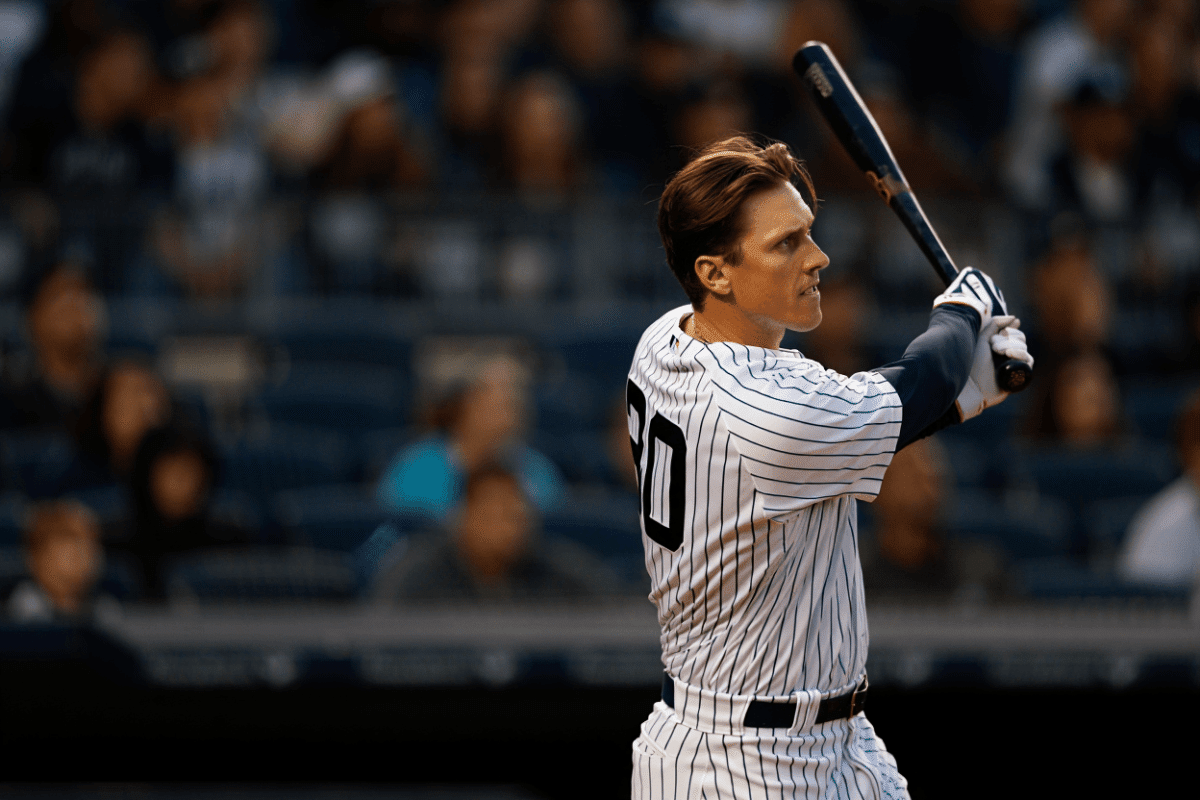
Max Schuemann enters May as a utility infielder caught between ambition and the realities of Major League Baseball depth. Acquired by the New York Yankees from the Oakland Athletics in February 2026, the 28-year-old has demonstrated resilience navigating a crowded infield where playing time remains scarce and positional competition intensifies daily.
🔥 Quick Facts
- Max Schuemann acquired via trade on February 9, 2026 from Oakland Athletics for prospect Luis Burgos
- Optioned to Triple-A Scranton on March 21, 2026 following the Andy Ibáñez acquisition
- 2026 season stats show .286 batting average with an .929 OPS in limited appearances
- Defensive strength remains his primary asset, with versatility at shortstop, second base, and third base
The Trade That Promised Opportunity
When the Yankees announced the acquisition on February 9, observers noted the fit made sense. Schuemann offered something the Yankees roster valued: defensive flexibility and depth. After appearing in 234 games over two seasons with the Athletics, accumulating exactly 1 WAR (Wins Above Replacement), he represented a calculated gamble on untapped potential.
The trade cost was modest—minor league right-hander Luis Burgos—suggesting New York viewed this addition as low-risk depth rather than a cornerstone acquisition. Yet for Schuemann, transitioning from Oakland to the Bronx meant auditioning for a fresh start with baseball’s most storied franchise.
Spring Training Promise and the March Demotion
During spring training, Schuemann showed glimpses of form. Reports indicated he impressed in non-roster invitee status, earning consideration for the opening roster. However, the emergence of infield depth altered his trajectory. When the Yankees signed Andy Ibáñez in late March, the logjam intensified. On March 21, 2026, Schuemann was optioned to Triple-A Scranton/Wilkes-Barre.
This marked the first awkward moment—a player acquired in winter finding himself demoted before Opening Day. Yet the demotion wasn’t punitive; it was pragmatic. The Yankees maintained that Schuemann would receive opportunities at the major league level when injuries or performance demanded roster adjustments.
The Crowded Infield Reality
Understanding Schuemann’s predicament requires examining the Yankees infield composition in May 2026. Anthony Volpe, the franchise’s homegrown shortstop prospect, competed for regular playing time. Jose Caballero emerged as a defensive standout, ranking second among shortstops in Defensive Runs Saved (DRS). Second baseman spots featured incumbent talent. Most significantly, Giancarlo Stanton’s injury rehab created temporary roster flexibility, yet even his eventual return would further compress opportunities.
Schuemann’s skill set—elite defense with spot-starting capability—typically thrives in the right situation. But the 2026 Yankees constructed a roster where utility infielders fought for limited bench spots. The organization invested in multiple depth options, reducing any individual prospect’s playing time guarantee.
May Performance and Limited Opportunities
| Metric | 2026 YTD Performance | 2025 Athletics Season |
| Games Played | 14 | 101 |
| Batting Average | .286 | .212 |
| OPS | .929 | .603 |
| Primary Position | Shortstop/Utility | Shortstop/Infielder |
| Defensive Strength | Multiple positions | Strong at short |
When Schuemann returned to Yankees roster in late April and early May, his opportunities arrived in small increments. Called up on April 28 following Giancarlo Stanton’s injury, he faced an immediate awkward dynamic: filling a spot without knowing when he might be demoted again. His May performance revealed both promise and struggle—demonstrating the offensive upside he’d develop with consistent at-bats, yet constrained by infrequent playing time.
A notable moment came May 12 when Schuemann botched a feed on a potential double-play ball against Baltimore, highlighting pressure those limited opportunities create. One fielding miscue when you barely see the field carries disproportionate weight.
Lessons in Accepting Professional Reality
What makes Schuemann’s narrative compelling isn’t a dramatic breakout. Instead, it’s his apparent acceptance of circumstances beyond his control. In a May 29 New York Post feature, Greg Joyce chronicled how the utility infielder navigated the psychological toll of demotion, limited playing time, and organizational decisions made above his head.
The “awkward situation” isn’t a single moment but rather the entire 2026 arc: acquired optimistically in winter, benched by spring, recalled reluctantly in summer. For minor-league-bound prospects, this creates clarity. For established players, it breeds uncertainty. Schuemann occupied the uncomfortable middle ground.
His professional resilience demonstrates the intangible quality separating MLB careers from brief calls: the ability to accept demotion, prove yourself at Triple-A, return when called, and perform without guarantees. In May 2026, this meant preserving confidence despite circumstantial signals suggesting the organization retained other infield priorities.
What Comes Next for Schuemann’s Yankees Tenure?
By late May, Schuemann’s path forward depended on continued injuries elsewhere or unexpected roster changes. The Yankees maintained him on the active roster, suggesting belief in his value while acknowledging that belief wouldn’t translate to everyday playing time. His .929 OPS in limited May action suggested offensive growth, yet 14 games offered insufficient evidence for role expansion.
The broader lesson applies across professional baseball: organizational depth management creates winners and losers not based on talent but circumstance. Schuemann’s defensive versatility—strength at shortstop, competence at second base and third base—should theoretically guarantee major-league employment. Yet the 2026 Yankees roster construction proved even defensive excellence doesn’t guarantee consistent opportunities.
Moving forward, Schuemann faces a familiar test: prove his value with minimal chances, hope for competitive advantage through injury-driven opportunity, and maintain professional composure throughout. His willingness to accept this awkward position—caught between minor-league demotion and major-league margins—may ultimately determine whether his Yankees chapter becomes a breakthrough or another footnote in a career of organizational depth chess.