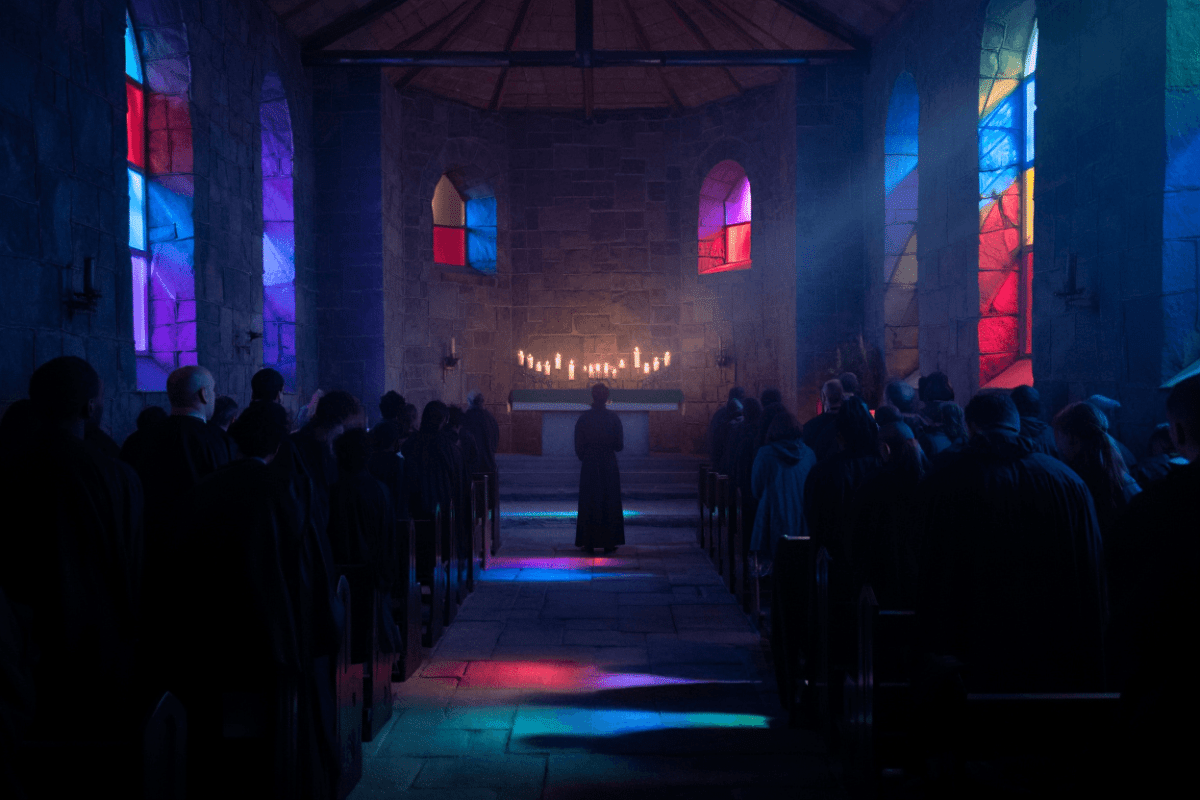
Midnight Mass, now streaming on Netflix, represents a landmark achievement in supernatural horror television. Created and directed by Mike Flanagan, this 7-episode limited series premiered on September 24, 2021, and has earned an impressive 7.7/10 rating on IMDb with 87% on Rotten Tomatoes. The miniseries examines profound themes of faith, redemption, fanaticism, and belief through the lens of a dying island community confronted by inexplicable miracles and supernatural terror.
🔥 Quick Facts
- 7 episodes total, each running 60–71 minutes for approximately 7 hours of runtime
- Released September 24, 2021 on Netflix as a limited series (no season 2 planned)
- 87% critics’ score on Rotten Tomatoes with praise for direction, performances, and thematic depth
- Stars Zach Gilford, Kate Siegel, and Hamish Linklater in central roles exploring faith and morality
A Gothic Exploration of Faith and Fanaticism
Midnight Mass centers on Crockett Island, a remote, economically depleted Catholic community that experiences a spiritual awakening following the arrival of Father Paul Hill, a charismatic yet mysterious young priest portrayed by Hamish Linklater. The townspeople initially interpret the supernatural phenomena—miraculous healings, visions, and unexplained events—as divine intervention, a sign that their dying faith community has been chosen for redemption.
Flanagan’s approach differs markedly from conventional religious horror. Rather than presenting faith itself as inherently dangerous, the series interrogates how uncritical devotion, confirmation bias, and collective delusion transform even well-intentioned belief into something capable of destruction. The narrative complexity deepens as viewers discover that Father Paul is actually Monsignor Pruitt, the island’s original pastor who disappeared decades earlier, presenting an exploration of guilt, atonement, and the corrupting nature of certainty.
Ensemble Cast Excellence and Character-Driven Narrative
Kate Siegel delivers a nuanced performance as Erin Greene, a recovering addict and questioning Catholic who serves as the series’ moral center. Zach Gilford portrays Riley Flynn, a young man haunted by past mistakes, whose arc demonstrates Flanagan’s sophisticated approach to character development. Samantha Sloyan steals scenes as Beverly Keane, whose religious rigidity and judgment create interpersonal conflict before the supernatural stakes escalate.
The supporting ensemble—including Kristin Lehman, Igby Rigney, and Rahul Kohli—fills out a complete community rather than providing mere background. This decision creates investment in individual fates when the series pivots toward horror in its final episodes, where miraculous interventions reveal themselves as something far more sinister and morally ambiguous.
Thematic Architecture: Sin, Resurrection, and Communion
Flanagan demonstrates sophisticated theological awareness by structuring episodes around Catholic concepts. Early episodes establish personal conflicts and spiritual questions among islanders. Mid-series episodes amplify supernatural phenomena while deepening character backstories. The final two episodes function as a crescendo, revealing that the miraculous events stem from an angelic entity—neither fully malevolent nor benevolent—that offers eternal life through resurrection and physical transformation.
The series subverts typical religious horror tropes by avoiding simplistic “religion bad” messaging. Instead, Midnight Mass asks how persuasive charisma, desperate hope, and communal validation can override individual judgment. When Father Paul offers his parishioners eternal life, many willingly embrace the consequences, revealing that the real horror lies not in supernatural transgression but in humanity’s eagerness to surrender autonomy for perceived salvation.
| Aspect | Detail |
| Network | Netflix |
| Creator/Director | Mike Flanagan |
| Format | Limited Series (7 episodes, no renewal) |
| Episodes Runtime | 60–71 minutes per episode |
| Genre | Gothic Supernatural Horror, Drama, Mystery |
| Release Date | September 24, 2021 |
| Ratings (Critics) | 87% (Rotten Tomatoes) |
| Audience Rating | 7.7/10 (IMDb, 169,661 votes) |
“Midnight Mass is abundant with connected themes and overt symbolism. Flanagan is playing with the darker side of religious scripture, connecting things like resurrection and drinking blood to a different kind of narrative.”
— Brian Tallerico, film critic, based on Roger Ebert analysis
Cultural Reception: Spirituality, Theology, and Artistic Merit
The series has generated spirited debate within religious communities. Catholic reviewers have noted that while Midnight Mass contains sophisticated theological conversations, it ultimately presents a pessimistic view of institutional faith. Some celebrate its moral complexity; others critique its portrayal of clergy complicity and religious hypocrisy. This divergence reflects the series’ central achievement: it presents faith not as a simple binary of true versus false, but as a deeply human struggle with certainty and doubt.
Critics across secular outlets have praised the series as an example of prestigious Netflix horror storytelling, comparing its ambition to The Haunting of Hill House and The Haunting of Bly Manor—Flanagan’s previous acclaimed miniseries. The visual cinematography of the island setting, combined with unsettling atmospheric sound design, establishes dread through atmosphere rather than jump scares, appealing to horror audiences seeking psychological engagement.
Why This Miniseries Deserves Your Attention
Midnight Mass succeeds because it respects audience intelligence. The series takes time to establish relationships, conflicts, and ideological positions before introducing supernatural elements. The slow-burn structure—criticized by some as pacing issues—allows character development that makes the horror genuinely impactful rather than visceral.
The finale performs a complete genre pivot: the series transforms from intimate human drama into apocalyptic horror, yet the transition feels earned through five episodes of groundwork. Viewers who invest in understanding each character’s psychology experience the climax as both terrifying and tragically inevitable. The concluding episode operates on multiple thematic levels simultaneously—addressing mortality, faith, skepticism, and what it means to face extinction with or without belief.
Unlike some horror content, Midnight Mass contains substantial thematic depth rarely found in streaming entertainment, exploring existential questions rather than relying on plot contrivance alone.
Is Midnight Mass Still Worth Watching in 2026?
Five years after its release, Midnight Mass has aged exceptionally well. The themes of community, authority, and collective belief remain relevant. The theological arguments presented feel more pressing in contemporary cultural discourse around institutions, trust, and ideological capture. For viewers who appreciate elevated horror with literary depth—comparable to works like The Haunting of Hill House or recent films exploring faith and doubt—this miniseries offers sophisticated storytelling unavailable in most streaming horror productions. Its conclusion remains among streaming television’s most devastating final episodes, combining philosophical inquiry with visceral emotional impact.
Sources
- Netflix Official Site — Midnight Mass listing and official synopsis
- IMDb — Cast, crew, ratings, and episode-specific information
- Rotten Tomatoes — Critical aggregation (87% critics score)
- Roger Ebert — Critical analysis of Flanagan’s thematic approach and symbolism
- America Magazine — Catholic theological perspective on the series
- Wikipedia — Production details, running time, release information