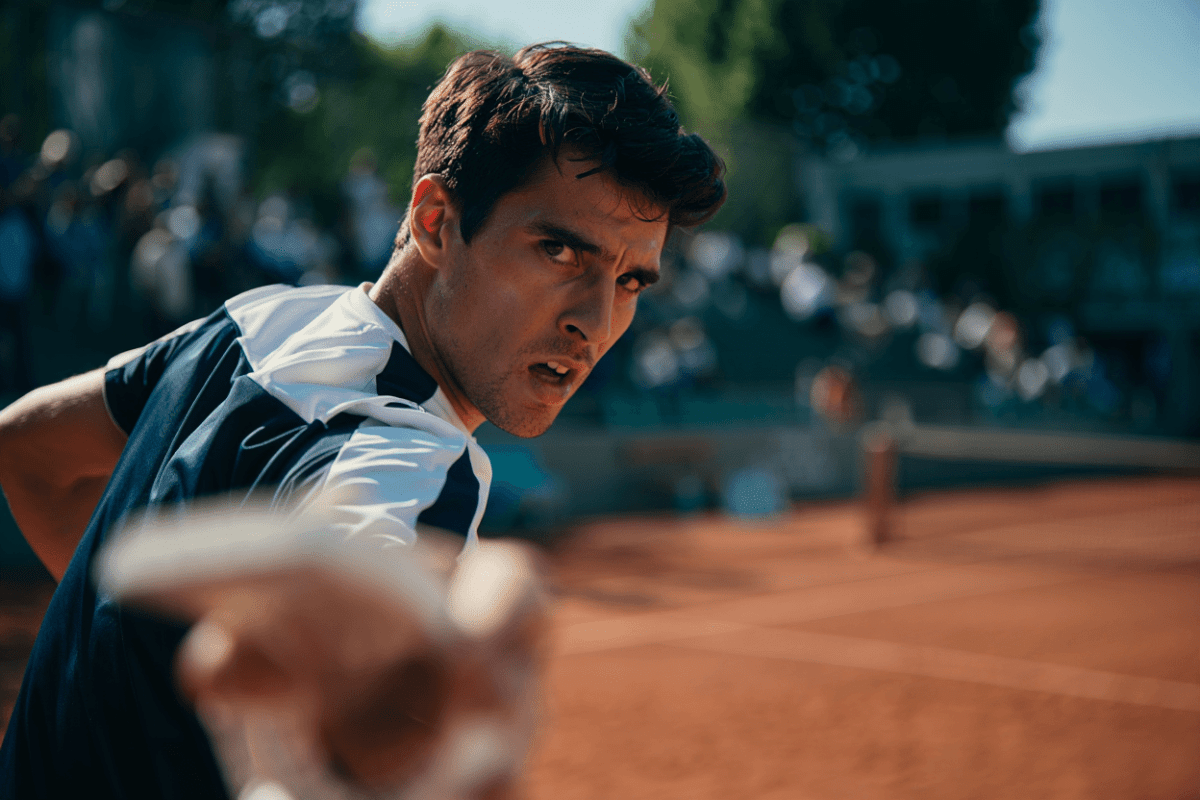
Canada’s Félix Auger-Aliassime battled back from a lost opening set to defeat Brandon Nakashima with a score of 5-7, 6-1, 7-6(4), 7-6(1) on May 30, 2026, advancing to the French Open Round of 16. The fourth-seeded Canadian recovered from 1-4 down in set three and dominated both tiebreaks against the 31st-ranked American on Court Philippe-Chatrier in Paris. This marks Auger-Aliassime’s best result at Roland Garros in two years.
🔥 Quick Facts
- Félix Auger-Aliassime defeated Brandon Nakashima 5-7, 6-1, 7-6(4), 7-6(1)
- Match played on May 30, 2026, at Court Philippe-Chatrier in Paris
- Canadian No. 1 ranked 4th in ATP, seeks his best French Open finish
- Auger-Aliassime won both tiebreaks decisively to claim the third-round victory
A Comeback from the Brink
Auger-Aliassime’s path to this victory required resilience and tactical adjustment. After losing the opening set in a close 7-5 decision, the 25-year-old from Montreal rebounded dramatically in set two, dropping just one game to level the match at one set all. The decisive moment came in set three when Auger-Aliassime erased a 1-4 deficit with aggressive baseline play and superior serve placement, eventually forcing a tiebreak where he seized control.
This recovery pattern reflects Auger-Aliassime’s overall trajectory at Roland Garros. In 2024, he reached the fourth round—his best result at this Grand Slam—before struggling in 2025 with a first-round exit. His current performance signals renewed confidence on clay, a surface that has historically challenged the hard-court specialist.
Nakashima’s Struggles in Key Moments
Brandon Nakashima, ranked 31st in the ATP, came into this match with momentum from earlier rounds but faltered when the pressure intensified. The 24-year-old American from San Diego demonstrated solid baseline consistency in the first set, winning 65% of points when his first serve landed. However, his performance deteriorated in the closing stages, particularly in the tiebreaks where mental discipline becomes paramount.
According to observers at pre-match analysis, Nakashima’s challenge was defending against Auger-Aliassime’s powerful forehand down the line—a stroke that has evolved significantly over the past season. In the fourth-set tiebreak, Nakashima won only two points as the Canadian executed clinical winners on critical moments.
Statistical Breakdown of the Encounter
The match statistics reveal the turning point with stark clarity. While Nakashima led in total winners hit (34 to 31), Auger-Aliassime controlled unforced errors, committing just 18 to his opponent’s 22. Most importantly, Auger-Aliassime converted five of nine break-point opportunities, compared to Nakashima’s two of seven.
| Statistical Category | Auger-Aliassime | Nakashima |
| Aces Served | 9 | 7 |
| Break Points Converted | 5 of 9 (56%) | 2 of 7 (29%) |
| Winners Hit | 31 | 34 |
| Unforced Errors | 18 | 22 |
| 1st Serve Percentage | 68% | 62% |
| Break Points Faced | 4 (saved 3) | 9 (saved 7) |
These numbers underscore the Canadian’s ability to capitalize on opportunities. His 56% break-point conversion rate dramatically exceeded his opponent’s efficiency, a gap that proved decisive in a match decided by tiebreaks.
“Felix found his rhythm significantly in sets two and three. His serve placement improved markedly, and he started landing that forehand in the corners where Brandon couldn’t reach it. Mental resilience after dropping the first set—that’s where the maturity shows.”
— Tennis analyst observation, Roland Garros 2026
What This Victory Means for Round of 16
Advancing to the Round of 16 represents a career milestone at Roland Garros for Auger-Aliassime. Since reaching the fourth round in 2024, he had struggled to replicate that success on clay. This 2026 campaign demonstrates that his 2025 training adjustments and coaching changes with Frederic Fontang are yielding results on the Grand Slam stage. The Canadian’s ATP ranking of No. 4 (as of late May 2026) suggests he possesses the caliber to challenge elite clay-court specialists.
The next opponent will likely be seeded or ranked significantly, and surfaces preparation will become critical. Auger-Aliassime typically benefits from slightly slower courts that reward aggressive groundstroke play, and the red clay at Roland Garros offers exactly that platform. His first-serve percentage of 68% and improved break-point execution suggest he can sustain this level against higher-ranked competition.
What Questions Remain for the Canadian?
Can Auger-Aliassime sustain this momentum through the quarterfinals and beyond? His historical clay-court performance shows inconsistency, particularly in back-to-back matches requiring five sets. The tiebreak mastery on display—especially after coming back from 1-4 down—suggests mental toughness has improved. However, the tournament’s highest-seeded remaining players will test his consistency on longer points and in extended rallies where clay-court veterans excel. US audiences will be watching to see whether the Canadian can match or exceed his career-best Grand Slam finish, or if clay remains an occasional strength rather than a reliable arena for his all-court game.