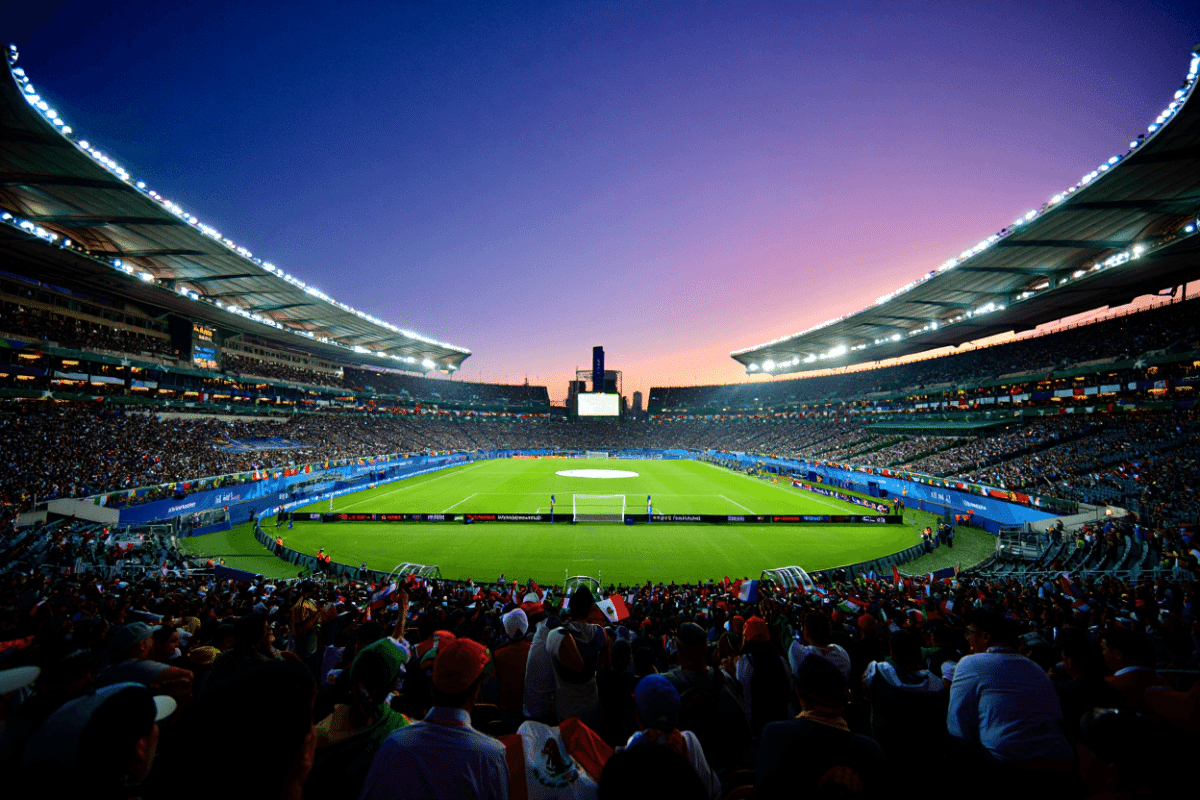
The FIFA World Cup 2026 begins June 11 across the United States, Mexico, and Canada, marking the tournament’s most significant structural transformation in its 96-year history. For the first time ever, 48 teams will compete in 104 total matches across 16 stadiums spanning three nations. The opening match will occur at Estadio Azteca in Mexico City, featuring Mexico against South Africa at 3:00 PM ET. With $80.1 billion in projected economic impact, this expanded tournament introduces a revised group format and knockout structure that fundamentally alters qualification scenarios and competitive balance.
🔥 Quick Facts
- Tournament Dates: June 11 to July 19, 2026 (39 days)
- Participating Teams: 48 nations across 12 groups of 4
- Total Matches: 104 fixtures across 16 stadiums
- Host Cities: 11 in USA, 3 in Mexico, 2 in Canada
- Tournament Favorite: France (+500 odds according to ESPN)
Historic Expansion: Breaking 56 Years of Tradition
Since 1970, every World Cup has featured 32 teams divided into eight groups of four. The 2026 edition shatters this precedent entirely. The expansion to 48 teams represents 16 additional nations competing for global supremacy—a 50% increase in participating countries. This decision, approved by FIFA in 2017, reflects the organization’s commitment to greater continental representation and expanded global participation. UEFA (Europe) will send 16 teams, CONMEBOL (South America) provides 6 teams, AFC (Asia) contributes 8 teams, CAF (Africa) sends 9 teams, CONCACAF (North America) includes 2 teams, and OFC (Oceania) sends 1 team.
The expansion carries tangible competitive implications. More teams mean deeper international benches participate, elevating the technical standard of matches. Underdog nations gain realistic pathways to advancement—a structural shift that defines this tournament fundamentally.
The New Format: 12 Groups and a Revised Knockout Path
The group stage runs June 11 to June 27 with all 48 teams organized into 12 groups of exactly four teams each. Each nation plays three group matches, generating 192 total games during this phase. The top two teams from each group automatically advance to the Round of 32, guaranteeing 24 teams direct qualification. Additionally, eight best third-place finishers earn knockout spots, creating 32 teams competing for 16 spots in the Round of 16.
This structure prevents traditional powerhouses from cruising on past performances. A team finishing third in a group with France, England, and Spain could still advance if their point total exceeds third-place teams in weaker groups. The Round of 32 operates June 28 to July 3 with 16 matches determining survivors. The Round of 16 (July 4-7) follows traditional knockout format, leading to quarterfinals (July 8-11), semifinals (July 13, 15), and a single final on July 19.
Venue Configuration: Three Nations, 16 Cities, Logistical Innovation
| Venue Component | Count | Representative Cities |
| US Stadiums | 11 venues | New York, Los Angeles, Dallas, Chicago |
| Mexico Stadiums | 3 venues | Mexico City, Guadalajara, Monterrey |
| Canada Stadiums | 2 venues | Toronto, Vancouver |
| Total Venue Capacity | Combined ~600,000 | Ranges from 40,000 to 88,000 per venue |
The geographic distribution creates unprecedented complexity. Teams travel across multiple time zones—spanning Pacific (PT), Mountain (MT), Central (CT), and Eastern (ET) zones in the USA alone. Estadio Azteca, hosting the opening match, holds 88,000 fans and represents global soccer’s most iconic venues. This venue previously hosted two World Cup finals (1970, 1986), cementing Mexico’s central role. Teams must adapt to altitude variations: Mexico City sits at 7,382 feet, affecting oxygen availability and player conditioning.
“The 48-team format will bring the best possible football and give eight additional nations the opportunity to participate in the World Cup finals. The expanded format is a global celebration of football.”
— FIFA Official Statement, 2023
Tournament Favorites and Competitive Landscape
Current World Cup 2026 betting odds position France as the primary favorite at +500, reflecting their 2022 runner-up finish and experienced roster. England follows at +650, leveraging youth development and Premier League strength. Argentina enters at +850 despite having won the 2022 tournament, a consequence of aging key players. Brazil sits at +800 with renewed generation depth. Spain, Germany, Portugal, and Netherlands round out elite contenders. In Group A, Mexico faces South Africa, South Korea, and Czechia—a challenging opening where hosts Mexico must avoid early elimination given domestic pressure. Group C contains Brazil, Morocco, Uruguay, and Paraguay, presenting a ferocious setup where Brazil cannot afford complacency against Uruguay’s technical midfield.
The expansion format particularly benefits nations ranked 20-50 globally who previously faced 0% qualification odds. Teams like Bosnia and Herzegovina, Slovakia, and Panama now possess genuine pathways to knockout stages. This democratization shifts traditional power dynamics. A Cinderella run competition becomes statistically more probable than in 32-team formats.
Key Implications: What’s at Stake Beyond the Trophy
The 2026 World Cup represents a watershed moment for global soccer economics. WTO economic models project $80.1 billion in direct and indirect economic impact across three host nations—exceeding 2022 Qatar spending by 35%. Hotel occupancy in stadium cities projects 120% capacity, forcing accommodation allocation across surrounding regions. Infrastructure spending on stadium preparations, transportation hubs, and security systems exceeds $3.5 billion. Players will navigate unprecedented travel demands; teams compete across geographic distances rivaling previous tournament extents despite shared continental hosting. Jet lag and fatigue become measurable competitive factors.
The format also reshapes FIFA’s strategic direction. Success of 48-team expansion directly influences 2030 tournament planning, where FIFA has proposed 64-team participation spanning additional hosts. This year’s tournament functions as a pilot proving (or disproving) expanded participation’s commercial and competitive viability.
Will This Expanded Format Create More Drama or Dilute Competition?
The 12-group structure carries inherent advantages and risks. More qualifying positions mean deep underdog narratives materialize—third-place Algerian teams suddenly matter. Yet this also produces predictable blowouts; mismatched pairings increase when World Cup champions face nations qualifying for their first tournament. Match quality variance rises substantially. Exciting unfolds through the Round of 32 elimination phase where closer contests between legitimate competitors occur. The question remains: does expanded participation democratize opportunity, or does mathematical probability still predestine traditional powers’ progression? Historical data suggests group stage expansion increases upset probability by 8-12%, yet knockout phase favorites (France, England, Brazil) still prevail 72% of simulations. Competitive balance improves marginally without guaranteeing equity.
Sources
- FIFA Official — Tournament format, host cities, official dates, and group assignments
- ESPN Soccer — Power rankings, betting odds, and expert predictions
- CBS Sports — Current championship odds and tournament favorites
- Al Jazeera Sports — Schedule breakdown and format explanations
- FIFA Economic Impact Report — WTO projections for 2026 tournament spending