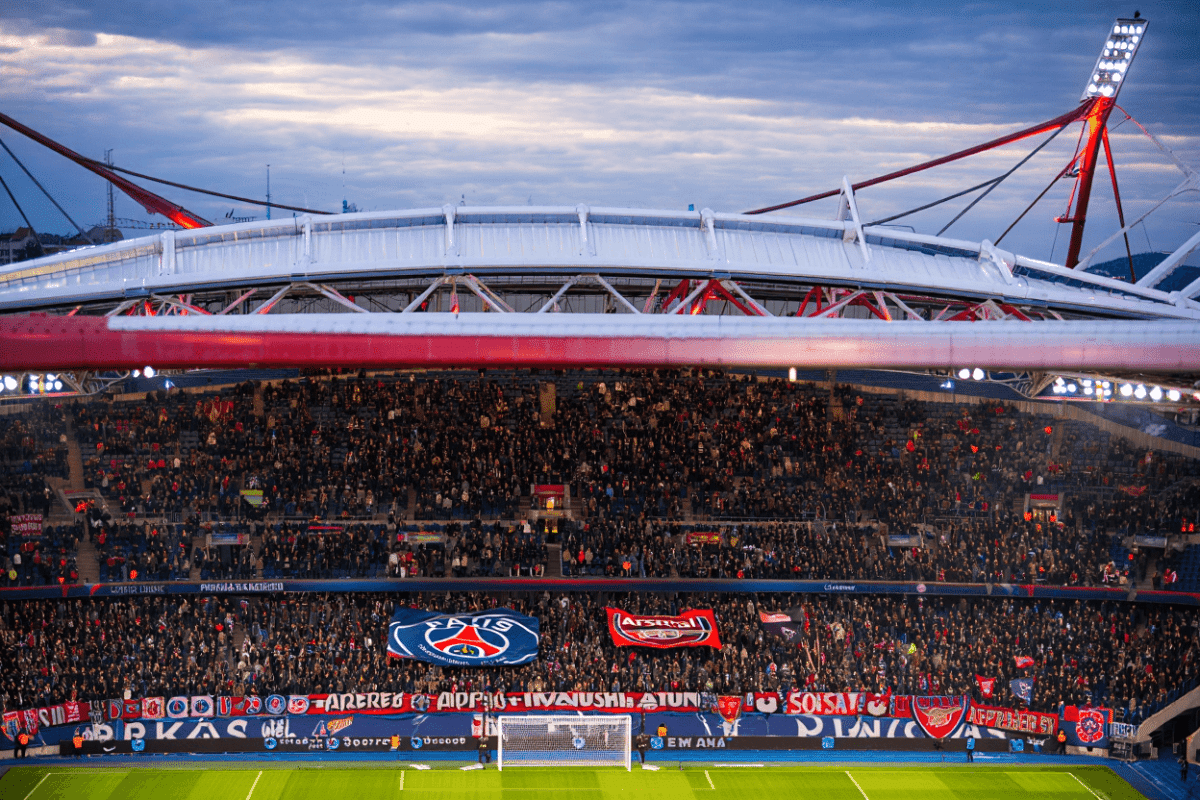
Paris Saint-Germain faces Arsenal this evening in the 2026 UEFA Champions League final at Puskás Arena in Budapest, where PSG seeks back-to-back European titles while Arsenal pursues their first-ever Champions League crown. The showpiece event kicks off at 6:00 PM CET (12:00 PM ET), with 67,215 spectators expected to fill Europe’s Hungary venue. PSG’s record-breaking season – paced by 44 goals across all group and knockout stages – contrasts sharply with Arsenal’s balanced attacking approach, creating contrasting tactical narratives in Budapest’s most anticipated club match of the year.
🔥 Quick Facts
- Match venue: Puskás Arena, Budapest, Hungary
- Kick-off time: Saturday, May 30, 2026, 6:00 PM CET (12:00 PM ET)
- Stadium capacity: 67,215 all-seater configuration
- PSG’s tournament record: 44 goals in 2025-26 Champions League campaign
Budapest’s Historic Stage for Europe’s Premier Club Competition
The Puskás Arena officially opened on November 15, 2019, becoming Hungary’s national stadium and replacing the historic Ferenc Puskás Stadium that once held over 100,000 supporters. This marks the 34th different venue to host the UEFA Champions League final in the competition’s 71-year history. The modern all-seater design reflects contemporary UEFA standards, with 39,000 tickets allocated to club supporters and neutral fans, while hospitality and premium packages fill additional capacity. Budapest’s location provides geographical advantages, offering a roughly equidistant travel point between Paris and London, emphasizing UEFA’s commitment to rotating final venues across European capitals.
PSG’s Historic Offensive Dominance vs. Arsenal’s Defensive Resilience
PSG’s attacking output represents one of the most prolific campaigns in modern Champions League history. The Ligue 1 champions rank first in goals (44), shots on target (113), and total attempts (297)—demonstrating a clear intent to overwhelm opponents through volume and precision. Arsenal, conversely, emphasizes structure and efficiency, ranking sixth in goals (29) with 86 shots on target across 209 attempts. This efficiency differential—Arsenal converting shots at 13.87% compared to PSG’s near-15%—reveals opposing philosophies. PSG under Luis Enrique privileges expansive, possession-based attacking, while Arsenal under Mikel Arteta exploits half-spaces and transitions. The tactical battle hinges on PSG’s ability to maintain attacking rhythm versus Arsenal’s capacity to compress defensive gaps and capitalize on counterattacks. Arsenal’s seventh-place rank for passing accuracy (6,358 total passes) suggests a team comfortable absorbing possession, then striking with intent.
Statistical Breakdown: Key Metrics Shaping the Final
| Metric | PSG | Arsenal |
| Goals Scored | 44 | 29 |
| Shots on Target | 113 | 86 |
| Total Shots | 297 | 209 |
| Total Passes | TBA | 6,358 |
| Rank (Goals) | 1st in UCL | 6th in UCL |
| Direct H2H Record | 2 Wins | 2 Wins |
PSG’s numerical superiority in both volume metrics and conversion efficiency reveals their dominance. However, Arsenal’s selective approach—fewer shots, higher accuracy—indicates a team less interested in controlling play than in extracting maximum value from limited opportunities. The semi-final precedent offers insight: PSG defeated Arsenal 3-1 on aggregate, winning 2-1 at home with Ousmane Dembélé’s early goal proving decisive, then defending competently in the 0-1 away leg. This result demonstrated PSG’s ability to handle Arsenal’s attacking shape while maintaining attacking threat.
“PSG’s attacking juggernaut had only 27 percent of the ball in the second half of their semi-final, and they were more than comfortable playing that way. This shows intelligence in transition and patience under pressure.”
— According to ESPN’s tactical correspondents analyzing PSG’s defensive strategy
Implications for England: Arsenal’s Quest for Club Football’s Ultimate Prize
This final carries profound significance for Arsenal’s trophy drought in Europe’s premier competition. The Gunners have never won the Champions League, reaching the final only once in their modern era. A victory would signal the club’s transformation under Mikel Arteta’s tenure, validating a squad rebuilt through strategic acquisitions and academy development. Conversely, defeat would extend Arsenal’s European wait, potentially creating personnel questions despite a successful 2025-26 domestic season. For PSG, back-to-back European titles remain elusive—their sole Champions League triumph occurred in 2019-20. Winning tonight would represent genuine transformation beyond the financial dominance of the Qatari investment era. The American television audience observes Arsenal’s first genuine chance at club football’s ultimate prize in decades, a stake that elevates every tactical decision and match moment beyond standard seasonal importance.
What Determines Victory in Budapest?
Four factors will prove decisive: PSG’s ability to maintain attacking frequency while Arsenal’s capability to capitalize on the transition. Set-piece execution becomes crucial when open play yields stalemates—both teams rank among Europe’s elite at standardized situations. Goalkeeper performance may prove pivotal; Gianluigi Donnarumma’s heroics in the semi-final showcased PSG’s shot-stopping advantage. Finally, tactical flexibility in the second half separates champions from finalists. Can PSG maintain intensity if Arsenal applies effective counter-pressing? Can Arsenal’s deeper block resist sustained PSG possession without surrendering space? The Puskás Arena’s neutral setting removes home-field advantage, placing premium on adaptability and execution rather than atmospheric advantage.
Which team benefits most from early dominance?
PSG prefers establishing attacking rhythm early, pressing Arsenal high and forcing turnovers in dangerous areas. An early goal would demoralize Arsenal’s compact structure, forcing them into more offensive shape that amplifies the space PSG’s dynamic attackers exploit. Arsenal, conversely, thrives in close matches where substitution timing and tactical pivots matter most. A deadlocked contest heading into the final quarter favors Arteta’s ability to engineer tactical switches against Enrique’s established system preferences. Tonight’s opening thirty minutes will reveal which team dictated terms, with implications rippling through Budapest’s 67,215-capacity stadium and across global audiences witnessing club football’s pinnacle.
Sources
- UEFA.com – Official Champions League statistics and venue information
- ESPN Soccer – Match preview and tactical analysis from international correspondents
- FlashScore/FBRef – Comprehensive statistical comparisons and head-to-head records
- CBS Sports Golazo – Expert predictions and championship analysis