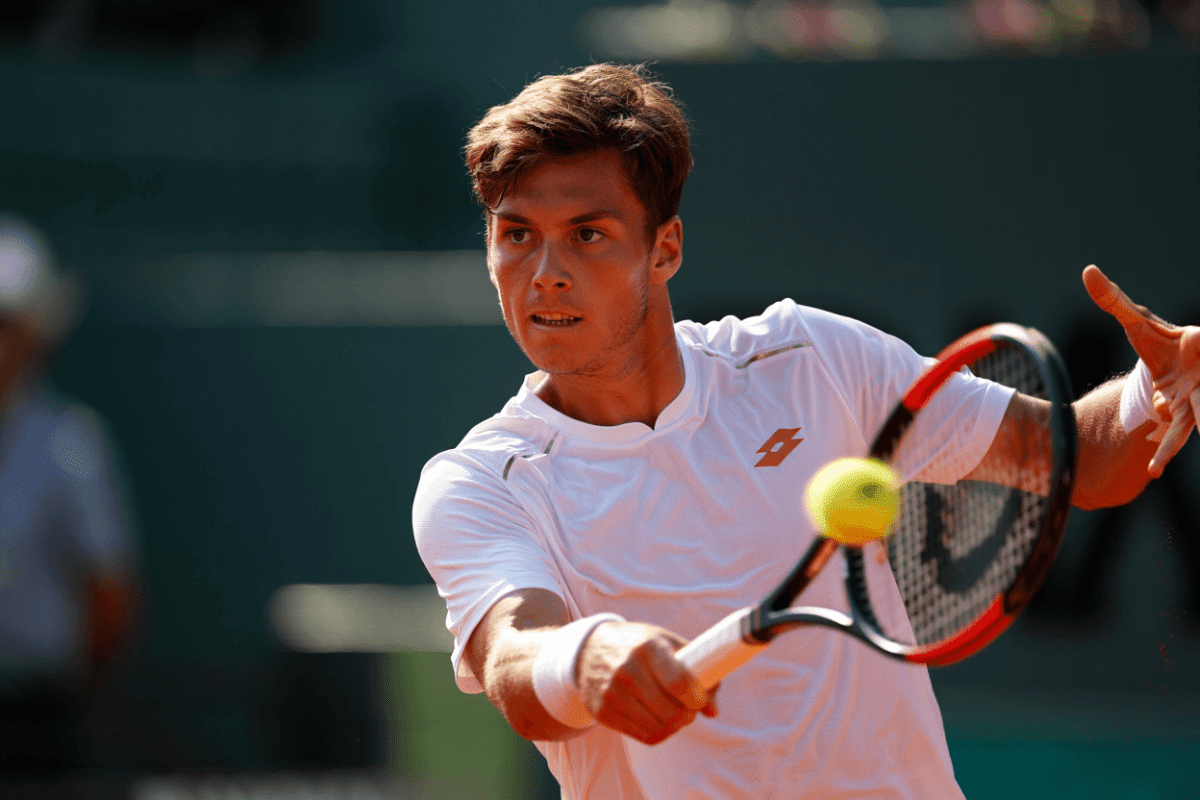
Zachary Svajda, the 23-year-old American from San Diego, has achieved his greatest Grand Slam success at the 2026 French Open by advancing to the third round. The world No. 85 had never won a match in a Grand Slam main draw before this competition—now he has already secured two consecutive victories against ranked opponents, setting up a critical matchup against seeded competition that carries significant implications for his career trajectory.
🔥 Quick Facts
- Svajda became the first American man to win multiple Grand Slam main draw matches in his first appearance since breaking the top 100
- Defeated Australian Alexei Popyrin 3-6, 6-3, 7-6(7-3), 7-5 in the opening round, rallying from a set down
- Defeated Adam Walton 6-3, 6-4 in the second round to reach the round of 16
- Faces 25th seed Francisco Cerundolo in the third round on May 30, 2026
- Career-high ATP ranking of No. 82 achieved just two months before this tournament
A Breakthrough Moment for San Diego Tennis
Svajda’s breakthrough at Roland Garros represents a defining moment in his professional career. The San Diego native is of Czech descent—a heritage that connects him to a rich tennis tradition—and his path to the top has been marked by gradual, methodical progress rather than sudden stardom.
Before this tournament, Svajda had never recorded a victory in a Grand Slam main draw. His breakthrough came after years of competing on the ATP Challenger circuit, where he gradually built his ranking through consistent performances. The Australian Open 2026 marked his first Grand Slam main draw appearance, where he lost to Yannick Hanfmann in the opening round. This tournament represents his second Grand Slam attempt—and it has already exceeded all expectations.
How Svajda Dismantled Popyrin and Walton
Svajda’s first victory against Alexei Popyrin was particularly impressive, showcasing the mental toughness required at the highest level. Down a set, the American executed a remarkable comeback, winning three consecutive sets to overturn the match.
The 7-6 tiebreak victory in the third set demonstrated Svajda’s ability to perform under pressure. Popyrin, ranked significantly higher and with far more Grand Slam experience, was unable to close out the match despite holding a set advantage. The fifth set saw another dominant performance from the American, who closed out the match in straight sets after winning the tiebreak.
In Round 2, Svajda faced Australian Adam Walton, who had created headlines by defeating Daniil Medvedev in the previous round. This victory alone suggested Walton posed a significant challenge, yet Svajda remained composed. The American dominated with clean baseline tennis, recording a 6-3, 6-4 victory that showcased improved consistency compared to his opening match.
| Stat Category | Svajda’s Performance | Context |
| ATP Ranking | #85 | Career-high #82 (March 2026) |
| Career Prize Money | $1,582,605 | Combined singles and doubles |
| Grand Slam Main Draw Wins | 2 (before French Open) | Zero career wins entering tournament |
| Age | 23 years old | Born November 29, 2002 |
| Height | 5-foot-9 | Weight: 154 lbs |
These victories establish Svajda as a player capable of competing against established ATP competitors on tennis’s biggest stages. His ranking of #85 may not suggest Grand Slam success, but his current performances prove rankings tell only part of the story.
“Red clay is still very new for me, but I’m adapting quickly to the surface and finding my rhythm in matches.”
— Zachary Svajda, in a Roland-Garros media interview
The Cerundolo Challenge and Road to the Quarterfinals
Svajda’s next opponent, Francisco Cerundolo, represents a significant step up in competition. The 25th seed is a seasoned Argentine competitor with extensive grass and clay expertise. Cerundolo carries a 15-7 record on clay in 2026, demonstrating his comfort on red clay surfaces—precisely where Roland Garros is contested.
The head-to-head record between the two stands at 1-1, with Cerundolo holding a prior victory on clay surfaces. However, Svajda’s momentum cannot be ignored. Players who win their first two Grand Slam main draw matches often experience psychological confidence that propels them deeper into tournaments. If Svajda can continue his current level of play while adapting to the unique characteristics of clay-court tennis, a quarterfinal appearance remains within reach.
A victory over Cerundolo would establish Svajda as a legitimate Grand Slam threat and significantly boost his ranking trajectory. Conversely, loss to the seeded competitor would still represent a remarkable achievement for a player competing in only his second Grand Slam main draw.
What This Achievement Means for American Men’s Tennis
Svajda’s advancement carries broader significance for American men’s tennis, which has lacked consistent contenders at the Grand Slam level in recent years. The San Diego native joins a select group of young American men competing effectively at the highest echelon of professional tennis.
His journey from complete Grand Slam main draw novice to third-round contestant in a single tournament demonstrates that sustained development through the Challenger circuit can produce results. This pathway—often overlooked by fans focused on flashy juniors—has proven effective for Svajda, who turned professional in 2019 and has steadily improved through consistent competition.
The American tennis community now watches closely to see whether Svajda can continue this breakthrough or if the Cerundolo match represents his ceiling at this year’s French Open.
Can Svajda Maintain His Red Clay Momentum?
Clay court tennis presents unique technical demands that differ markedly from hard courts. The surface rewards patience, consistent footwork, and the ability to generate depth through high-bouncing shots. Svajda’s earlier victories suggest he has adapted reasonably well, though Cerundolo’s clay expertise means the American must elevate his game further to proceed.
Key factors determining the Cerundolo match include Svajda’s first-serve percentage—critical for setup and aggression on clay—his movement consistency, and his ability to dictate rallies from baseline positions. If Svajda maintains the same level of precision and mental focus demonstrated against higher-ranked opponents, his chances improve significantly.
Sources
- AP Tennis – Roland-Garros 2026 results and player statistics
- ATP Tour Official – Ranking data and match records
- ESPN Tennis – Player profiles and career achievements
- Tennis Channel – Broadcast interviews and analysis
- Roland Garros Official – Tournament draw and match information