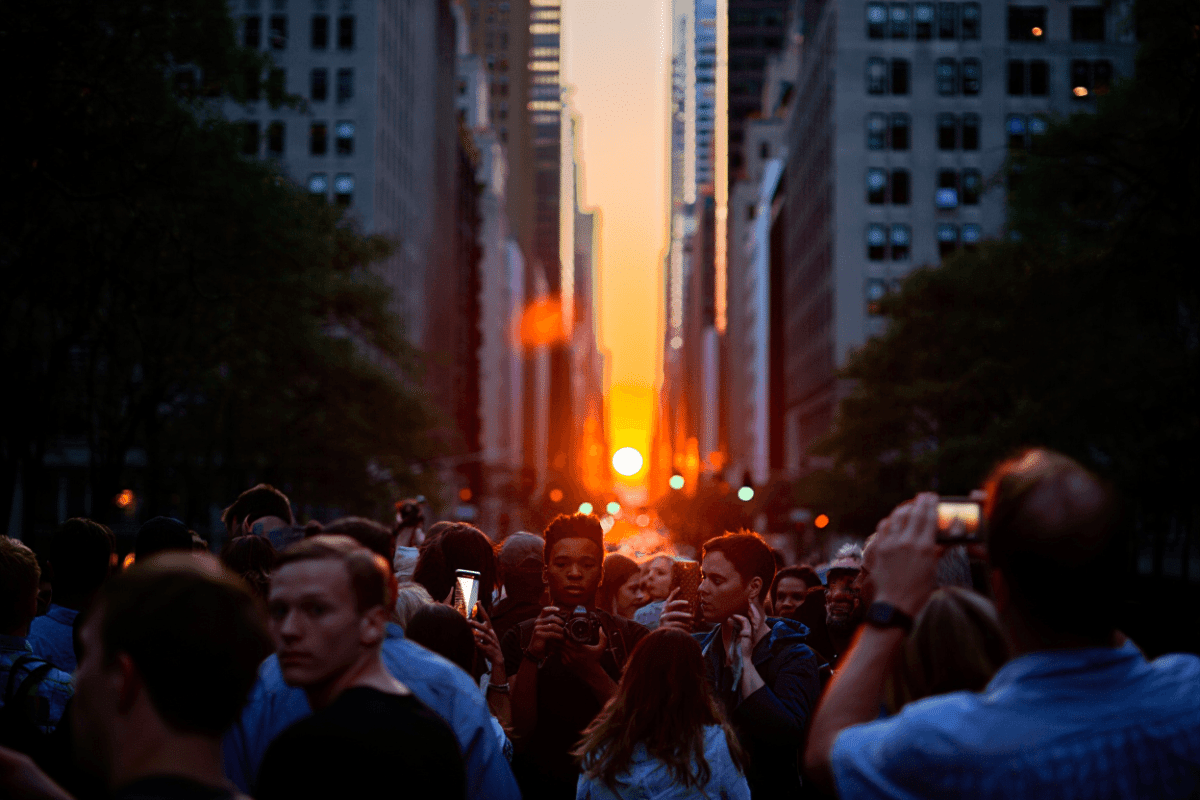
Manhattanhenge 2026 reaches its premier moment tonight, May 29, at 8:13 PM ET, when the setting sun aligns perfectly with Manhattan’s east-west street grid. This full-sun spectacle—a rare astronomical-urban phenomenon—will illuminate 42nd Street and other major cross streets as the solar disk sinks below buildings framing the western horizon. The alignment lasts only minutes, creating what millions of New Yorkers call the city’s most visually striking natural event.
🔥 Quick Facts
- Tonight’s peak alignment: 8:13 PM ET (May 29, 2026)
- Best viewing streets: 14th, 23rd, 34th, 42nd, and 57th Streets
- Duration: Only 2–3 minutes of optimal viewing
- Occurs 4 times yearly: twice around the summer solstice, twice around winter solstice
- Unplanned result: Manhattan’s 1811 grid rotated 29° from true east-west, perfectly aligning with sunset paths
The Accidental Monument: How Manhattan’s 1811 Grid Created a Solar Spectacle
When city planners designed Manhattan’s rectangular street grid in 1811 via the Commissioners’ Plan, they had no intention of creating one of the world’s largest sun-aligned monuments. Yet by rotating the grid 29 degrees clockwise from true east-west, they inadvertently positioned streets to capture the sunset twice annually. The phenomenon—dubbed Manhattanhenge by the American Museum of Natural History’s Hayden Planetarium—became the city’s most celebrated urban-astronomical alignment.
The May 28-29 event occurs near the summer solstice, when solar declination reaches its northernmost extreme. The July 11-12 event mirrors this around the solstice as the sun tracks southward. Manhattan’s unique geography—wide cross streets with unobstructed western horizons—combined with its precisely engineered grid, makes viewing possible year after year with predictable precision.
Tonight’s Peak Viewing: Timing, Location, and Photography Strategy
Time to head outside: 8:10 PM–8:16 PM ET. Arrive early at your chosen street; thousands of photographers and spectators will gather along major cross streets. The sun must be completely above the horizon during alignment for a “full-sun” Manhattanhenge—last night’s May 28 event showed a “half-sun” version. Tonight’s full-sun moment represents the most photogenic window of 2026’s spring occurrence.
Prime viewing locations ranked by accessibility: 42nd Street (Times Square area, extremely crowded but iconic); 34th Street (near Penn Station, moderately crowded); 23rd Street (Flatiron District, good balance of views and crowds); 14th Street (union Square area, wider avenue); 57th Street (Central Park South, fewer obstructions). Photographers using aperture priority mode with f/11 or higher will capture the starburst effect. Use a tripod and high shutter speed to avoid motion blur while preserving the sun’s corona detail.
Observable Data: Alignment Precision and 2026 Schedule
The Commissioners’ Plan created a grid aligned to N-S azimuth of 299°—exactly 29° north of true west. Solar declination places sunset on this azimuth only when the sun’s angle matches this geometry, which occurs in narrow annual windows.
| Event | Date 2026 | Type | Time (ET) |
| Spring: Half-Sun | May 28 | Sunset | 8:14 PM |
| Spring: Full Sun (Peak) | May 29 (Tonight) | Sunset | 8:13 PM |
| Summer: Full Sun | July 11 | Sunset | 8:20 PM |
| Summer: Half-Sun | July 12 | Sunset | 8:21 PM |
The full-sun Manhattanhenge on consecutive days (May 29 and July 11) represents the two premier annual viewing opportunities. Summer dates show slightly later times as peak solar declination shifts, while the phenomenon never occurs during the true equinoxes—only near solstices when solar declination reaches extremes.
“The Streets are aligned 28.9 degrees east from North, and the sun sets near this angle twice a year—once around May 28-29 and again around July 11-12. This creates a sun-aligned monument the planners never intended, and it’s one of the most massive and famous examples of urban astronomy.”
— Hayden Planetarium, American Museum of Natural History, NYC
Why Thousands Gather on Manhattan Streets for Three Minutes
Manhattanhenge isn’t scientifically rare—it’s urban-architecturally rare. Solstice sunsets occur everywhere; the alignment of a major city’s street grid with solar geometry happens nowhere else on the planet with this precision and scale. New York City’s accidental monument transforms functional infrastructure into a temporary astronomical theater.
The phenomenon draws photographers, tourists, and city residents who rarely pause to notice the urban landscape. Tonight’s event will repeat on July 11, then again in winter (December-January) for sunrise alignments. For those unable to view tonight, the July event offers a second chance within the same year—though slightly later sunsets (8:20 PM) and the possibility of summer storm systems may reduce visibility.
Will You See the Full Disk or Just Half? Predicting Clear Skies
Weather becomes the primary variable tonight. A full-sun alignment requires an unobstructed western horizon. Haze, clouds, or pollution between the observer and horizon can obscure the disk. Cloud cover above the western horizon will reduce the spectacle’s visual drama. Check local NYC forecasts 2 hours before the event; the Hayden Planetarium and NYC Parks Department will post visibility predictions online.
If tonight’s viewing is compromised, July 11 provides a backup opportunity with a projected 8:20 PM ET full-sun alignment. The summer date occasionally offers clearer atmospheric conditions after evening thunderstorms pass, though high humidity can create haze. December’s sunrise alignment (reverse Manhattanhenge) occurs around 6:28 AM, attracting fewer crowds but offering a pristine beginning-of-day backdrop.
Sources
- American Museum of Natural History, Hayden Planetarium — 2026 Manhattanhenge dates, solar alignment technical details, azimuth calculations
- NYC Parks Department — Official viewing locations, street recommendations, event duration specifications
- Space.com — 2026 Manhattanhenge schedule, best viewing streets, photography timing
- ABC7 Eyewitness News (NYC) — Real-time weather and visibility conditions for May 29, 2026