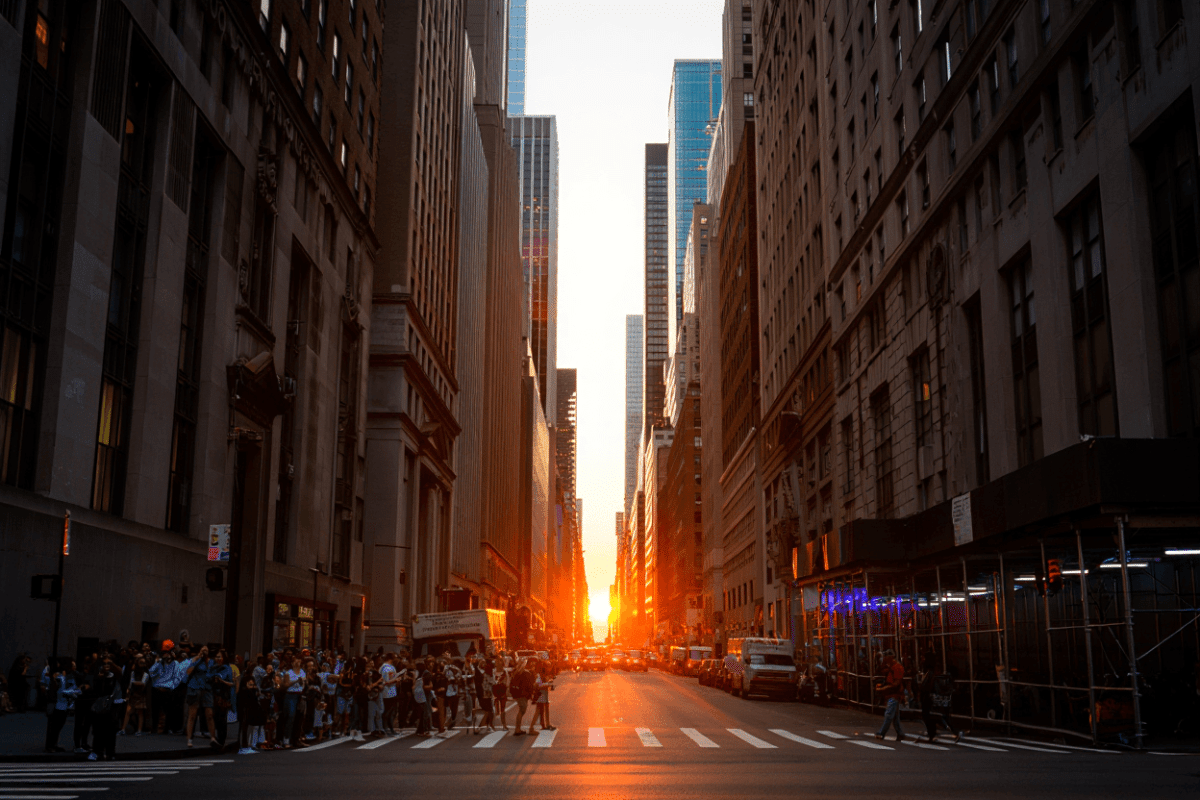
Manhattanhenge 2026 reaches its peak tomorrow night when the setting sun aligns perfectly with Manhattan’s east-west street grid at 8:13 p.m. EDT on May 29. This rare astronomical phenomenon creates a dramatic corridor of light framed by skyscrapers, visible from select locations across the city. The alignment lasts only minutes but draws thousands of New Yorkers and photographers annually.
🔥 Quick Facts
- Peak Time: Friday, May 29, 2026 at 8:13 p.m. EDT — Full-sun alignment moment
- Four Annual Alignments: Two sunset events, two sunrise—May/July for sunsets, December/January for sunrises
- Manhattan’s Grid Rotation: 30 degrees east of true north — Key reason the alignment happens at different times than equinoxes
- Best Viewing Locations: 14th, 23rd, 34th, 42nd, 57th Streets — Face west for clearest sightlines
- Duration: Only 3-5 minutes — Clear weather is essential for visibility
Understanding the Science Behind a 200-Year-Old Urban Accident
Manhattanhenge, also called the Manhattan Solstice, owes its existence to a design decision made in 1811 by New York City planners. When commissioners laid out the city’s famous grid system, they aligned it approximately 30 degrees clockwise from true geographic east-west. This wasn’t intentional astronomical planning—it was practical city design.
Because of this specific angle, the sun’s path during certain times of year creates perfect visual alignment with Manhattan’s street canyons. The phenomenon demonstrates how human urban design can accidentally capture astronomical precision. Astrophysicist Neil deGrasse Tyson coined the term “Manhattanhenge” by analogy with England’s famous Stonehenge monument, which aligns with solstices thousands of years after its construction.
Why Manhattanhenge Happens on Different Dates Than Traditionalists Might Expect
If Manhattan’s grid had been perfectly aligned with geographic north-south axes, Manhattanhenge would occur on the equinoxes (March 21 and September 23). Instead, the 30-degree rotation shifts the dates approximately two months before the summer solstice (May 28-29) and two months after (July 11-12). The winter sunrise alignment follows the same offset logic, occurring around December 5 and January 8.
This difference illustrates a key principle in astronomy: solar azimuth—the compass direction where the sun appears on the horizon—changes constantly as Earth orbits the sun. The sun’s azimuth only matches Manhattan’s grid alignment during these four specific date windows each year, making the event predictable but not evenly distributed throughout the calendar.
Prime Viewing Locations and Photography Strategy
| Street/Location | Visibility Quality | Best For |
| 14th Street | Excellent | Lower Manhattan views, clearer sightlines |
| 23rd Street | Excellent | Classic urban canyon photography |
| 34th Street | Excellent | Empire State Building framing options |
| 42nd Street | Very Good | Midtown classic shot, crowded |
| 57th Street | Very Good | Uptown perspectives, moderate crowds |
| Tudor City Overpass | Good | Unique elevated viewpoint |
| Hunter’s Point South Park | Good | Long Island City, facing west toward Manhattan |
The key to optimal viewing is positioning yourself as far east as possible on any cross street, looking west directly down the street canyon. This orientation ensures the sun appears centered during the alignment. Many photographers favor 42nd Street for its iconic composition with midtown skyscrapers, though crowds can be substantial. 14th Street offers clearer sightlines farther downtown with fewer obstructions.
“Manhattanhenge is a lesson in Astronomy 101: a reminder that we live on a rock that is spinning at a tilt as it swiftly moves through space in orbit around the sun. This phenomenon makes that tangible.”
— Jackie Faherty, Researcher, American Museum of Natural History Hayden Planetarium
How Tomorrow Night Fits Into the 2026 Cycle
Tomorrow marks the second and final full-sun Manhattanhenge of May 2026. Thursday, May 28 technically offers a half-sun alignment when only the bottom half of the solar disk aligns with the grid. Friday’s 8:13 p.m. EDT event shows the complete disc centered in the street canyon—what astronomers call the “full-sun” alignment. Both evenings are part of the same astronomical event, but May 29 delivers the textbook-perfect moment.
For those who miss tomorrow, the summer cycle returns July 11-12, 2026, at approximately 8:20 p.m. EDT. The winter sunrise alignments follow in December and January, though those require standing outdoors at dawn. The phenomenon repeats annually without exception, making it one of the most predictable natural spectacles in the urban environment.
What Determines Whether the Event Will Actually Be Visible Tomorrow Evening?
Clear skies are everything for Manhattanhenge. Cloud cover, haze, or extended overcast conditions will render the alignment invisible, no matter how perfect the astronomical alignment. Check weather forecasts closely through tomorrow afternoon. If clouds block the sunset, the full alignment will be impossible to observe until July, though the mathematical alignment still occurs whether or not human observers can see it.
The event’s brevity adds urgency: once the sun passes below the grid plane, the alignment is over. Photographers typically position themselves 15-20 minutes before 8:13 p.m., using the sun’s approach to fine-tune their framing. Even a few seconds of cloud clearing can mean the difference between capturing the moment and missing it entirely—which is precisely why Manhattanhenge remains so compelling despite its predictability and brief duration.
Sources
- American Museum of Natural History Hayden Planetarium — Official Manhattanhenge research, dates, times, and viewing guidance
- NYC Parks — Viewing location recommendations and best-practices guidance
- Space.com — Astronomical explanation and 2026 event details
- The New York Times — Reporting on Manhattanhenge 2026 dates and coverage
- Wikipedia — Historical context and grid angle specifications (30-degree rotation)