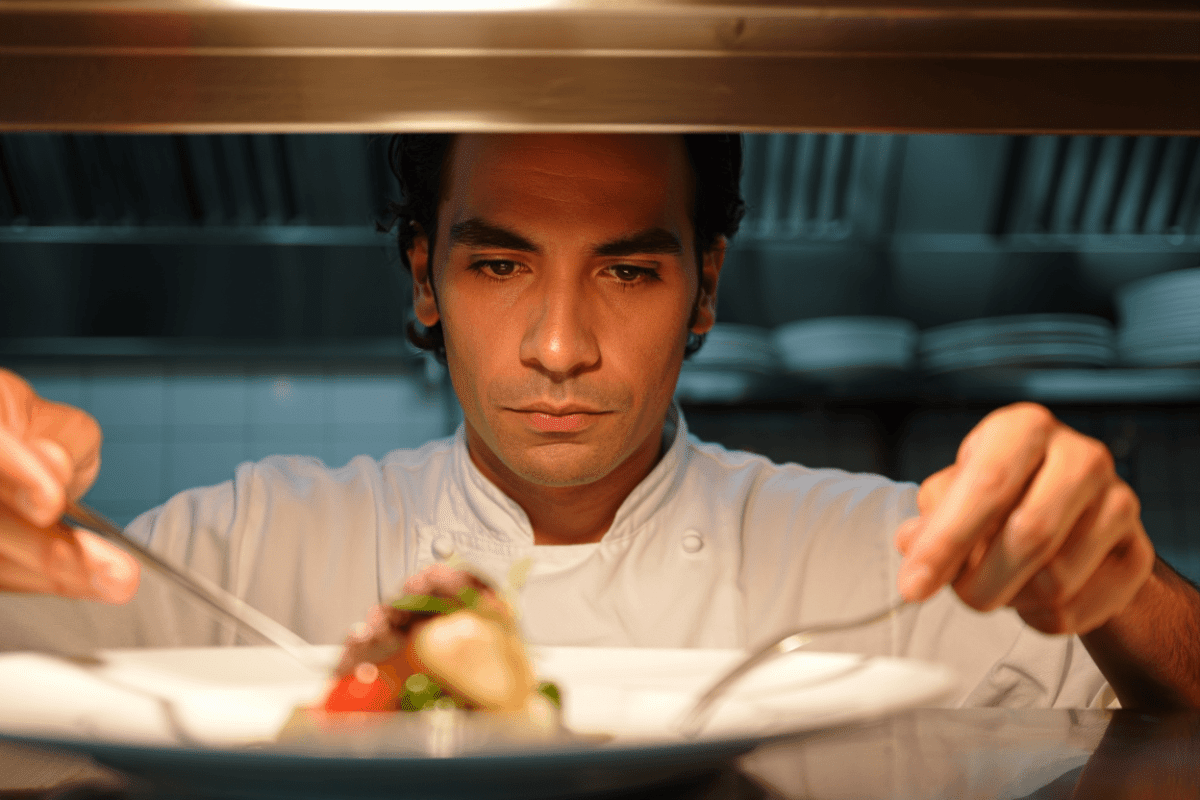
Sieger Bayer‘s journey on Top Chef Season 23 ended for the second time on May 26, 2026, when his pâté mousse dish faltered during the Appalachian Celebration elimination challenge in Asheville, North Carolina. The Chicago chef and Berria seasonal pop-up bar owner faced judges Tom Colicchio and Gail Simmons, who critiqued his dish for inconsistent texture and inadequate refinement—a critical misstep when working with a traditionally finesse-demanding French preparation.
🔥 Quick Facts
- Sieger Bayer eliminated on May 26, 2026 in Episode 12 of Top Chef: Carolinas
- Second elimination for the Chicago chef this season after returning from Restaurant Wars
- Primary critique: texture issues with his pâté mousse preparation using Appalachian ingredients
- Episode location: Asheville, North Carolina, featuring regional culinary traditions and local producers
- Jonathan also in bottom two for excessive acidity in his competing dish
Why Texture Matters in Classical French Preparations
Pâté represents one of cooking’s most technically demanding preparations—a dish where emulsification, temperature control, and precise ratios separate professional execution from amateur efforts. Sieger’s mousse failed on texture consistency, suggesting inadequate whipping, improper stabilization, or temperature mismanagement during construction. In competition kitchens, texture flaws signal more than technique—they reveal lack of discipline under pressure, a critical vulnerability when judges evaluate foundation skills.
The Asheville episode deliberately elevated challenge difficulty by pairing classical French technique with Appalachian regional ingredients. This combination required ingredient adaptation and culinary translation skills—translating modern American ingredients into forms expected in refined cuisines. Sieger’s struggle with texture control suggested he couldn’t successfully navigate this intersection.
The Elimination Challenge Context: Appalachian Ingredients Meet Competition Pressure
The Appalachian Celebration elimination challenge tasked remaining contestants with preparing dishes for 200 regional guests using locally-sourced Appalachian produce and proteins. Judges specifically wanted to spotlight Western North Carolina’s agricultural heritage and emerging culinary reputation. As described in official coverage, contestants worked under standard time constraints with ingredients emphasizing foraged elements, regional proteins, and authentic local traditions.
Sieger’s decision to construct a pâté mousse was strategically ambitious but technically risky. Pâté demands precise mise-en-place preparation, careful equipment control, and steady execution—elements difficult when facing unfamiliar regional ingredients and heightened competitive pressure. Unlike simpler preparations that can recover from minor setbacks, mousse dishes expose every execution flaw immediately upon plating.
Comparison: How Other Contestants Navigated the Round
| Factor | Sieger Bayer | Jonathan |
| Dish Type | Pâté mousse (classical) | Contemporary plated dish |
| Primary Critique | Liquidy texture, insufficient emulsification | Excessive acidity masking flavors |
| Skill Area | Fundamental technique (French) | Flavor development and seasoning balance |
| Competition Status | Second elimination this season | Continuous competition |
| Overall Record (Last 5) | Mixed performance post-return | Competitive throughout |
The contrast between Sieger’s texture failure and Jonathan’s acidity overreach illustrates how different skill gaps manifest under pressure. While Jonathan’s issue stemmed from seasoning miscalibration, Sieger’s problem reflected mechanical execution breakdown—suggesting fundamentals deteriorated when facing unfamiliar ingredient challenges.
Sieger’s Path: From Restaurant Wars Return to Second Exit
Sieger returned to the competition during Restaurant Wars (Episode 7, approximately 4 weeks before Asheville), replacing a departed contestant. His initial Restaurant Wars return showed promise, but subsequent weeks revealed inconsistent performance. This elimination represents a pattern of vulnerability in high-stakes elimination challenges, where pressure amplifies technical mistakes.
The Chicago-based chef’s Berria pop-up emphasizes seasonal ingredients and contemporary techniques—a profile misaligned with classical French pâté preparation. Judges consistently note genre mismatches during elimination rounds; when competitors cook outside their culinary identity, results suffer. Sieger’s attempt to prove classical range backfired when he couldn’t maintain precision under time pressure.
“The judges booted Sieger because his mousse was liquidy and improperly emulsified, failing to meet the refinement standards expected in classical French preparation.”
— Top Chef Episode 12 Recap, May 26, 2026
What’s Next: Remaining Competitors and Playoff Implications
Sieger’s departure narrows the final five to four remaining chefs competing for the Top Chef: Carolinas title. With two weeks until the finale, judges will evaluate sustained excellence across remaining elimination rounds. The advance to Late-stage competition requires both fundamental consistency and strategic adaptability—strengths Sieger demonstrated inconsistently.
Appalachian ingredients will likely feature again in remaining episodes, as the season emphasizes regional culinary storytelling. Remaining contestants demonstrated stronger technique-to-pressure ratios, suggesting they’ll maintain execution quality when facing similar ingredient-based challenges. Sieger’s elimination removes a technically skilled but inconsistently focused competitor, shifting the final stretch toward chefs with clearer culinary identities and steadier performances.
Did Sieger’s Second Return Undermine His Competition Viability?
Returning to competition once already raises psychological and strategic questions. Contestants earning second chances face heightened judging scrutiny and implicit pressure to prove worthiness of another opportunity. After returning from Last Chance Kitchen or replacement status, competitors must demonstrate exceptional focus and growth—exactly where Sieger faltered. His recurring texture issues suggest he didn’t adequately address foundational weaknesses during his time away.
Top Chef’s format occasionally disadvantages returning chefs who haven’t had sufficient time to reset mentally between eliminations. The four-week window between Restaurant Wars and Asheville may have been insufficient for Sieger to rebuild technical precision and mental resilience. This pattern—quick return followed by early re-elimination—reinforces that competition momentum matters as much as individual talent.
Sources
- Entertainment Now — Top Chef 2026 Week 12 elimination coverage and judge critiques
- Vulture — Season 23 Episode 12 “Appalachian Celebration” recap and analysis
- Reality Blurred — Detailed episode recap with judge commentary and contestant evaluations
- Bravo TV Official — Top Chef Season 23 episode guide and Asheville episode details
- Citizen Times (Asheville) — Appalachian food traditions and regional culinary context