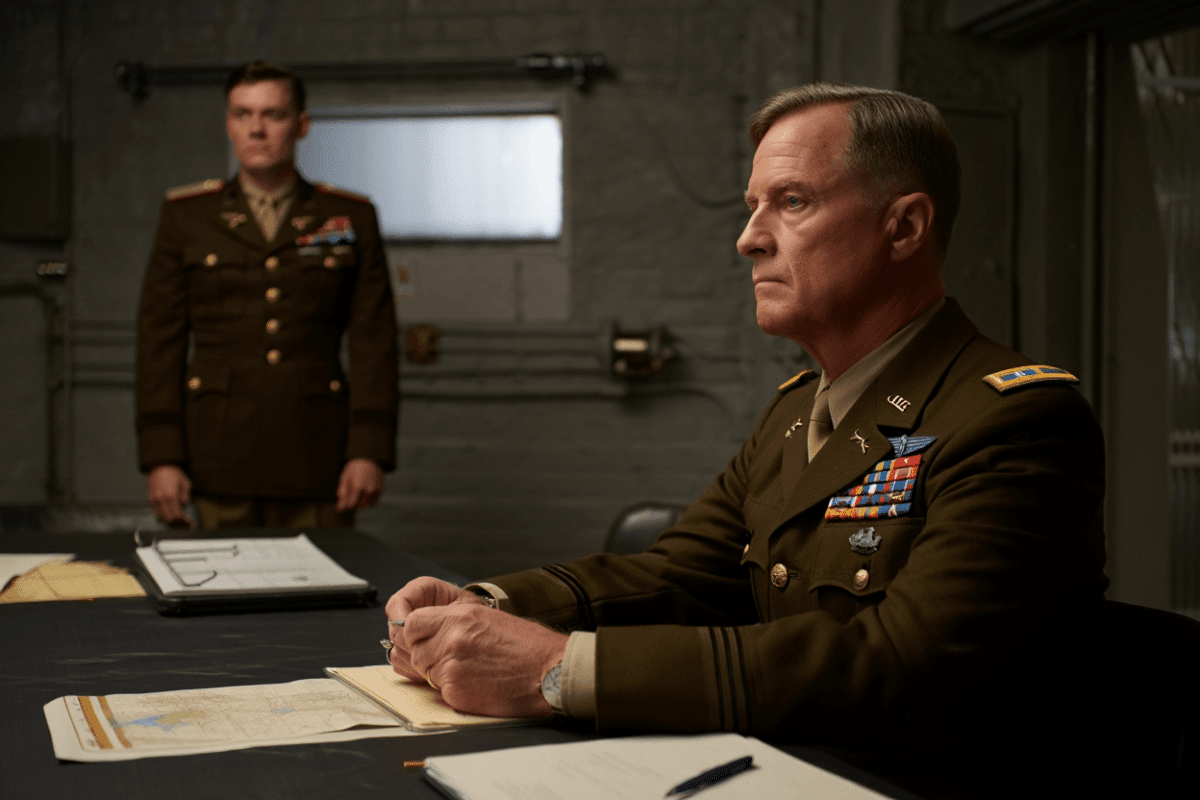
Brendan Fraser stars in “Pressure,” an acclaimed World War II drama centered on the 72 hours before D-Day when the fate of the Allied invasion hung on one meteorologist’s forecast. The film arrives in select theaters for Memorial Day early access screenings on May 25, with its wide release scheduled for May 29, 2026—approaching the 82nd anniversary of Operation Overlord.
🔥 Quick Facts
- “Pressure” opens theatrically May 29, 2026 after Memorial Day preview screenings
- Brendan Fraser portrays General Dwight D. Eisenhower in this limited release drama
- Andrew Scott plays meteorologist Captain James Stagg, the Scottish weather expert who advised the D-Day decision
- The film focuses on the actual weather conference held June 3-5, 1944, deciding Operation Overlord’s fate
- Director Anthony Maras adapted David Haig’s acclaimed 2014 stage play for the screen
The Untold Story Behind D-Day’s Biggest Decision
“Pressure” tells the historically significant account of a moment few audiences have witnessed on film: the tense military negotiations that determined whether Operation Overlord—the Normandy invasion—would proceed on schedule. The film’s narrative framework concentrates on a narrow 72-hour window where weather forecasts held the power to alter the outcome of World War II.
Most WWII dramas focus on combat itself. This film pivots toward the administrative and meteorological pressures preceding the invasion, showcasing how scientific expertise and military command intersected during history’s largest amphibious operation. The historical accuracy is grounded: meteorologist Captain James Stagg really did deliver pivotal weather predictions that influenced General Eisenhower’s critical decision to delay the invasion by one day—a choice that potentially saved thousands of lives.
Brendan Fraser and Andrew Scott Navigate Command Under Uncertainty
Brendan Fraser, who earned an Academy Award for his role in “The Whale,” assumes the burden of portraying General Dwight D. Eisenhower. Fraser depicts the Supreme Commander as a figure wrestling with the weight of command—responsible for millions of soldiers and the strategic direction of the war itself. His interpretation emphasizes the emotional toll of command-level decision-making rather than tactical heroics.
Andrew Scott, known for roles in “Sherlock” and “Fleabag,” anchors the film as Captain James Stagg, the meteorologist whose technical expertise proves decisive. Scott’s portrayal captures the tension between a scientist’s demand for accuracy and military decision-makers’ need for definitive answers. The dynamic between Fraser’s Eisenhower and Scott’s Stagg forms the emotional core of the narrative, illustrating how expertise and authority sometimes conflict under pressure.
Supporting performances by Kerry Condon, Chris Messina, and Damian Lewis round out the ensemble cast, portraying military planners, staff officers, and strategic advisors involved in the operation’s planning.
The Historical Context: Why Weather Mattered More Than Firepower
The Normandy invasion required specific conditions: favorable tides, clear skies for air support, and calm seas for landing craft. These conditions occurred only during narrow windows each month. In early June 1944, the original invasion date faced deteriorating weather forecasts. Military planners had only hours to decide: launch into uncertain conditions or postpone, risking surprise loss and diplomatic consequences.
Stagg’s forecast—calling for a brief weather window on June 6, despite larger storms brewing—became the deciding factor. Eisenhower’s authority to delay despite political and military pressure to proceed demonstrates how scientific analysis and human judgment converged at a critical historical moment. The film examines this decision-making process with specificity rarely seen in cinema.
| Element | Details |
| Film Title | Pressure |
| Release Date | May 29, 2026 (wide release); May 25, 2026 (Memorial Day screenings) |
| Director | Anthony Maras |
| Rating | PG-13 |
| Running Time | TBA |
| Distributor | Focus Features |
| Theatrical Screen Count | Approximately 1,500 screens (opening week) |
“In the tense 72 hours before D-Day, and with the fate of the free world hanging in the balance, PRESSURE follows General Dwight D. Eisenhower and Captain James Stagg with an impossible choice – proceed with the planned seaborne invasion or risk losing the war.”
— Focus Features, Official film synopsis
Why This Film Arrives at a Pivotal Cultural Moment
“Pressure” emerges at a time when audiences increasingly seek narratives exploring institutional decision-making and scientific expertise. The film’s focus on how commanders rely on expert forecasting—and how political pressures can override scientific judgment—resonates with contemporary discussions about authority, expertise, and consequence. The film doesn’t glorify war; instead, it examines the human cost of uncertainty and the weight of consequential decisions.
The 82nd anniversary of D-Day arrives during Memorial Day weekend, making the film’s timing strategically relevant for audiences honoring military sacrifice. Special screening events at the National D-Day Memorial Foundation and military-affiliated venues underscore the film’s historical significance beyond typical commercial cinema.
What Audiences Can Expect from This Unusual WWII Drama
“Pressure” differs markedly from conventional war films. There are no battle sequences, explosions, or combat scenes. Instead, the narrative tension derives from dialogue, strategic planning, scientific uncertainty, and interpersonal conflict among high-ranking commanders and advisors. Director Anthony Maras, who previously helmed the 2018 acclaimed drama “Hotel Mumbai,” brings his expertise in confined-setting thrillers to this material.
The film operates as a historical thriller, building tension through time constraints and factual uncertainty. Viewers unfamiliar with the Stagg story will discover a previously underexposed chapter of WWII history. For those familiar with D-Day, the film offers insight into the decision-making processes that preceded the invasion’s execution.
The limited theatrical release—approximately 1,500 screens for its opening week—indicates Focus Features’ positioning as a prestige drama rather than a mass-market blockbuster. This platform release strategy suggests the distributor expects strong word-of-mouth among discerning audiences interested in character-driven historical narratives.
Why This Story Remains Relevant to Modern Audiences?
The central theme of “Pressure”—a leader facing conflicting expert opinions while bearing responsibility for millions—extends beyond historical drama. The film implicitly asks contemporary questions: How do leaders make decisions under uncertainty? What happens when scientific expertise contradicts political pressure? How do individuals navigate moral responsibility when mistakes could cost lives?
These questions transcend the 1944 setting, subtly connecting WWII history to ongoing debates about institutional decision-making, scientific authority, and leadership ethics. For audiences seeking historical cinema with philosophical depth, “Pressure” offers uncommon thematic resonance.
Sources
- IMDB – Film cast, crew, and plot summary
- Wikipedia – Pressure (2026 film) production details and historical background
- Rotten Tomatoes – Official film synopsis
- Focus Features – Official distributor information and release schedule
- Military Times, Washington Post, SF Chronicle – Review coverage and historical context on James Stagg
- National D-Day Memorial Foundation – Screening event details