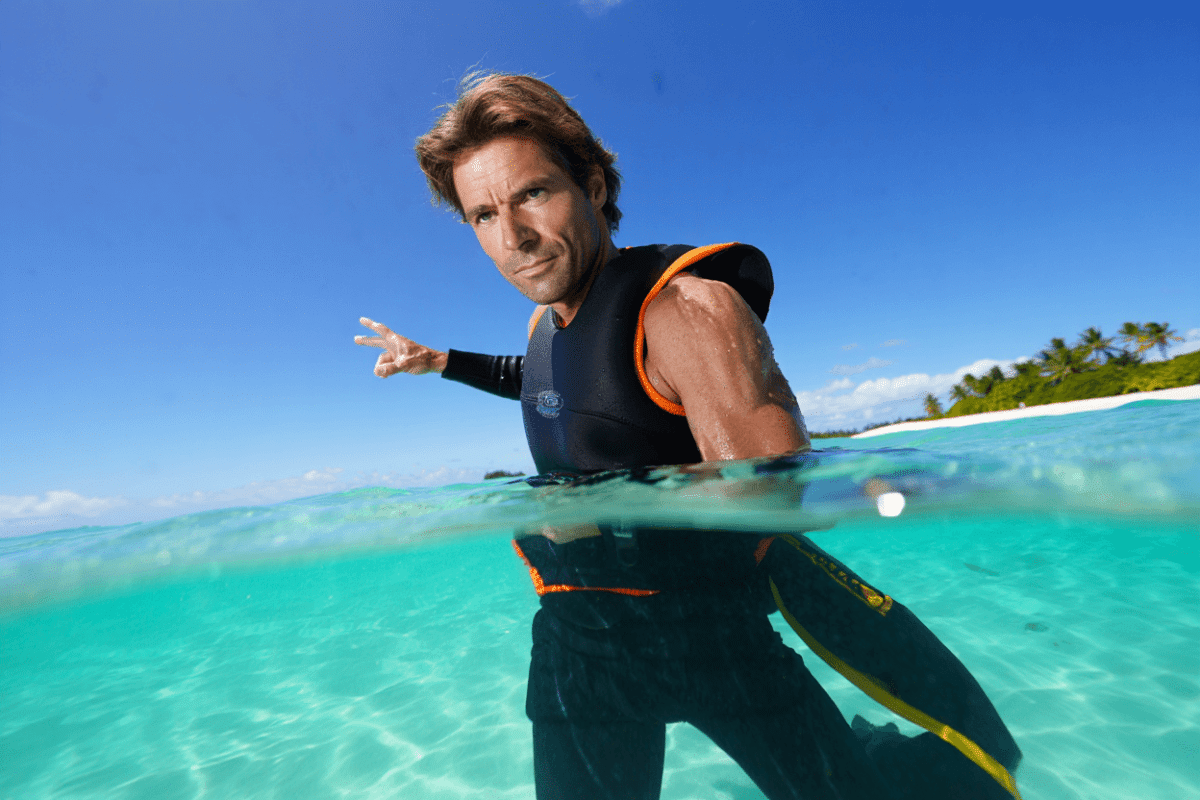
Paul de Gelder, the renowned shark attack survivor turned television host, leads the expert team on Channel 9’s new reality series Shark!, which premiered May 31 and continues tonight, June 1, at 7:30 PM ET (4:30 PM PT). The five-episode adventure takes six Australian celebrities to Bimini, Bahamas—the shark capital of the world—where they face their deepest fears while diving alongside sharks. This represents a significant shift in de Gelder’s media presence: from Shark Week participant to guide, mentor, and authority figure guiding celebrities through an experience that tests both physical courage and psychological resilience.
🔥 Quick Facts
- Series Start: Two-part premiere May 31 and June 1 on Channel 9
- Tonight’s Episode: June 1 at 7:30 PM ET / 4:30 PM PT on Channel 9 and 9Now
- Cast Includes: Tammy Hembrow, Lynne McGranger, Scott Cam, Ariarne Titmus, Sam Thaiday, Matt Nable
- Location: Bimini, Bahamas—world-renowned shark habitat filmed over five 60-minute episodes
- Expert Guides: Paul de Gelder and shark conservationist Annie Guttridge lead three shark experts
Paul de Gelder: From Survivor to Shark Expert Authority
De Gelder’s path to hosting Shark! represents one of television’s most compelling transformation arcs. In 2009, during a counter-terrorism exercise in Sydney Harbour, a 9-foot bull shark attacked the elite Navy clearance diver in an eight-second assault that left him missing his right hand and right leg. The attack could have ended his diving career—and his life. Instead, it became the foundation for his most authentic expertise.
After leaving full-time Navy service in 2012, de Gelder transitioned into motivational speaking, marine conservation, and television. Since 2014, he has hosted Discovery Channel’s Shark Week, one of television’s longest-running and most prestigious natural science programs. This background—combining military discipline, scientific understanding, and lived experience with predators—positions him uniquely to guide celebrities through shark encounters. Unlike a standard television host, de Gelder brings credibility that cannot be manufactured.
The Celebrity Cast and Their Challenge
Scott Cam, the beloved Australian television presenter, headlines a cast of six celebrities, each bringing distinct profiles to the show. Ariarne Titmus, a four-time Olympic gold medalist swimmer, paradoxically faces her deepest fear in water—a psychological inversion that creates genuine tension. Lynne McGranger, the 2025 TV Week Gold Logie Award winner, brings established television credibility. Tammy Hembrow, the social media entrepreneur with millions of followers, represents younger digital-native celebrity culture. Supporting cast includes Sam Thaiday (rugby league) and Matt Nable (actor), each with their own psychological baggage regarding deep water and apex predators.
The show’s genius lies in this contrast: athletic excellence—Titmus has conquered Olympic pools—provides no advantage against primal fear. A Gold Logie winner’s performance skills cannot shield against genuine peril. Social media influence means nothing when surrounded by bull sharks, tiger sharks, and Caribbean reef sharks. The Bahamas location intensifies this psychological pressure: Bimini is not a controlled environment but a genuine shark habitat.
Expertise, Methodology, and Shark Conservation
De Gelder shares hosting duties with Annie Guttridge, a world-renowned underwater photographer and shark conservationist who serves as President of Saving the Blue, an organization dedicated to marine research and shark advocacy. Together, they represent a philosophical framework: sharks are not monsters to conquer but magnificent creatures worthy of respect and study. This educational approach distinguishes Shark! from sensationalist wildlife programming.
The show is produced by Plimsoll Productions, the production company behind acclaimed nature documentaries and BBC wildlife programming. This pedigree ensures scientific rigor. Episodes feature actual shark behavior—feeding patterns, territorial responses, predatory instincts—rather than manufactured drama. De Gelder and Guttridge function as educators, teaching celebrities (and viewers) how to read shark body language, understand species-specific behavior, and recognize the difference between genuine danger and media-constructed fear.
This represents a significant departure from traditional reality television: there is no elimination mechanic, no manufactured conflict between contestants, no prize pool. The only genuine stakes are psychological—facing fear and emerging with a transformed perspective on an animal that has killed an estimated ten people annually out of billions of ocean interactions. The implicit argument: your fear of sharks far exceeds their interest in you.
Why This Timing Matters: 2026 Television Landscape
Channel 9’s investment in Shark! reflects changing audience expectations for documentary-style reality content. Traditional competition-based reality television (The Bachelor, Survivor-style formats) has fragmented viewership. Meanwhile, nature and science programming has consolidated passionate audiences. By combining celebrity participation with genuine expertise and conservation messaging, Shark! targets multiple demographics: nature enthusiasts intrigued by de Gelder’s credibility, celebrity watchers curious about A-list vulnerability, and younger audiences seeking entertainment with educational substance.
The 7:00 PM Sunday and 7:30 PM Monday time slots position the show directly against MasterChef Australia and other established competitors, suggesting Channel 9’s confidence in the format. This placement carries genuine risk: underperformance would signal waning interest in celebrity-driven adventure content. Success would generate international sales (UK networks have already expressed interest in versions featuring British celebrities, based on earlier Shark! Celebrity Infested Waters programming on ITV).
What Viewers Should Expect Across Five Episodes
Shark! unfolds over five episodes filmed entirely in Bimini, a location chosen deliberately. The Bahamas location is not random: Bimini hosts some of Earth’s highest concentrations of shark species, particularly bull sharks, known for aggressive feeding behavior and territorial responses. Water visibility, depth, currents, and thermal dynamics create conditions far more challenging than aquarium settings or controlled shallow-water experiences. Celebrities cannot retreat to a safe zone if anxiety escalates. De Gelder and Guttridge must manage genuine risk while pushing participants beyond psychological comfort zones.
Episodes typically follow a narrative arc: introduction to shark species and behavioral science, confined water exercises to build comfort, open-ocean diving with sharks present, and finally, unscripted encounters where unpredictable predator behavior tests psychological resilience. The series culminates with participants demonstrating mastery and perspective shift—many will explicitly state that sharks ceased being monsters and became comprehensible animals with comprehensible motivations.
The Broader Implications: Celebrity Culture and Fear
Shark! engages with a cultural question that extends beyond entertainment: how do high-status, accomplished individuals confront existential fear when achievement and resources cannot guarantee safety? Ariarne Titmus dominated Olympic competition through discipline and physical excellence; that discipline becomes irrelevant underwater. Lynne McGranger captivated audiences for decades through performance; performance becomes impossible when confronting genuine danger. Scott Cam built a career managing interpersonal dynamics and creative problem-solving; neither skill translates to shark encounters.
This is the show’s implicit depth: wealth, fame, and accomplishment cannot substitute for courage. De Gelder’s presence reinforces this—he survived predator attack through factors largely outside conscious control (military training, physical resilience, medical intervention, psychological fortitude compressed into eight seconds). His survival was not victory; it was chance. His subsequent career—hosting Shark Week for over a decade, returning to waters where he was attacked, becoming an advocate for creatures that nearly killed him—represents something culturally anomalous: gratitude instead of vengeance, education instead of sensationalism.
Will You Tune In Tonight?
The premiere already aired May 31 to strong ratings, with viewers expressing genuine fascination with celebrity vulnerability and de Gelder’s composed expertise. Tonight’s June 1 continuation (7:30 PM ET / 4:30 PM PT on Channel 9 and streaming on 9Now) escalates the psychological stakes as celebrities move from confined water to open-ocean settings. De Gelder’s guidance becomes increasingly critical—and increasingly valued by participants who initially resisted his counsel. This is compelling television precisely because it refuses easy answers, manufactured conflict, or predetermined outcomes. Sharks remain unpredictable. Fear remains authentic. Growth remains possible.
Sources
- Channel 9 Official – Series premiere information, air times, and cast confirmation
- Mediaweek Australia – Paul de Gelder interview and series analysis
- TV Tonight – Cast profiles and episode details
- Paul de Gelder Official – Professional background and career timeline
- Annie Guttridge Official – Shark conservationist credentials and Saving the Blue organization
- Hollywood Reporter – De Gelder’s Shark Week career trajectory and achievement analysis
- Plimsoll Productions – Series production information and creative approach