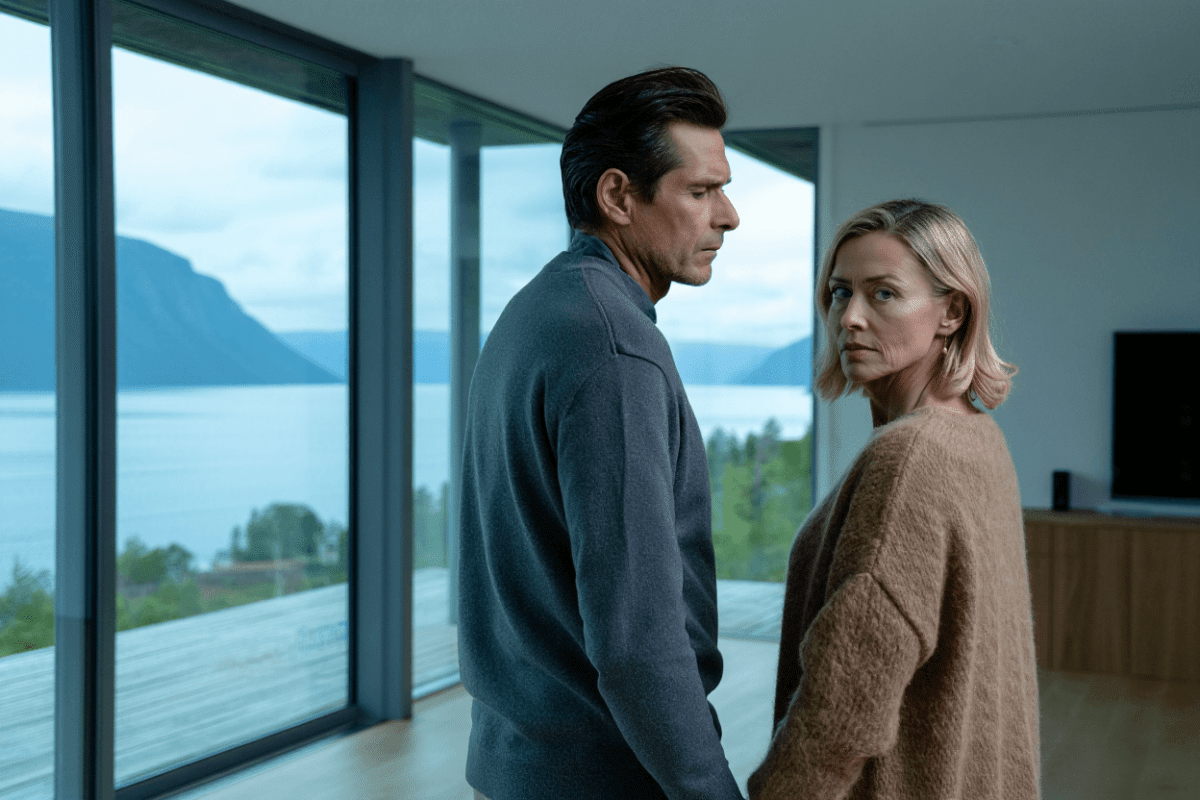
Fjord, directed by Cristian Mungiu, won the Palme d’Or at the 79th Cannes Film Festival on May 23, 2026, securing Neon its record seventh consecutive award in the festival’s most prestigious category. The Romanian filmmaker’s English-language debut stars Sebastian Stan and Renate Reinsve as members of a devout evangelical couple navigating cultural tensions in a remote Norwegian fjord community. Fjord represents a landmark moment for independent distribution, cementing Neon‘s dominance at the world’s most prestigious film festival.
🔥 Quick Facts
- 79th Cannes Film Festival ended May 23, 2026 with awards announced
- Fjord earned the Palme d’Or, Neon‘s record seventh in consecutive wins
- Director Cristian Mungiu previously won Palme d’Or in 2007 for 4 Months, 3 Weeks and 2 Days
- Film shot in Ålesund, Norway with cinematographer Tudor Vladimir Pandoru
- Standing ovation lasted approximately 10 minutes at world premiere
The Historic Seventh Palm for Neon Distribution
Neon’s win with Fjord extends an unparalleled winning streak at Cannes. The distributor acquired six consecutive Palmes d’Or prior: Parasite (2019), Titane (2021), Atelier Despain (2022), Boy From Heaven (2023), All Fours (2024), and Memoria Hereford (2025). This achievement reflects Neon‘s strategic ability to identify and acquire films that resonate with international juries—a capability that has positioned the independent distributor among Hollywood‘s most successful acquisition houses. Since 2017, Neon has garnered 57 Academy Award nominations and 11 total wins, including two Best Picture victories for Parasite and Anora.
Fjord arrives as Neon‘s ninth film in the Cannes 2026 official selection and sixth in the main competition, demonstrating the distributor’s substantial presence at the festival. The company’s ability to maintain this dominance speaks to both its curatorial taste and its relationships with accomplished international filmmakers.
Cristian Mungiu’s English-Language Milestone
Fjord marks Cristian Mungiu‘s first feature in English—a significant stylistic departure for the Romanian director known for his unflinching examinations of Romanian society across five previous features since 2002. With this film, Mungiu turns his observational lens outward, examining cultural integration, faith, and social friction through the lens of a Romanian-Norwegian evangelical family. The move represents artistic expansion without abandonment of his signature approach: unflinching moral complexity and extended takes that challenge audience perception.
Mungiu‘s previous Palme d’Or win came in 2007 for 4 Months, 3 Weeks and 2 Days, one of the most acclaimed films of the 2000s. Since then, he has accumulated multiple Best Actress and screenwriting awards at Cannes, establishing himself as one of Europe’s most consistently respected auteurs. His return to the Palme competition as a two-time winner signals the festival’s recognition of Fjord as essential cinema.
Cast, Crew, and Norwegian Production
| Element | Details |
| Director / Writer | Cristian Mungiu |
| Lead Actors | Sebastian Stan, Renate Reinsve, Lisa Loven Kongsli, Thorbjørn Harr |
| Cinematography | Tudor Vladimir Pandoru (returning collaborator) |
| Editing | Mircea Olteanu |
| Production Design | Marius Winje Brustad |
| Production Location | Ålesund, Norway (principal photography March 2025) |
| Production Company | Mobra Films |
| Distributor | Neon |
Fjord was filmed in Ålesund, Norway, a picturesque coastal region famous for its mountains and maritime landscape. Mungiu‘s decision to shoot in this austere environment emphasizes the film’s exploration of isolation and cultural displacement. Cinematographer Tudor Vladimir Pandoru, who previously collaborated with Mungiu, translates the cold landscape into visual metaphor—harsh light and wide compositions reflecting the emotional distance between characters. The 10-minute standing ovation at the world premiere indicated immediate recognition of Fjord‘s artistic achievement among festival audiences and industry professionals, as documented in the broader coverage of the 79th edition’s award announcements.
Critical Reception and Artistic Ambition
Fjord has earned widespread praise for its ambitious examination of morality in gray zones. Critics have noted Mungiu‘s ability to depict family life and religious faith without sentimentality or condemnation, instead presenting characters as complex individuals navigating genuine ethical questions. Sebastian Stan‘s performance has been highlighted for its restrained intensity, while Renate Reinsve has been recognized for her nuanced portrayal of a woman caught between cultural identity and community belonging.
Unlike conventional festival fare that resolves moral dilemmas, Fjord leaves audiences uncomfortable—a hallmark of Mungiu‘s directorial approach. The film neither condemns nor validates its characters’ choices but instead forces viewers to confront their own assumptions about integration, faith, and social responsibility. This refusal to provide easy answers likely resonated with the Cannes jury, which has increasingly favored challenging cinema that prioritizes artistic substance over entertainment formula.
What Fjord’s Victory Signals for Film Festivals and Distribution
Neon‘s historic seventh Palme d’Or signals sustained industry confidence in independent distributors’ curatorial judgment. Traditionally, major studios dominated festival recognition, but Neon‘s consistent success has demonstrated that strategic acquisition and selective theatrical release can identify prestige films ahead of broader markets. Fjord‘s win suggests that Mungiu‘s reputation as a two-time Palme winner combined with Hollywood star power in Sebastian Stan positioned the film as a consensus choice among jury members assembled by president Park Chan-wook, the acclaimed South Korean director of Oldboy and recent Oscar winner Parasite.
The 2026 festival has reinforced a trend: international auteur cinema remains competitive at Cannes when paired with significant film craft and performances. Fjord‘s victory ensures Neon‘s continued position as one of the film world’s most influential acquisition and distribution entities, capable of bringing challenging, artistic films to broader audiences while maintaining Cannes‘s status as cinema’s ultimate arbiter of prestige.
What This Means for US Audiences and Oscar Consideration
Palme d’Or winners have historically translated into significant awards season momentum. Parasite‘s 2019 win preceded Best Picture victory at the 2020 Oscars, while films like All the Candles in the World have generated substantial international and North American interest. Neon‘s distribution network positions Fjord for significant US theatrical release, likely timed for awards season consideration in autumn 2026. Mungiu‘s previous Oscar nominations and Palme d’Or pedigree suggest the film will receive consideration in multiple categories, including International Feature, Best Director, Best Cinematography, and potentially Best Picture should Neon pursue aggressive festival strategy.
For American viewers unfamiliar with Mungiu‘s work, Fjord represents an opportunity to experience uncompromising contemporary European cinema addressing universal themes of belonging and faith. The film’s English language dialogue and Hollywood cast accessibility contrast markedly with Mungiu‘s previous works, potentially broadening its reach beyond traditional art-house audiences.