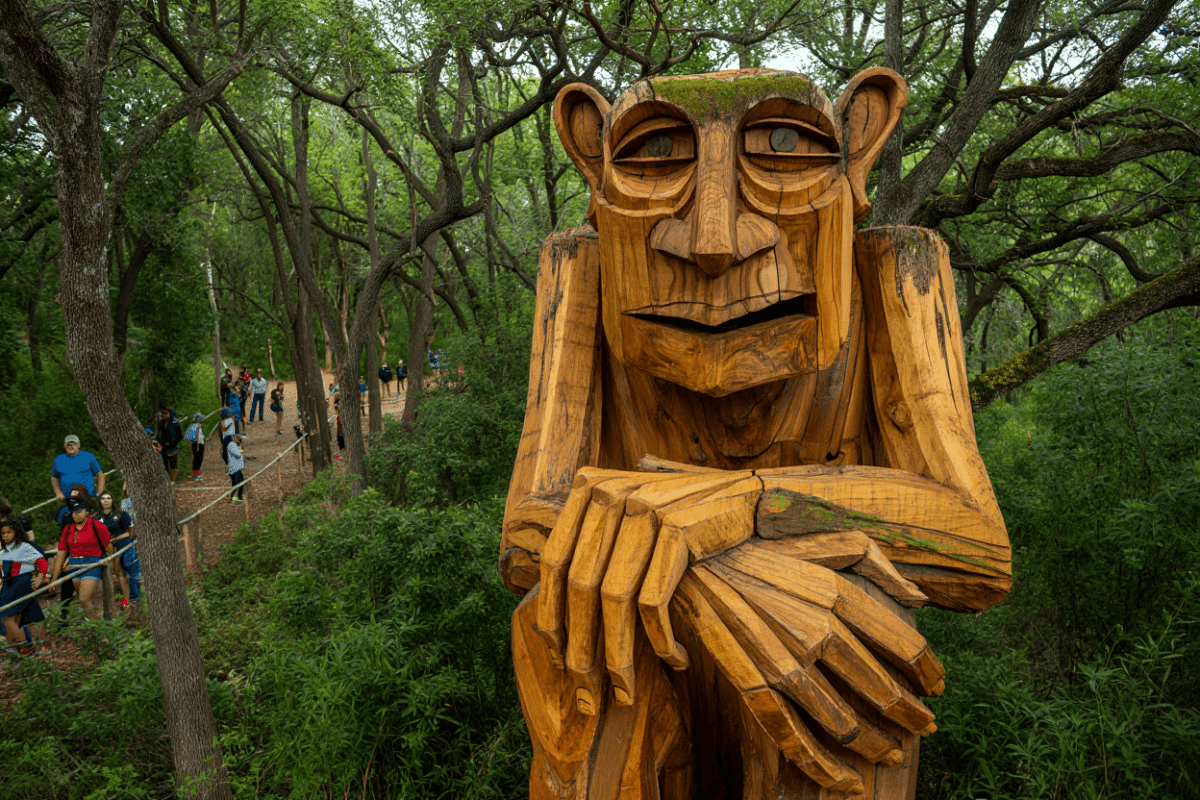
Malin, a towering 18-foot-tall wooden troll sculpture nestled in Pease Park, has emerged as one of Austin’s most visited cultural attractions since its completion in March 2024. Created by renowned Danish artist Thomas Dambo with help from 150 Austin-based volunteers, this public art installation operates as a year-round destination with free Troll Trek tour access available daily between 9 AM and 6 PM on weekends. The sculpture sits approximately 1,200 feet up the scenic Shoal Creek Trail, welcoming visitors to explore its environmental significance and distinctive artistic craftsmanship.
🔥 Quick Facts
- 18-foot-tall wooden sculpture created by acclaimed recycled artist Thomas Dambo
- Completed March 2024, making it Dambo’s first and only troll in Texas
- 150 Austin volunteers participated in the construction process
- Over 80% recycled materials used, demonstrating sustainable art practices
- Open 6 AM to 10 PM daily, free admission year-round at Pease Park
- 4.9-star rating across 287+ visitor reviews on Google Maps
Understanding Thomas Dambo and His Global Troll Movement
Thomas Dambo stands out as the world’s leading recycle artist, transforming discarded materials into monumental public sculptures that challenge conventional perceptions of waste. Over his career, Dambo has created more than 100 trolls globally, each with unique names and environmental messaging. His artistic philosophy centers on portraying trolls as “protectors and voice of nature”—guardians of environmental consciousness positioned within natural landscapes to foster community connections with the outdoors.
Dambo’s approach to art represents a deliberate shift toward sustainable creativity. By sourcing materials from landfills, urban salvage sites, and deconstructed buildings, he demonstrates that monumental sculpture need not depend on virgin resources. The Pease Park installation required months of planning and community coordination, with Austin’s Pease Park Conservancy managing partnerships to bring this vision to life in the heart of Texas.
Malin’s Fountain: Artistic Design and Water-Protector Symbolism
Malin, the official name given to this Austin troll, represents Dambo’s interpretation of a water protector in feminine form. The sculpture incorporates a fountain element—hence “Malin’s Fountain”—reinforcing its thematic connection to aquatic ecosystems. Positioned alongside the Shoal Creek Trail, the troll acts as both artwork and environmental educator, prompting visitors to reflect on waterway preservation and ecological responsibility.
The construction scale warranted intensive labor: visitors often remark on the sculpture’s intricate detail work, from facial features to hand positioning. Every element integrates sustainably sourced or repurposed wood, creating visual interest while maintaining Dambo’s environmental ethics. The wooded alcove setting was deliberately chosen to create a naturalistic aesthetic—the troll appears as though emerging organically from the forest rather than imposed upon it. This contextual placement reinforces the artist’s messaging that art should harmonize with, rather than dominate, natural environments.
Year-Round Visitor Experience: Access, Tours, and Community Engagement
Pease Park maintains extended operating hours from 6 AM to 10 PM daily, making the troll accessible to early-morning joggers, lunch-break seekers, and evening explorers. The Troll Trek initiative—Pease Park Conservancy’s guided experience program—offers structured tours from Kingsbury Commons parking lot (located at 1100 Kingsbury Street) and other Austin Recreation Center access points. Tours operate on weekends and Sundays between 9 AM and 6 PM, providing expert context on Dambo’s artistic vision, sustainable materials utilization, and the environmental themes embedded within Malin’s design.
Visitor traffic demonstrates sustained engagement: Google’s busyness data reveals that Saturdays at 3–4 PM represent peak visitation hours, with some 100% capacity metrics during favorable weather. However, the park offers ample opportunity for quieter visits on weekday mornings, allowing contemplative engagement with the sculpture. The 1,200-foot trail distance from parking to the troll accommodates family visits, accessible walking paces, and opportunity for light hiking combined with cultural tourism. Supporting amenities include clean restrooms, water fountains, and water bottle filling stations throughout Pease Park.
Environmental Messaging and Sustainable Art Practices
| Aspect | Details |
| Materials Sourced | Recycled, repurposed, or salvaged wood; reclaimed construction debris |
| Percentage Sustainable | Over 80% of total materials recycled or reclaimed |
| Environmental Mission | Troll functions as water protector; promotes ecological awareness via Shoal Creek Trail |
| Community Participation | 150 Austin volunteers contributed during construction phase |
| Artistic Philosophy | Trolls serve as nature guardians; challenge waste narratives through monumental scale |
The Pease Park troll initiative reflects Austin’s commitment to integrating public art with environmental stewardship. Pease Park Conservancy partnered with Dambo specifically because his practice aligns with the city’s “Keep Austin Weird” cultural identity—embracing unconventional creativity that reinforces community values. The sculpture’s water-protector symbolism becomes particularly relevant in Austin, where water conservation and aquatic ecosystem health rank among pressing municipal priorities. By placing the artwork within a working trail system connected to actual creek infrastructure, the Conservancy ensured Malin functions not merely as aesthetic statement but as environmental advocacy tool.
Marketing Reach and Cultural Significance in Austin’s Entertainment Landscape
Since opening, Malin has generated substantial social media engagement and tourism momentum. The sculpture’s distinctive appearance—a colossal wooden humanoid figure with expressive facial features—translates remarkably well to photography, driving organic content creation across Instagram, TikTok, and YouTube platforms. Young adult visitors particularly respond to the blend of art appreciation, outdoor recreation, and Instagram-worthy aesthetics the site provides.
“More than 80% of the materials used to build Austin’s beloved troll were recycled, repurposed, or found. The troll lives in an urban forest, not far from downtown Austin, and teaches visitors about environmental protection through its water-guardian narrative.”
— Pease Park Conservancy, Official Resource Documentation
What Future Trends Might Sustainable Public Art Installations Inspire Across Major U.S. Cities?
The Pease Park troll’s success raises intriguing questions about scaling sustainable art practices in urban planning. If cities nationwide adopt similar models—pairing monumental sculptures with environmental themes, local volunteer participation, and free public access—municipalities could reshape how culture influences ecological behavior. The $1.2 million funding requirement for this single installation illustrates both the resource investment and community commitment necessary for such projects.
Austin’s experience suggests that integrated public art functions most effectively when aligned with existing park infrastructure, environmental missions, and community activation patterns. Rather than treating sculptures as isolated installations, forward-thinking cities might embed artistic experience within broader recreational and educational frameworks—much as Shoal Creek Trail system now serves triple duty as hiking route, water interpretation space, and art gallery. The troll’s permanent placement (unlike temporary art interventions) indicates sustained institutional support and long-term vision for cultural programming.
Sources
- Pease Park Conservancy – Official Pease Park troll information, visitor guidelines, and FAQ documentation
- Thomas Dambo Studios – Artist background, portfolio of 100+ troll installations globally, sustainable materials methodology
- KUT Austin Public Radio – March 2024 reporting on troll completion, community response, and Dambo’s artistic approach
- Texas Monthly Travel – Feature coverage on the Austin installation as Dambo’s first Texas troll
- CBS Austin News – March 2025 anniversary coverage documenting Malin’s first-year visitor engagement metrics
- Austin Statesman – March 2024 inaugural reporting on volunteer participation and construction timeline
- Google Maps Data – Real-time visitor patterns, hours of operation, and user review aggregation (287+ reviews, 4.9-star rating)