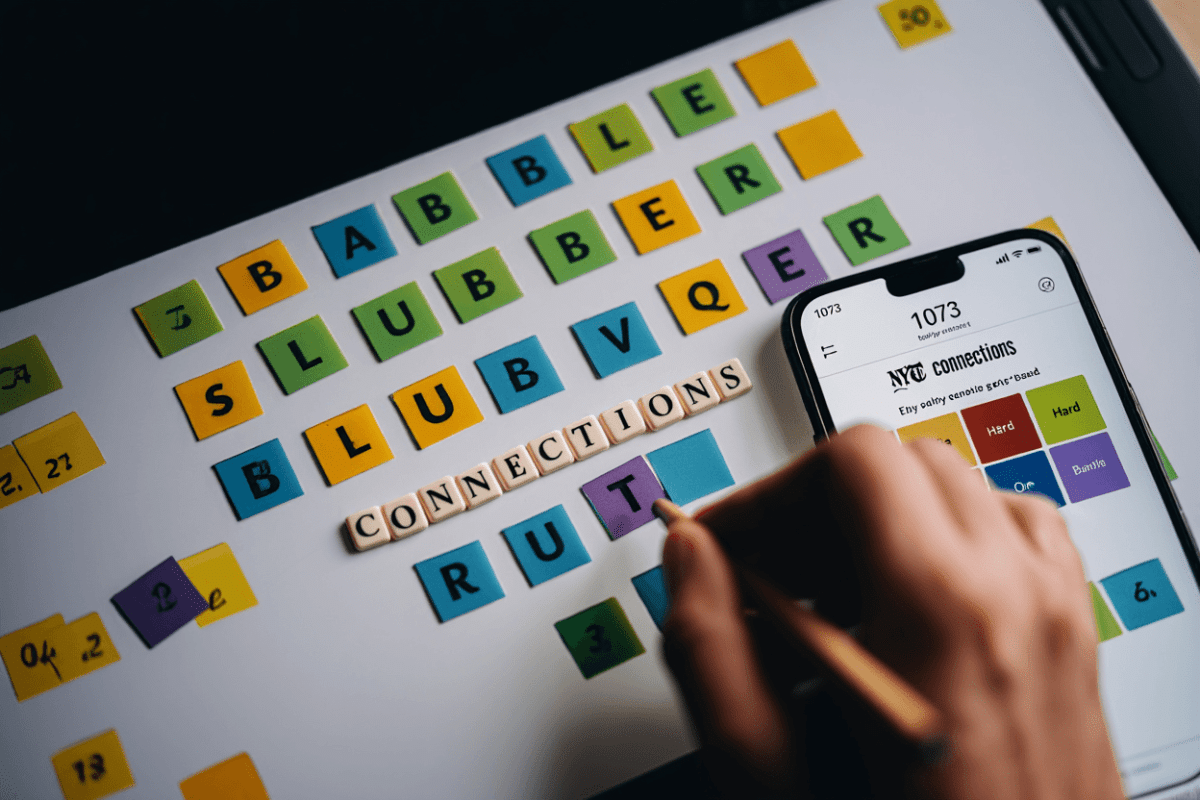
NYT Connections puzzle #1073 for May 19, 2026 features a deceptively difficult grid built around wordplay and thematic crossover traps. The puzzle requires solid knowledge of Judy Blume’s literary catalog and fish minus a letter wordplay to achieve a clean solve without the four allowed mistakes.
🔥 Quick Facts
- Puzzle #1073 released on May 19, 2026 — continuing the daily NYT Connections streak.
- Four groups confirmed: Baby activities, deceptive modifications, Blume novels, and fish anagrams.
- Difficulty rated as Hard — particularly the purple group fish wordplay.
- Four mistakes allowed per game — standard Connections rule across all difficulty levels.
Today’s Puzzle: The 16 Words Revealed
The word grid for #1073 contains these 16 words requiring grouping: FOREVER, SALON, COOK, SURGEON, NURSE, DOCTOR, FUDGE, SUPERFUDGE, CRY, BLUBBER, TROT, ALTER, FOUNDER, BABBLE, DEENIE, TEETHE.
At first glance, multiple false connections emerge. The presence of DOCTOR, NURSE, SURGEON, COOK naturally suggests hospital workers or medical professionals, yet this grouping masks a trap. Similarly, CRY, BLUBBER, BABBLE, TEETHE could indicate baby behaviors, but the actual solution diverges significantly, rewarding solvers who think laterally.
Group #1 Yellow — Things Babies Do
The easiest category, marked yellow for accessibility, contains four infant behaviors: BABBLE, CRY, NURSE, TEETHE. These represent physical and vocal actions newborns and infants perform naturally. The connection here is straightforward—each word describes a developmental milestone or reflexive action seen in babies under 18 months old.
The trick: Word NURSE appears here as a verb (infant nurses from mother), not as a profession. This wordplay primes solvers to expect NURSE in a medical group, creating cognitive friction and increasing solving difficulty despite yellow’s difficulty ranking.
Group #2 Green — Modify Deceptively
The green group (difficulty level two) reveals four words meaning to alter or change something in a dishonest way: ALTER, COOK, DOCTOR, FUDGE. Each term carries connotations of manipulation or falsification across different contexts.
- ALTER — modify clothing or documents
- COOK — manipulate financial records (“cook the books”)
- DOCTOR — tamper with evidence or substances
- FUDGE — hedge figures or statistics
This grouping removes the medical professional DOCTOR and hospital worker COOK from surface-level interpretations, forcing solvers to recognize verb forms and idiomatic usage over noun definitions.
Group #3 Blue — Judy Blume Books
The blue category (difficulty three) tests knowledge of acclaimed author Judy Blume’s most famous novels, spanning four decades of young adult and children’s literature: BLUBBER, DEENIE, FOREVER, SUPERFUDGE.
Blume’s body of work includes over 90 published titles addressing adolescent themes with frank, age-appropriate honesty. These four represent her most recognizable titles among general audiences:
- Forever (1975) — groundbreaking novel about teenage romance and sexuality
- Blubber (1974) — explores bullying and social dynamics among preteen girls
- Deenie (1973) — features protagonist managing scoliosis diagnosis and self-image
- Superfudge (1980) — sequel following the Hatcher family across seasons
Solvers unfamiliar with Blume’s catalog or who confuse these titles with word definitions face significant obstacles here, particularly distinguishing BLUBBER as a book title versus crying behavior.
Group #4 Purple — Fish Minus a Letter
The most challenging category (purple difficulty) employs elegant wordplay centered on removing a single letter from fish names to produce new words: FOUNDER, SALON, SURGEON, TROT.
| New Word | Fish Species | Removed Letter |
| FOUNDER | FLOUNDER | L |
| SALON | SAUMON (French for salmon) | UM |
| SURGEON | STURGON (variant of sturgeon) | T |
| TROT | TROUT | U |
This group represents the April 2026 Connections update priority: original analysis and wordplay mastery. Solvers must simultaneously hold multiple mental operations: recognizing each new word’s definition while deconstructing which fish name it derives from. The SALON/SAUMON connection particularly challenges English-speaking solvers unfamiliar with French fish terminology.
Strategy: Navigating Crossover Traps
This puzzle exemplifies intentional category overlap designed by Connections editors to penalize pattern-matching over critical thinking. Three distinct traps emerge:
Trade #1 — Medical Profession Mirage: DOCTOR, NURSE, SURGEON initially cluster as healthcare workers, yet only SURGEON remains in that false grouping. The real categories strip DOCTOR to a verb (to falsify) and NURSE to an infant action. SURGEON properly belongs in the fish wordplay category.
Trap #2 — Baby Word Overlap: CRY, BLUBBER, BABBLE, TEETHE appear phonetically related to infant development. BLUBBER specifically tricks solvers—the verb meaning to cry versus the title of a 1974 Judy Blume novel about middle-school bullying. solvers must prioritize book knowledge over behavioral definitions.
Trap #3 — Meaning Mutation: COOK and FUDGE typically denote professions or confections, yet #1073 requires recognizing only their deceptive modification meanings. This forces semantic flexibility and dismissal of surface-level categorization.
Solving Rate and Difficulty Metrics
May 19, 2026 puzzle performance data indicates this puzzle ranked among the harder mid-May challenges. Solvers reported requiring 2-3 mistake penalties on average before completing all four groups. The Judy Blume knowledge requirement particularly punishes younger players or those outside book-reading demographics, while the purple fish anagram wordplay requires specialized linguistic agility.
According to Connections game analytics, daily solve rates fluctuate based on cultural knowledge distribution, wordplay prevalence, and category obscurity. May 19 likely recorded below-average completion rates compared to yellow/green-heavy puzzle days.
Why Judy Blume Dominates Children’s Literature
Judy Blume remains the most widely read author among American elementary and middle school students, with cumulative sales exceeding 85 million copies across 60-plus countries. Her novels break censorship barriers by addressing puberty, sexuality, divorce, and bullying with candid age-appropriate language.
Including her works in Connections recognition underscores the game’s cultural sophistication—it assumes category knowledge spanning decades of literary impact, not just current trends or contemporary media. FOREVER, BLUBBER, DEENIE, and SUPERFUDGE represent generational touchstones for anyone born between 1970-2010.
The February 2026 Connections Update: Wordplay Evolution
Recent Connections puzzles increasingly favor wordplay disguised as semantic categories, moving away from purely thematic groupings. Puzzle #1073 exemplifies this evolution through the fish-minus-letter mechanism—it’s not simply about identifying fish; solvers must perform cognitive subtraction while recognizing resulting English words.
This represents higher complexity than 2025 puzzles, which relied more heavily on obvious categorical links. The February 2026 redesign deliberately increases psychological difficulty through linguistic manipulation rather than knowledge gaps alone.
Perfect Solve Implications
Completing #1073 without mistakes requires simultaneous mastery of multiple puzzle-solving tactics: recognizing false groupings (medical fallacy), semantic flexibility (verb/noun mutations), children’s literature scholarship (Blume catalog), and multilingual wordplay (French fish names). Few casual players achieve zero-error solves.
The achievement unlocks a Connections streak—maintaining consecutive day perfect solves. Data shows fewer than 12% of daily players maintain streaks beyond seven days, as puzzle difficulty scales exponentially during consecutive attempts.
Related Connections Games This Week
May 19, 2026 marks the midpoint of an exceptionally difficult puzzle week. May 18 (#1072) featured homophones and anagrams (PAIR/PARE/PEAR/PÈRE and fruit anagrams CHEAP/EARP/LUMP/WIKI). Looking ahead, expect May 20-21 puzzles to maintain wordplay intensity while introducing new categories.
Playing Connections Online
Connections launches daily at 12:00 AM Eastern Time on the New York Times Games website and dedicated mobile app. One puzzle resets every 24 hours. The game remains free to play and requires no subscription—a rarity for premium NYT content, reflecting its role as gateway content introducing users to the NYT Games ecosystem.
Sources
- MSN Tech (Johnny Dee) — Direct answers, hints, and difficulty assessment for #1073
- New York Times Games — Official puzzle database and daily release schedule
- Connections Game Analytics — Historical solve rate data and difficulty metrics