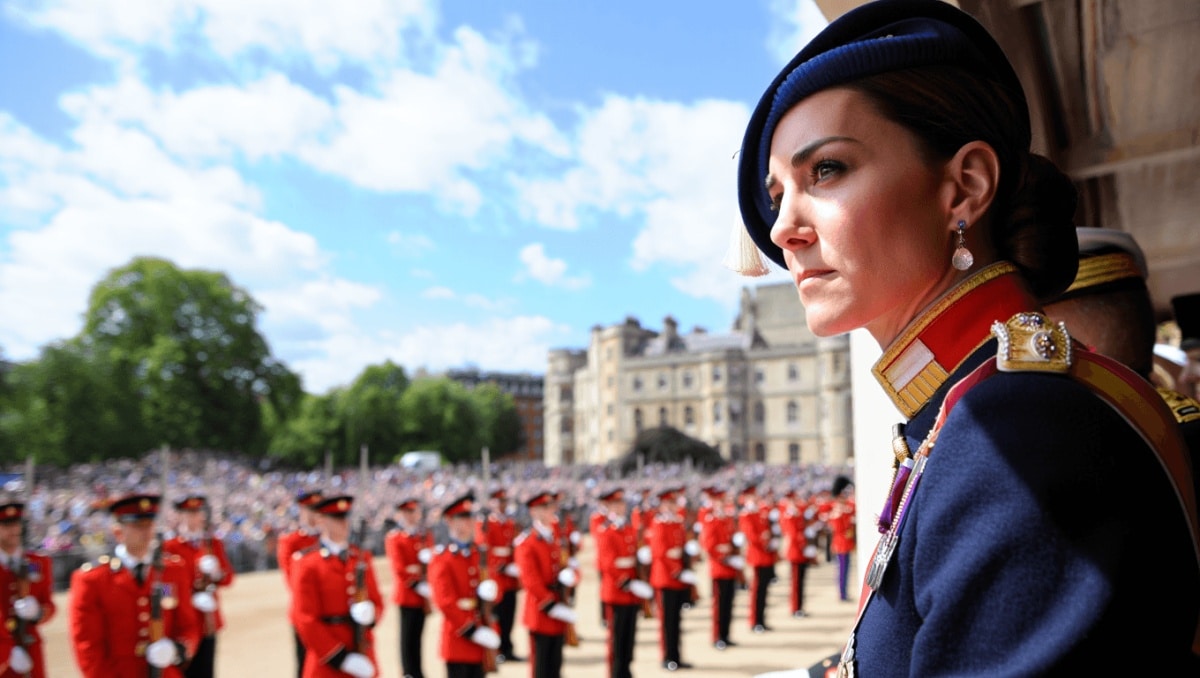
At Saturday’s Trooping the Colour, the Princess of Wales made a quietly deliberate nod to her late mother‑in‑law, a gesture that drew attention without spectacle. The moment underscored how symbolism in royal dress and posture continues to shape public conversation about the monarchy.
The annual Trooping the Colour is as much a display of continuity as it is a military parade, and this year the Princess of Wales used that platform to reflect a lineage of royal style and public memory. Observers noted subtle cues — in posture, placement and overall presentation — that echoed the late Princess Diana’s well‑known approach to ceremonial duties, prompting renewed discussion about legacy and perception at key royal events.
Fashion and protocol have long been instruments of messaging for the royal family. When a senior royal references a predecessor through wardrobe or ceremony, the effect can be immediate: headlines, social‑media commentary and analysis about what the gesture means for both the family and the wider public.
Why the homage matters now
At a moment when public attitudes toward the monarchy remain closely watched, small, nonverbal gestures serve multiple purposes. They can reassure supporters, signal continuity to institutions and evoke personal memory for a generation that still remembers Diana vividly. For the Princess of Wales, who occupies a highly visible role within the institution, these choices carry symbolic weight.
- Visibility: Trooping the Colour places royals on a global stage; even understated references are amplified.
- Legacy continuity: Echoing Diana’s public persona reinforces an enduring narrative about the family’s commitments and values.
- Public sentiment: Such gestures can shape how different audiences relate emotionally to the monarchy.
- Media framing: Journalists and commentators use these moments to frame broader stories about the royal household’s direction.
Past instances have shown that sartorial echoes are rarely accidental. The Princess of Wales has on occasion drawn on familiar elements of royal dress that the public associates with Diana, creating an immediate visual link without overt statement. That pattern continued at Trooping, where restraint itself became the message.
What happens next matters as well. Quiet tributes set expectations for future ceremonial moments — state engagements, commemorations and public appearances — where symbolism will again be parsed for meaning. For royal observers and the general public alike, the choice to nod to Diana at a high‑profile national event invites ongoing attention to how the royal family balances heritage with the pressures of modern visibility.
For readers watching how the monarchy evolves, this Trooping moment offers a clear reminder: in the royal arena, small details are rarely small in impact.