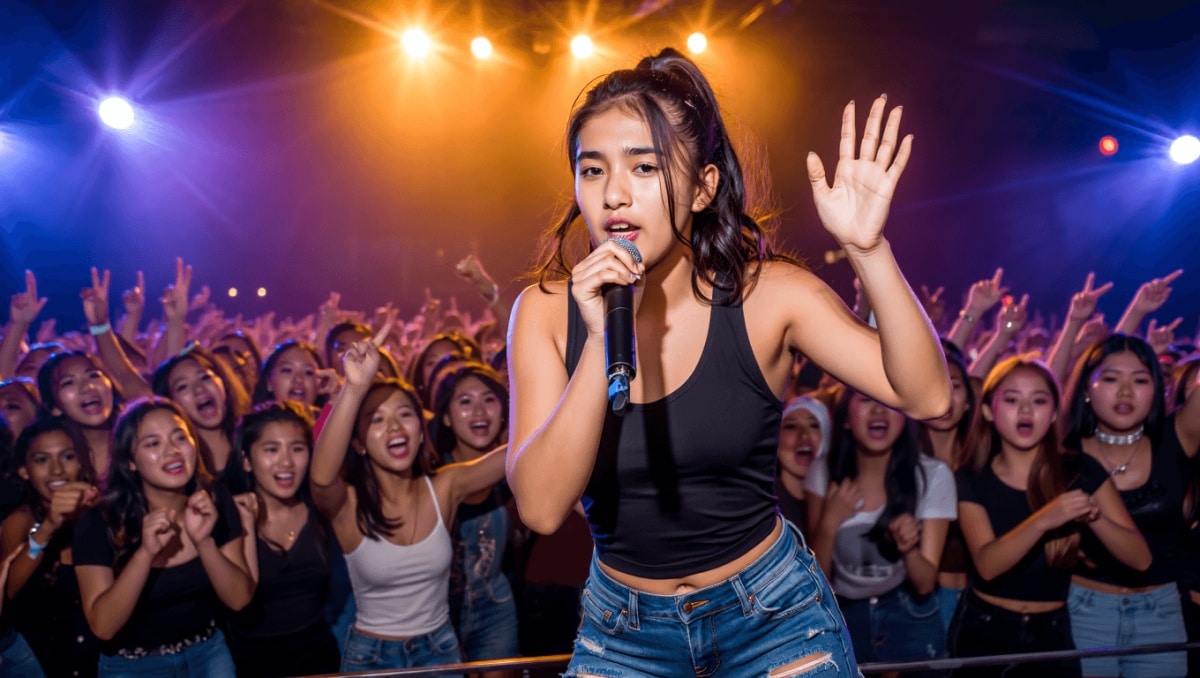
As she shifts from sold-out arenas to headline festival stages, LANA is reframing what pop-rap performance can mean for young women in Japan — and why emotional education matters as much as vocal skill. In a recent conversation she described how solitude, collaboration and a refusal to live by other people’s expectations are shaping both her music and her public role.
Teaching what schools don’t
LANA says the messages she receives from fans often point to a single shortfall: young people lack practical guidance for inner life. She argues that schools should offer basic courses on emotional self-care, financial literacy and the value of counseling — the kinds of lessons that could prevent the drift into harmful behaviour she sometimes sees among peers.
That gap is not academic for her. Writing and performing have become a way to pass on the skills she wishes someone had handed her: how to sit with difficult feelings, how to respond rather than react, and how to keep a sense of identity in a noisy, judgmental world. Music, she suggests, can be an informal classroom.
On solitude, therapy and emotional rhythm
She still sees a therapist intermittently and is candid about the search for the right fit. LANA describes her emotional life as cyclical — a pattern of ups and downs that return in seasons — and says cultivating the endurance to live through low points has been essential.
Her practice is simple and pragmatic: when she’s elated she tries to savor it; when she feels low she leans on other people’s warmth. The lesson she wants listeners to take away is not optimism for its own sake, but the development of coping mechanisms that make people more resilient in everyday life.
Why she largely avoids social media
LANA no longer follows the online chatter around her. She credits the decision with preserving mental space and allowing her to stop performing a version of niceness she didn’t mean. Cutting out constant feedback, she says, has been key to refining her public persona — and to focusing on the craft of songwriting.
Artistic focus after rapid growth
2025 has been a landmark year: solo dates at the historic Nippon Budokan, arena shows and major festival appearances. Despite the scale, LANA emphasizes a return to fundamentals. “At the end of the day, my job is to deliver songs,” she told the interviewer, explaining that no amount of spectacle replaces the need for strong material and authentic expression.
That emphasis is visible onstage: even highly produced sets, she says, should amplify what the artist carries inside rather than mask it.
Collaboration as statement: the Elle Teresa moment
Her joint performance with rapper Elle Teresa at the POP YOURS festival in May — and their new single “Konna Hi wa” — drew attention not only for the music but for the symbolism of two different female voices sharing a spotlight. LANA described the collaboration as both intimidating and liberating: working with an artist she admired since adolescence forced her to confront expectations and, in her view, sent a clear message about solidarity.
Audience reactions were mixed, she acknowledged, but the visual of two women from different corners of the scene walking the stage together carried its own impact. For LANA, that moment was as much about representation as it was about sound.
Spending time with Elle offstage — shopping, eating and simply getting to know one another — revealed to LANA how differently two confident women can build their identities within the same cultural lane.
Gendered pushback, and a response
Questions about bias in music production and daily life are frequent. LANA recounts examples of gendered assumptions she encounters, from subtle commentary about how women should behave to more explicit attempts to control or minimize female performers.
Her answer is defiant but pragmatic: rather than internalize slights, she meets them with doubled resolve. That attitude, she believes, helps explain why her audience has broadened to include more male listeners — a sign, she hopes, that cultural expectations are slowly shifting.
Creating space for women behind the camera
One persistent gripe is underrepresentation: LANA has worked on sets with few or no women in creative roles, which she says changes the outcome of visual projects. When female creators do appear, she finds collaboration both energizing and efficient. Projects with artists such as Awich and Elle feel, to her, like purposeful alliances that encourage others to step forward.
- Emotional education: LANA wants schools to teach students how to manage loneliness and seek help.
- Therapy as tool: She attends sessions periodically and sees them as part of a larger resilience practice.
- Deliberate privacy: Avoiding social media helps her protect creative focus.
- Public solidarity: Collaborations with female MCs are chosen partly for their cultural statement.
| Year / Event | What happened | Why it matters |
|---|---|---|
| 2025 — Nippon Budokan | Solo shows and arena dates | Marks rapid mainstream growth and a return to song-focused performance |
| May 2025 — POP YOURS | Debuted collaboration with Elle Teresa (“Konna Hi wa”) | High-visibility moment for female solidarity in hip-hop |
| Upcoming — Women In Music: EQUAL STAGE | Planned performance centered on women’s empowerment | Opportunity to present LANA’s aesthetic and messaging to new audiences |
Looking ahead, LANA says she plans to keep her performances grounded in personal truth while continuing to build networks with other women in music. Her aim is pragmatic: craft songs that matter, create stages where diverse voices meet, and nudge audiences — young and old — toward learning to sit with themselves rather than escape.