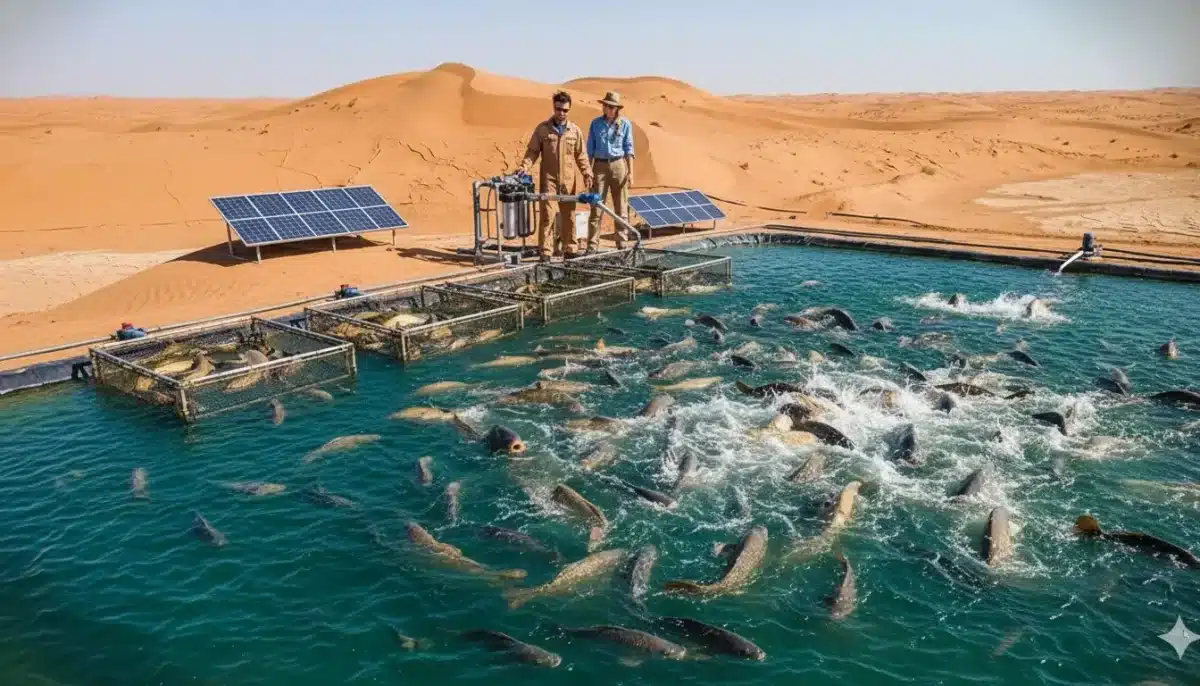
For millennia, the Taklamakan Desert has been the nightmare of Silk Road merchants, one of the world’s most hostile environments with its shifting dunes and merciless climate. Yet today, in 2026, this impossible landscape has undergone a radical transformation. Where absolute aridity once reigned, vast basins now stretch across the horizon. China has pulled off what seemed unthinkable: turning this sandy hell into a thriving seafood production hub that’s redefining how we think about modern aquaculture.
From Desert Graveyard to Industrial Wonder
The name Taklamakan itself, derived from Uyghur, suggests a place from which no one returns. For thousands of years, travelers understood this warning well. The desert was something you absolutely had to navigate around if you hoped to survive. But by 2026, the picture had completely changed.
What makes this achievement even more stunning is that it’s not merely an industrial daydream anymore. It’s a tangible reality that challenges everything we thought we knew about geography’s constraints on food production. China didn’t just build farms in the desert; they engineered an artificial inland sea where nothing should exist.
Engineering Against Nature: The Technology Behind the Miracle
Producing fish in Xinjiang isn’t simply a matter of irrigation. The real challenge runs much deeper. The soil there is saturated with salt and alkaline compounds, making conventional agriculture almost impossible. Chinese engineers faced an obstacle that would have defeated traditional farming approaches.
Their solution was ingenious: ultra-sophisticated recirculating aquaculture systems. The concept works by recovering water from saline groundwater aquifers and treating it chemically to reproduce the exact composition of seawater. By carefully adjusting pH and salinity levels, engineers create a custom environment for marine species like grouper and vannamei shrimp.
This approach transcends geographic limitations entirely. The technology maintains water at constant temperature despite the brutal temperature swings of the desert climate. It’s a delicate dance between fine chemistry and thermal management, and it’s working at an astonishing scale. In 2024, Xinjiang’s aquaculture production reached an impressive 196,500 tonnes.
The Strategic Imperative
Why push so relentlessly to raise seafood where nothing grows? The answer is fundamentally strategic. For China, reducing dependence on seafood imports and deep-sea fishing is a national priority. This ambitious project aims to create an artificial inland sea that supplies fresh fish to local populations without requiring shipments to traverse the entire continent from eastern coastal regions.
The water supply, while limited, proves constant and renewable through an unexpected source: meltwater from glaciers in the surrounding mountains feeds the Tarim Basin. This provides just enough resources to sustain these operations.
The Long-Term Question Mark
Yet this technical feat raises serious concerns about sustainability. The Taklamakan receives less than 100 millimeters of precipitation annually, and evaporation is massive. Maintaining these basins requires pumping from underground reserves that replenish extremely slowly. The industry watches with a mixture of fascination and apprehension as this transformation unfolds.
If this model proves reproducible without depleting groundwater aquifers, it could mark the beginning of a new era for the global food industry. For now, Xinjiang remains an open-air laboratory, an audacious attempt to master one of the planet’s most hostile environments. The stakes go far beyond fish production: this is about proving that technology can literally create life from nothing.