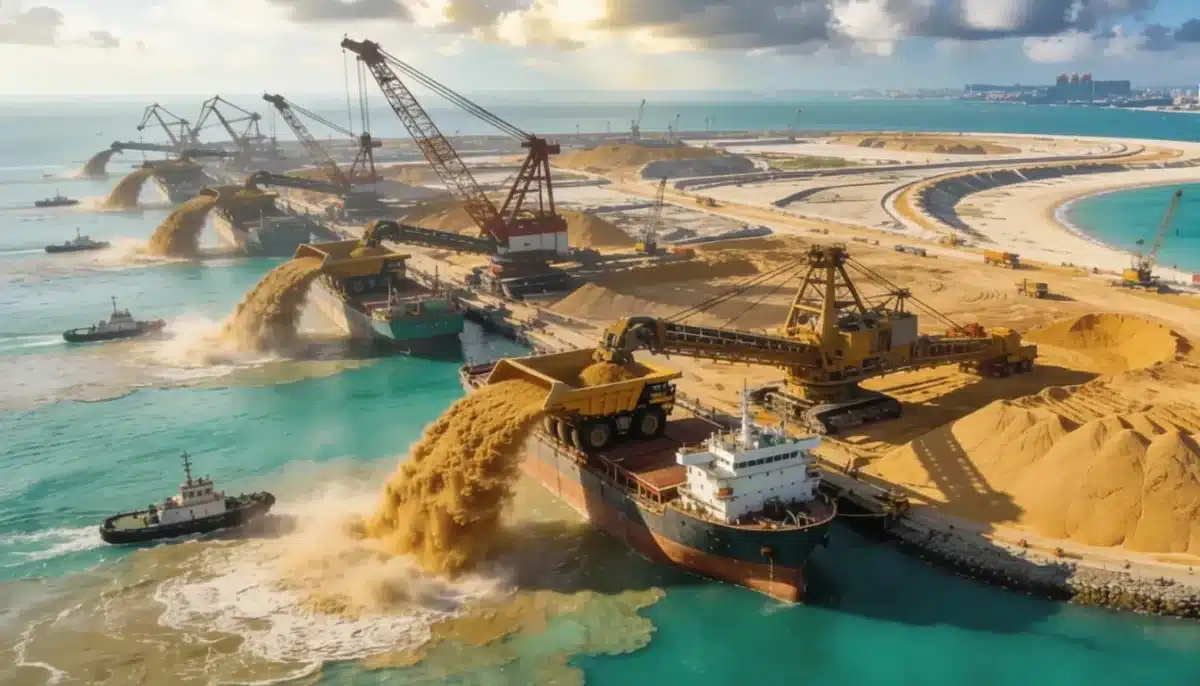
In just over a year, China transformed seven coral reefs into artificial islands by dumping millions of tons of sand into Southeast Asian waters. What started as an unprecedented engineering feat has evolved into a geopolitical powder keg, complete with environmental devastation and competing territorial claims.
The Birth of an Island Empire
Late 2013 marked the beginning of China’s ambitious island-building campaign. The country launched what the U.S.-China Economic and Security Review Commission would call an operation without precedent: the massive filling of seven coral reefs in the Nansha and Xisha archipelagos, known in the West as the Spratlys and Paracels. Between December 2013 and June 2015, China completed the first phase of its expansion drive. The numbers tell a striking story. More than 12 square kilometers of artificial land emerged in less than 20 months. To put that in perspective: it represents 17 times more territory than all neighboring countries combined managed to claim over the preceding 40 years.
The speed was staggering. The scale was immense. And the implications were unmistakable. Satellite imagery captured the transformation as it happened, with Google Earth archives now offering anyone the chance to witness the before-and-after of this maritime overhaul.
How Sand Becomes Strategy
The engineering method isn’t particularly sophisticated, but its execution is massive. Chinese teams first dredge the coral seabed, then pump the extracted sediments from shallow areas. This material deposits gradually, reinforced by retention discs and walls. Giant compactors and mechanical excavators then consolidate everything, lending structural stability. Finally, surfacing work begins: paving, roads, and runways for both transport and combat aircraft. It’s a straightforward formula applied with extraordinary force.
Since 2015, Beijing hasn’t paused. The country continues consolidating these new territories with strategic infrastructure:
- Landing strips
- Hangars
- Military ports
- Radar installations
Satellite images reveal relentless activity, and the transformation itself has become a visual metaphor for Chinese ambition: islands literally emerging from nothingness in real time.
The Official Story versus Regional Reality
China’s government presents a peacetime narrative. According to Beijing, these islands serve maritime rescue operations, fishing support, scientific research, secure navigation via radar systems, and meteorological data collection. And naturally, national defense when needed.
The region’s neighbors aren’t buying it. Vietnam, Taiwan, Japan, and the Philippines view this expansion as a unilateral attempt by Beijing to impose sovereignty over contested waters. Japan’s Defense Ministry is more blunt: these infrastructures allow China to establish a permanent and offensive presence throughout the South China Sea.
Recent 2025 reports from the Center for Strategic and International Studies strengthen this interpretation. They emphasize that China’s quasi-permanent logistical capacity in the region depends entirely on these construction projects launched a decade ago. Western analysts have detected runways suitable for fighter jets, ports for naval vessels, underground facilities, and possibly even missile launch platforms.
The tension is escalating further. Vietnam itself has followed China’s lead since 2013, dumping sand into the strait. What’s unfolding resembles a speed race to fill the seas, turning Southeast Asia into a genuine geopolitical pressure cooker.
The Silent Casualties
Beyond geopolitical calculations lies a brutal reality: these islands are killing ecosystems. Between 12 and 18 square kilometers of coral reefs, among the best preserved in the region, have been destroyed. Worse, sediment clouds released during dumping degrade zones far beyond the immediate construction site, disrupting currents and sediment deposit cycles across a broader area.
Even Chinese scientific studies acknowledge the damage: marine life is annihilated in affected zones, and impacts extend across entire ecosystems. China’s Ocean Administration offers partial pushback, claiming all projects underwent rigorous evaluation and cause no coral degradation. Instead, it points toward broader culprits: ocean acidification and climate change.
The irony is difficult to ignore. Islands rise. Life vanishes. And the world watches, fascinated and troubled in equal measure.