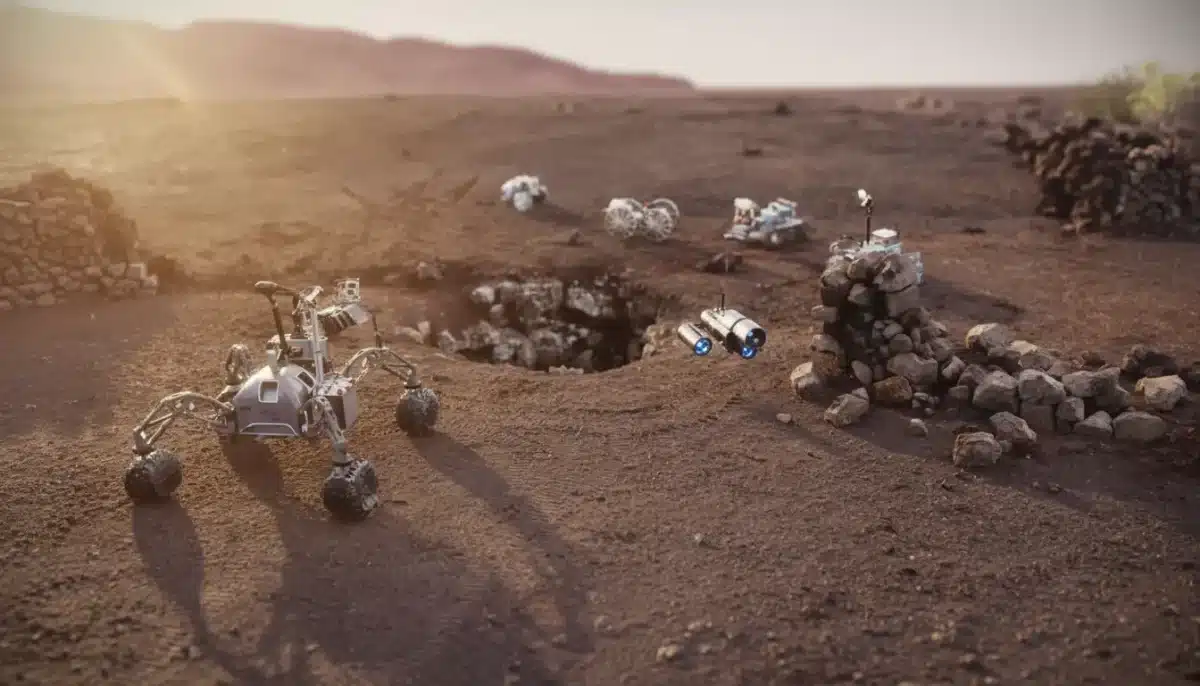
Three robots recently descended into a volcanic tunnel on the Spanish island of Lanzarote, not for a vacation but on a mission that could reshape humanity’s future among the stars. They were hunting for the perfect hideouts for space bases on the Moon and Mars, testing technologies that may one day shelter human colonists on hostile alien worlds.
The Challenge Ahead for Space Exploration
With the Artemis II mission aiming to return humans to the Moon more than half a century after the last Apollo landing, space agencies are intensifying their search for ways to reach and survive on other planets. The obstacle is formidable: space itself, and destinations like Mars, are brutally inhospitable to life. This is where space robotics becomes essential, serving as scouts and builders in environments where humans cannot yet venture.
A European research team, including the European Space Agency (ESA), took a decisive step by deploying an autonomous robotic system into a volcanic lava tunnel at Lanzarote. Their findings, published in Science Robotics, bring us measurably closer to the reality of future colonization on the Moon or Mars.
Nature’s Underground Bunkers
The Moon and Mars are far more than barren, flat deserts. Both worlds are volcanic in nature, riddled with vast underground cavities carved out millions of years ago by flowing lava. These aren’t small caves. Thanks to the low gravity on these planets, these formations reach dimensions measured in kilometres, offering enough space to house entire cities.
Similar structures exist right here on Earth. Lava tunnels appear in Hawaii and the Canary Islands, precisely where this research took place. The La Corona lava tunnel at Lanzarote boasts sections measuring 30 metres wide and tall, making it as cavernous as a cathedral. By studying these terrestrial equivalents, researchers gained invaluable insights into the chambers waiting to be explored on distant worlds.
Space presents an unforgiving environment. Extreme temperatures, intense radiation, and meteor showers create a hostile cocktail that makes survival difficult and the establishment of human bases challenging. Lava tunnels, however, offer strategic advantages. Their thick rock walls provide natural shielding against ionizing radiation, extreme thermal flux, and impacts from space debris.
Robots as Underground Explorers
The three different robots deployed into La Corona tunnel faced a demanding test. Lacking GPS and sunlight, they carried out a characterization mission under conditions that mirrored what future machines would encounter on the Moon or Mars. Creating 3D maps as they progressed through the darkness was just one of their objectives, with the mission technically directed by Germany’s Centre for Artificial Intelligence.
What set this mission apart was not just what the robots accomplished, but how they did it. These were not remotely controlled machines piloted from a control room. Instead, they operated autonomously, making real-time decisions without constant human guidance. This capability to collaborate independently is fundamental, because radio signals from Earth to Mars take several minutes to arrive, making real-time remote control impossible.
Future robot generations will have an expanded mission: exploring Martian and lunar tunnels to assess their conditions and search for any remaining traces of life or frozen water. These subterranean vaults represent the ideal hiding spots for such discoveries, protected from the harsh surface environment.
Progress and Promise
The heterogeneous and cooperative robotics test proved successful, demonstrating that autonomous systems can navigate, collaborate, and map alien terrain without direct human intervention. Yet challenges remain. Navigation in complete darkness and sensor reliability amid environmental interference still need refinement before robots are ready for their real mission on distant worlds.
Standing on Lanzarote’s alien-looking landscape, one realizes why researchers chose this location. It mimics another world. And with each successful test, humanity edges closer to turning underground bases from science fiction into engineering reality.