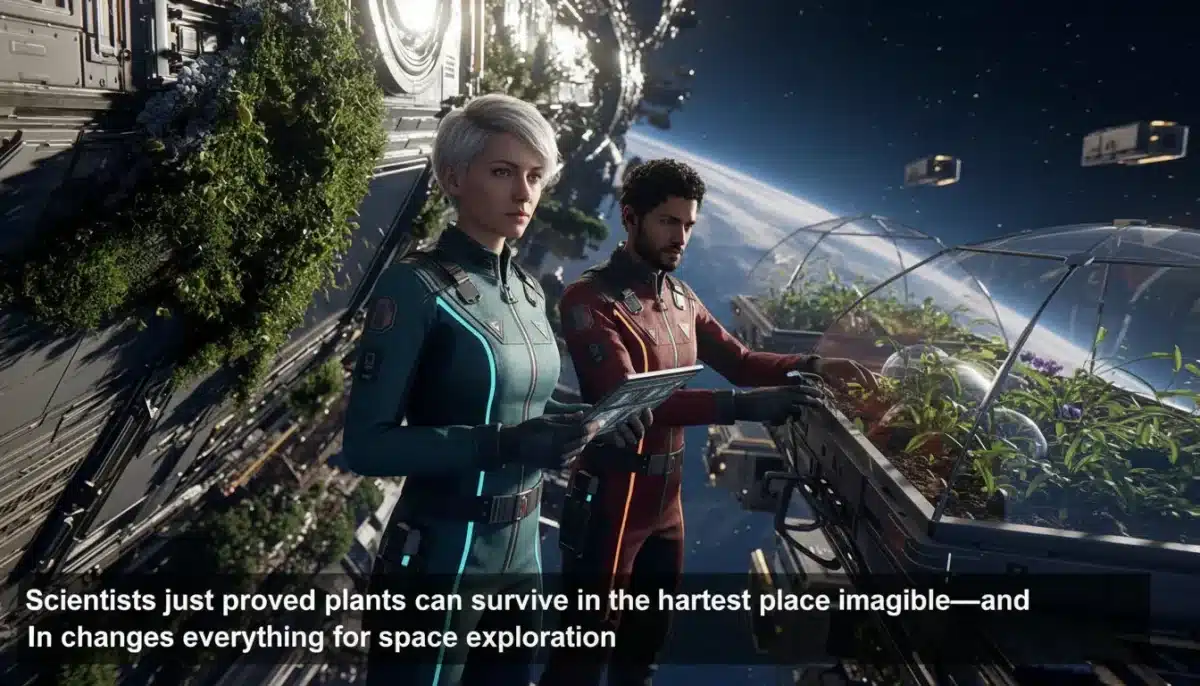
A moss sent to the outer reaches of the International Space Station just proved that life on Earth can survive in one of the cosmos’s most brutal environments—and the findings could revolutionize how we explore and colonize space.
We’ve long known that tardigrades, those nearly indestructible microscopic creatures, can withstand the vacuum of space. But what about Earth’s plants? Until recently, that question remained wide open. A groundbreaking experiment conducted outside the ISS has now answered it, revealing surprising truths about how terrestrial vegetation adapts to the cosmic inferno.
The Experiment: A Botanical Astronaut Takes Flight
Researchers sent a “vegetable astronaut” on a mission to test the absolute limits of biological life against the void. Rather than nurturing the moss in the cozy, pressurized modules of the station, scientists attached it directly to the ISS’s exterior hull. There, it faced lethal radiation and extreme temperatures for an entire year.
The organism chosen for this audacious test was Physcomitrium patens, a moss species. Scientists selected it deliberately, drawing on prior knowledge of its remarkable resilience in Earth’s deserts and Arctic regions. But space presents an entirely different level of stress. In March 2022, samples were dispatched to the ISS via a Cygnus resupply capsule. Once aboard, the spores were positioned on the exterior and left exposed for 283 days.
Against All Odds: Life Survives
Researchers initially expected survival rates near zero. The reality proved shockingly different. The majority of spores not only survived the ordeal but thrived. More than 80 percent were able to regenerate once returned to Earth, and they reproduced normally afterward.
This experiment marks the first time scientists have demonstrated that a primitive terrestrial plant can endure prolonged exposure in space. The moss’s exceptional resilience likely stems from two key mechanisms: ultra-efficient DNA repair systems and a protective spore structure that functions like biological armor against external assault.
Using mathematical modeling, researchers estimated something even more remarkable. These spores could theoretically survive approximately 5,600 days in space, roughly 15 years, with no protection whatsoever.
Reshaping Space Exploration and Settlement
The implications are staggering. If plant life can persist in the void for such extended periods, it opens doors previously thought sealed. Vegetation could potentially travel between planets and flourish once deposited in favorable environments. This suggests tantalizing possibilities for greening other worlds.
Beyond the achievement itself, this discovery offers weighty support to the ancient theory of panspermia. This hypothesis, dating back to antiquity, proposes that life on Earth may have originated from extraterrestrial contamination—organisms traveling aboard comets or meteorites. Imagine if our future Martian gardens were simply life returning to its cosmic origins. Nothing prevents us from dreaming.
The study fuels serious hopes for exobiology. What we’ve learned from a single moss could fundamentally alter humanity’s future in space, transforming how we approach long-term settlement beyond Earth and reshaping our understanding of life’s resilience across the cosmos.