Show summary Hide summary
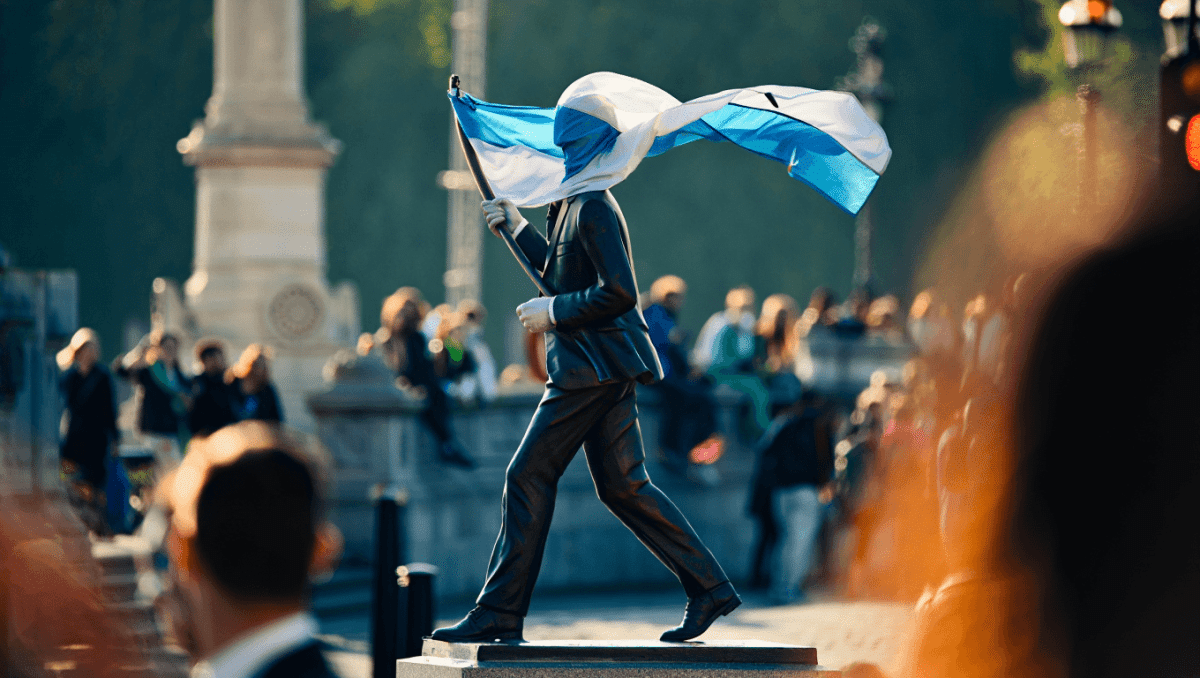
Banksy just shocked London with a striking new statue at Waterloo Place. The fiberglass sculpture depicts a suited man marching forward, blinded by a billowing flag across his face. Artist confirmed it hours after the overnight installation.
🔥 Quick Facts
- Location: Waterloo Place, St James’s, London central
- Installation Date: Overnight on April 30, 2026
- Artist Confirmation: Posted on Instagram April 30 with signature mark
- Material: Fiberglass construction, life-sized sculpture
A Statue Steps Into Controversy
Banksy appears on central London’s most imperialism-laden street. The Waterloo Place location was specifically designed in the 1800s to celebrate military dominance and imperial power. His new work sits among historic war monuments, creating instant tension. The suited figure walks purposefully off a stone plinth, completely obscured by a massive flag. Viewers immediately recognized the artistic message.
The overnight installation used a low-loader truck and what Banksy described as “the sort of dudes who can set up a Metallica concert in 24 hours.” The operation happened in darkness, avoiding detection until morning. By dawn, crowds had already gathered around the controversial sculpture.
Banksy statue appears at Waterloo Place in London, depicts man blinded by flag
Season finale: Watson wraps series tonight on CBS at 10 p.m. with murder mystery
Blind to Everything Except the Flag
Art critics immediately decoded the powerful symbolism embedded in this work. The man’s face is completely hidden behind a wind-blown flag covering his eyes, nose, and mouth. He strides confidently toward what appears to be danger, completely unaware. The flag obscures his vision entirely. Many observers interpreted this as a direct critique of blind nationalism and blind patriotism.
Global nationalism has intensified in recent years, making this timing particularly pointed. The sculpture speaks to how extreme loyalty to flags and nations can blind people to reality. Some called it “Blind Patriotism,” while others named it “Blind Nationalism.” The message resonated instantly with thousands who flocked to Waterloo Place.
Installation Details and Public Reception
| Detail | Information |
| Appearance Date | April 30, 2026, after dark |
| Confirmation | Instagram post April 30 with Banksy signature |
| Location Details | St James’s, among imperial war monuments |
| Material | Fiberglass, life-sized standing figure |
“We welcome Banksy’s latest sculpture in Westminster, which makes a striking addition to the city’s vibrant public art scene.”
— Westminster City Council, Official Statement
Will London Officials Remove This Bold Artwork
Westminster City Council moved quickly to protect the artwork. Unlike previous controversial pieces, they announced no removal plans. Officials praised it as a striking public art addition to London’s cultural landscape. The Metropolitan Police received a report of criminal damage but took no enforcement action.
This represents a significant shift in how London treats street art. Recent years saw Robert Milligan statues removed for colonial ties, making Banksy’s work particularly relevant. The council’s protective stance suggests they recognize the statue’s cultural and artistic merit. Tourists and Londoners continue visiting daily to photograph and discuss its meaning.
What Makes This Banksy Moment Different from His Earlier London Works
The permanence question has shifted for Banksy in 2026. His earlier pieces faced threatened removal or street-cleaning overnight destruction. This monumental three-dimensional sculpture demands different treatment than murals. The artist clearly intended this work to provoke sustained reflection, not days of viewing before erasure. London’s embrace of the statue marks changing public attitudes toward political street art.
Crowds gather daily at this location despite unpredictable London weather. The flag-wielding figure has become an accidental tourist attraction and debate center. Online conversations continue multiplying across social media platforms analyzing the artwork’s significance. Future art historians will likely point to this moment as when Banksy moved from walls to public monuments.
Sources
- BBC News – Coverage of Banksy statue confirmation on April 30, 2026
- Smithsonian Magazine – Detailed analysis of the sculpture’s artistic significance and interpretation
- NPR – Report on Westminster City Council’s decision to preserve the artwork