Show summary Hide summary
CBS Sunday Morning reveals how overtourism is destroying some of Europe’s most treasured cities. 30 million visitors flood Venice annually while residents flee. From Paris to Amsterdam, travel’s dark side is reshaping iconic destinations.
🔥 Quick Facts
- Global Impact: Tourism now represents 10% of global economy, one in ten jobs worldwide
- Venice Crisis: About 30 million tourists visit Venice yearly, roughly 600 times the local population
- Amsterdam Record: 23 million tourists in 2024 in a city with fewer than one million residents
- Access Fees: Venice charges 5 to 10 euros for daytrippers at peak times to manage crowds
Social Media Sparked a Tourism Explosion
When Paige McClanahan, author of “The New Tourist,” analyzed tourism’s growth, the numbers shocked researchers. In 1950, just 25 million tourists traveled worldwide annually. Today, that figure exceeds 1.5 billion. Social media fueled this explosion.
McClanahan stated that guidebooks, low-cost airlines, and platforms like Instagram transformed travel from luxury to daily experience. Influencers curate perfect shots, but crop out the crushing crowds beneath. “Where neighborhoods serve tourists more than residents, problems emerge,” she explained during interviews with the correspondent.
CBS Sunday Morning explores overtourism’s toll on Venice, Amsterdam, Paris
Sharon Stone shares unfiltered bikini photo at 68, makeup-free poolside pic on Instagram
The consequences are devastating. A canyon in Iceland closed after Justin Bieber filmed there. Italian farmers installed turnstiles to charge for Instagram-worthy views. Venice decided to charge visitors. None of these were planned city responses. They were desperate reactions.
Venice Sinking Under Its Own Popularity
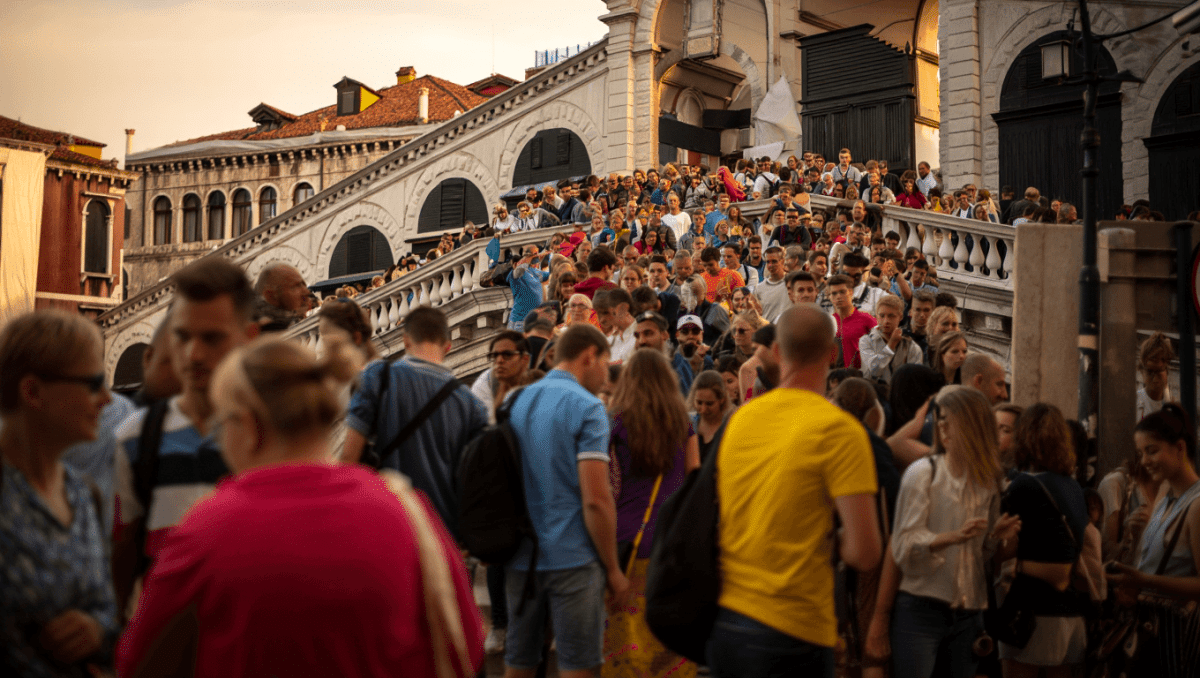
Venice exemplifies overtourism’s catastrophic impact better than any destination globally. The UNESCO World Heritage city attracts roughly 30 million visitors yearly. Its entire population in the historic center? A mere 50,000 people.
The city has attempted multiple restrictions. Cruise ships are now banned from entering the lagoon entirely. Venice implemented a 5 to 10 euro daytripper fee during peak hours on specific dates. Yet visitors still arrive relentlessly. Rising sea levels from climate change compound flooding risks, making Venice physically vulnerable as tourism multiplies strain.
Depopulation accelerates yearly. Young residents relocate seeking affordable housing and decent employment. “Venice is sinking under the weight of popularity,” experts now say plainly. The city becoming a theme park erodes authenticity visitors originally sought.
Amsterdam, Paris, and Portofino Fight Back
| City | Annual Visitors | Response Strategy |
| Amsterdam | 23 million (2024) | 12.5% tourist tax (highest in Europe) |
| Paris | 20+ million annually | Louvre employee strikes highlight capacity crisis |
| Portofino | TBA | Bans barefoot, shirtless visitors, €500 fine |
Amsterdam grapples with contradictions. Ten years ago, the “I amsterdam” marketing campaign succeeded brilliantly. Tourists flooded in. The city then launched campaigns discouraging rowdy visitors. Edwin Scholvinck, a 33-year resident of Amsterdam’s famous red-light district, sadly reported that friends stopped visiting. “Too many tourists,” he said simply. Bars now close earlier. Guided tours are banned in the neighborhood.
Paris faces similar pressure at the Louvre, the world’s most-visited museum. In June 2025, employees struck due to inability to manage crushing crowds. McClanahan called the Louvre “iconic and emblematic of pressures cities now face.” Portofino introduced startling rules: no barefoot walking, no shirtless people during peak hours, and no ground sitting in main streets. A €500 fine awaits violators.
“Tourism is having a coming-of-age moment, where destinations realize tourism needs regulation, taxes, urban planning laws, and physical infrastructure. Travelers are also waking up to the impact of our presence.”
— Paige McClanahan, Author, “The New Tourist”
Can Tourism Become a Force for Good
Spain removed tens of thousands of illegal Airbnbs and introduced taxes that decrease if visitors stay longer. The strategy encourages extended tourism rather than quick, high-volume visits. Economist Jasper van Dijk from Utrecht University argues Amsterdam’s measures lack sufficient force. The city originally capped tourists at 20 million. Amsterdam exceeded that and residents sued. Even Europe’s most aggressive tourist tax at 12.5 percent isn’t stopping growth.
McClanahan advocates for stronger tourism taxes as the sexiest policy solution. But beyond taxation, each community needs tailored approaches. Tours That Matter, founded by Anouschka Trauschke, guides visitors to less-trafficked neighborhoods. We Live Here campaigns remind tourists that residents live here too. These efforts represent cultural shifts, though they feel insufficient against 20+ million annual arrivals.
What Happens When Travelers Take Responsibility
The documentary showed something critical. Locals aren’t blaming tourists personally. They’re blaming systemic tourism. When Portofino’s Police Commander Chiarello Giuseppina explained new rules, visitors understood. “People comprehend we’re in a famous center requiring respect,” she observed. No complaints. Behavioral change happens when travelers grasp their collective impact.
McClanahan ended observations with a powerful statement. Whether tourism becomes constructive or destructive depends entirely on travelers themselves. “If we treat tourism with responsibility and scrutiny it deserves, we can turn it into a force for humanity,” she emphasized. CBS Sunday Morning‘s investigation documented the stakes. The choices we make about how and where we travel will determine whether Venice survives, whether Amsterdam remains livable, and whether Paris thrives as a city or becomes purely a museum.
Sources
- CBS News Sunday Morning – Correspondent Seth Doane’s investigation into overtourism across European cities
- Paige McClanahan – Author of “The New Tourist: Waking Up to the Power and Perils of Travel”
- European Tourism Analysis – WHO and city tourism data showing visitor impacts across Venice, Amsterdam, Paris, and Portofino