Right now, astronauts aboard the International Space Station are conducting critical medical tests and studying microorganisms in the harsh space environment. The Expedition 74 crew of seven astronauts is collecting biological samples to understand how microgravity affects human health. These groundbreaking experiments could transform medicine on Earth.
🔥 Quick Facts
- Expedition 74 Crew: Seven astronauts conducting health and microbiology research aboard the ISS today
- Primary Focus: Medical tests and microbiology dominate the research schedule for crew members
- CIPHER Study: Measures astronaut health before, during, and after spaceflight to study microgravity effects
- Orbital Altitude: Research conducted at 250 miles above Earth at 17,500 miles per hour
Astronauts Tackle Critical Health Tests in Microgravity Today
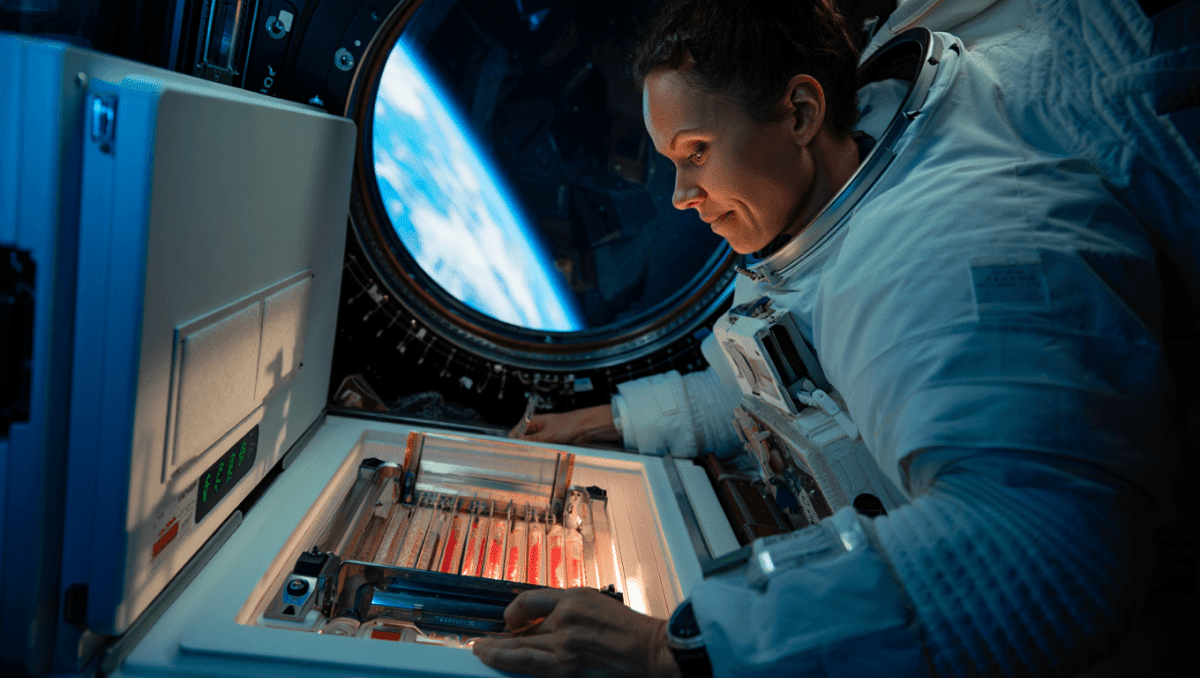
The International Space Station crew kicked off their shift with essential medical assessments. NASA flight engineer Chris Williams drew blood samples from Jessica Meir, processing them in a centrifuge for preservation in an ultra-cold science freezer. Williams later collected his own urine samples, continuing participation in the CIPHER study that monitors astronaut wellness during spaceflight. These biomedical samples provide doctors with continuous insights into how microgravity impacts human physiology and bone density.
The seven crewmates maintain rigorous health monitoring protocols. Scientists analyze samples constantly to understand muscle atrophy, fluid shifts, and cardiovascular changes. This research directly benefits patients on Earth facing similar health challenges. The data collected helps NASA prepare for longer missions to the Moon and Mars, ensuring astronaut safety during extended space travel.
Microbiology Research Reveals Space Station’s Hidden Ecosystem
Station commander Sergey Kud-Sverchkov and flight engineer Sergei Mikaev collected microbe samples from multiple modules including Nauka, Zvezda, and Zarya. These samples will be analyzed to map the orbital outpost’s microbial environment and understand how microorganisms thrive in weightlessness. Scientists have discovered over 100 new bacterial species from ISS environments, some with unique characteristics adapted to microgravity conditions. Understanding these microbes protects both crew health and station hardware from contamination.
Recent studies show that bacteria behave differently in space than on Earth. The International Space Station serves as a natural laboratory for studying microbial metabolism and evolution. Researchers are examining how viruses interact with bacteria in weightlessness, revealing surprising genetic adaptations. This knowledge could revolutionize how we approach antibiotic resistance and develop new medicines for treating infections.
Daily Operations Keep Space Station Running Smoothly
| Task | Crew Members | Purpose |
| Blood and Urine Collection | Chris Williams, Jessica Meir | CIPHER health study analysis |
| Cargo Consolidation | Jack Hathaway, Jessica Meir, Sophie Adenot | Optimize Leonardo module storage space |
| Spacesuit Maintenance | Jack Hathaway, Jessica Meir | Prepare liquid cooling garments for future spacewalks |
| Microbial Sampling | Sergey Kud-Sverchkov, Sergei Mikaev | Collect samples from station modules |
Jack Hathaway and Jessica Meir partnered to maintain critical spacesuit components. They filled a liquid cooling and ventilation garment with water and attached shoulder pads to ensure spacewalker comfort and safety. Sophie Adenot of the European Space Agency focused on cargo consolidation in the Columbus laboratory module and checked the Exploration Potable Water Dispenser, a technology demonstration advancing water sanitization methods. Andrey Fedyaev inspected water recycling hardware and purged residual fluids ensuring life support systems function properly.
“Doctors regularly analyze a crew member’s biomedical samples collected throughout a mission, constantly gaining insight into microgravity’s effect on the human body.”
— NASA Space Station Blog, March 2026
Why ISS Research Matters for Humanity’s Future in Space
The International Space Station has been continuously inhabited for 25 years, hosting nearly 300 astronauts from around the world. Medical research aboard the orbital lab directly supports longer human spaceflight missions. Understanding how bones lose density, how muscles atrophy, and how the cardiovascular system adapts to weightlessness is essential for deep space exploration. The CIPHER study compares health data before, during, and after spaceflight, providing baseline information for future lunar missions and Mars exploration programs.
Microbiology research extends beyond protecting astronauts. Scientists use the ISS to study how organisms evolve in extreme conditions. These findings apply to developing hardier crops, creating resistant microorganisms for medical applications, and understanding life’s adaptability. The space station demonstrates how international cooperation advances human knowledge and prepares civilization for the next generation of space exploration and settlement beyond Earth.
Will These Discoveries Change Medicine on Earth?
Absolutely. Every experiment conducted aboard the International Space Station generates data applicable to addressing health challenges on Earth. Understanding bone loss in microgravity helps treat osteoporosis patients. Studying muscle atrophy in space informs rehabilitation strategies for paralyzed individuals. Cardiovascular research in weightlessness reveals how the heart functions without gravity’s constant pull, leading to new treatments for heart disease. The microbiology research is uncovering novel bacterial species with potential pharmaceutical applications, from producing new antibiotics to developing biofuels.
The seven-person Expedition 74 crew continues NASA’s legacy of pushing scientific boundaries. As they collect blood samples, analyze microbes, and maintain life support systems 250 miles above Earth, they’re paving the way for human settlements on the Moon and eventually Mars. This work proves that investing in space exploration yields tangible benefits for everyone, from improved medicines to revolutionary technologies that eventually reach our homes and hospitals.
Sources
- NASA Space Station Blog – Medical tests and microbiology research updates from Expedition 74 crew activities
- NASA International Space Station – Official ISS information on research missions and astronaut health studies
- Astrobiology Magazine – Recent findings on bacterial behavior and viral interactions in microgravity conditions