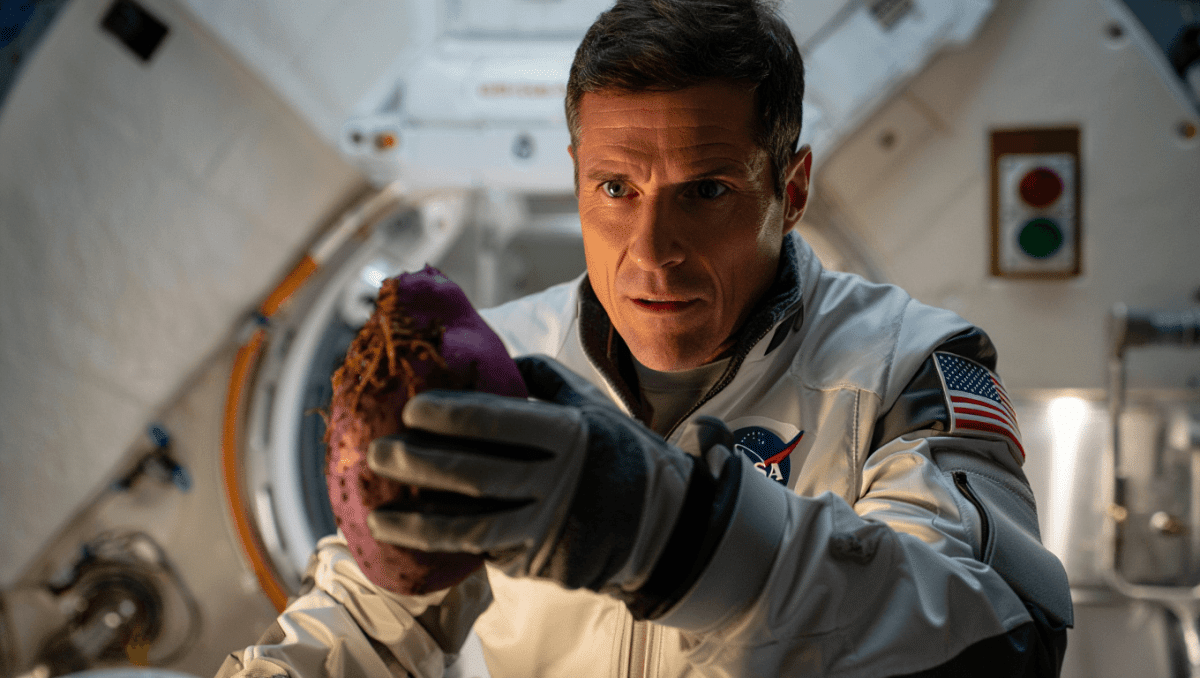
Don Pettit shared a shocking photo of a purple potato from the International Space Station, sparking viral theories about alien life. The NASA astronaut‘s image shows strange tentacle-like roots on an egg-shaped tuber. But the truth is far more terrestrial, revealing a brilliant space farming experiment.
🔥 Quick Facts
- Astronaut: Don Pettit captured the photo on Expedition 72 in March 2026
- The Object: An early purple potato nicknamed Spudnik-1, growing in a space garden
- Color Science: Purple potatoes contain high levels of anthocyanins, a natural pigment
- Future Purpose: Growing potatoes in space could sustain Mars and Moon missions
Internet Freaks Out Over ‘Alien’ Photo
When Don Pettit posted the unusual image on X (formerly Twitter), social media erupted. The purple, egg-shaped object with what appeared to be tentacles sparked wild conspiracy theories. Users joked about “killing it with fire,” imagining an actual extraterrestrial organism. Some accounts accumulated thousands of shares within hours. The photo seemed perfectly designed for viral panic. Headlines screamed about mysterious space creatures and tentacled growths.
Pettit, known for exceptional photography skills from four space missions totaling 590 days in orbit, revealed the truth within hours. The so-called alien had a very simple explanation.
Meet Spudnik-1: The Orbiting Potato
Pettit explained that the purple tuber was an early variety potato he grew during his spare time. The strange tentacle-like appearance came from roots growing outward in all directions in microgravity. The object featured a small spot of hook Velcro to anchor it safely inside his improvised terrarium. This personal space garden project had scientific purpose, not just curiosity. Potatoes represent one of the most efficient crops for space exploration missions.
The purple coloring comes from natural anthocyanins, not from space exposure or mutation. Earth-grown purple potatoes exhibit identical hues. Pettit deliberately selected an early purple variety for his experiment, combining practical nutrition with compelling visuals.
Why Grow Food in Space?
NASA, the European Space Agency, and other organizations increasingly focus on space agriculture technology. Long-duration missions to Mars and establishing permanent Moon bases demands reliable food production. Sending all nutrition from Earth becomes impossible on multi-year missions. Potatoes offer exceptional edible nutrition relative to total plant mass, making them ideal for space farming. Technologies like hydroponics and specialized grow light terrariums make cultivation feasible.
| Space Agriculture Focus | Agency or Program |
| Successful Crops (Lettuce, Peppers) | NASA Veggie and APH Programs |
| Bioregenerative Systems | European Space Agency (ESA) |
| Automated Greenhouse Techniques | German Aerospace Centre (DLR) |
| Hydroponics and Bioreactors | Multiple Agencies Combined |
“Potatoes are one of the most efficient plants based on edible nutrition to total plant mass, including roots. Recognized by Andy Weir in his book and movie The Martian, potatoes will have a place in future exploration of space. So I thought it good to get started now.”
— Don Pettit, NASA Astronaut
The Martian Effect: Inspiration from Science Fiction
Pettit directly credits Andy Weir‘s novel and film adaptation “The Martian” as inspiration. In the story, an astronaut stranded on Mars survives by growing potatoes in Martian soil. The narrative highlights how essential crop cultivation becomes during space exploration. Weir‘s science-based storytelling predicted current space agency priorities by years. Pettit’s experiment transforms fiction into practical reality aboard the ISS. His playful naming, Spudnik-1, references the Soviet Union’s historic Sputnik-1 satellite from 1957. Combining humor with serious scientific objectives creates compelling engagement.
Pettit has documented extraordinary phenomena during previous missions. He photographed comets C/2024 G3 and C/2023 A3 from orbit. He captured the stunning October 2024 aurora display from space. Yet this simple purple potato generated the most viral response, proving that human connection matters more than spectacular astronomy.
What Does This Mean for Future Space Missions?
Personal experiments like Pettit’s advance major space agency goals. NASA, ESA, Japan Aerospace Exploration Agency (JAXA), and China’s space program all prioritize food production systems. The technologies developing now will sustain astronauts on Mars expeditions lasting multiple years. Potatoes could become as essential to space colonization as they were to historical Earth exploration. Understanding how crops develop in microgravity with artificial lighting provides crucial baseline data. Every successful harvest, even tiny purple potatoes, builds the foundation for humanity’s future beyond Earth.
Sources
- BBC Sky at Night Magazine – NASA astronaut Don Pettit photography and space exploration profile
- Euronews Next – Space food-growing technology and agricultural space missions
- FOX Weather – Astronaut Don Pettit purple potato viral photo coverage