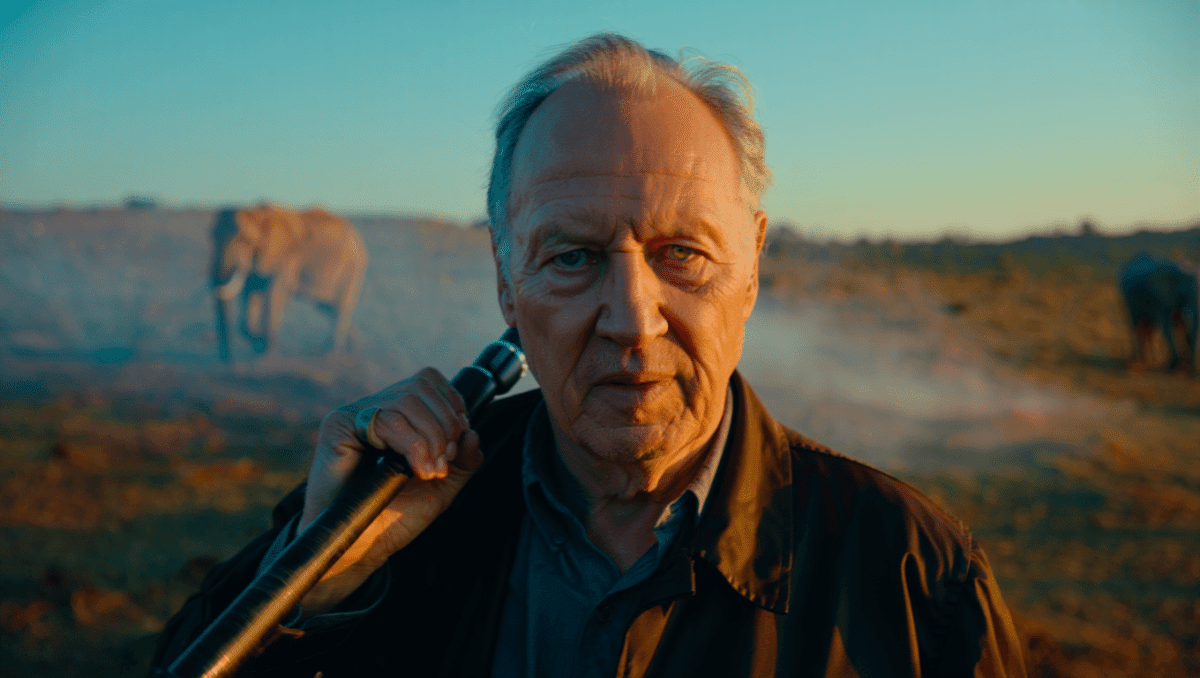
Werner Herzog just delivered a haunting meditation on obsession in ‘Ghost Elephants’ that proves the legendary filmmaker still possess his edge. The new documentary follows conservationist Steve Boyes into Angola’s remote highlands seeking creatures that may not exist, blurring the line between myth and reality.
🔥 Quick Facts
- Release Date: Premiered in theaters February 27, 2026, now streaming Disney+ and Hulu
- Runtime: 99 minutes of mesmerizing documentary craftsmanship
- Subject: Dr. Steve Boyes’ obsessive quest for giant ghost elephants in Angola
- Critical Reception: Called a fascinating meditation on human obsession and the pursuit of truth
A Filmmaker at Age 83 Still Taking Bold Risks
Werner Herzog has transformed from cinephile favorite into a genuine pop culture phenomenon, but his latest work proves he hasn’t softened with age. At a time when most filmmakers retire or recycle old themes, Herzog creates something audacious and daring. The German director focuses on what could have been a bland National Geographic feature, transforming it into a haunting exploration of obsession that resonates far beyond nature documentary conventions.
The doc doesn’t just tell a story; it questions the very nature of pursuit itself. Herzog explores what drives men to seek answers that may never come. He examines the lengths humans will go to prove their deepest convictions, even when facing overwhelming odds and uncertainty.
Following the Myth of Ghost Elephants Into Angola’s Heart
The film’s central character is Dr. Steve Boyes, a South African naturalist consumed by a single obsession. He believes that giant elephants exist in the highlands of Angola, creatures so elusive they’ve earned the name ‘ghost elephants’. The problem: Boyes has never actually seen one, and has no concrete proof they exist. A massive elephant specimen sits in the Smithsonian, shot in 1955, allegedly 1.5 times smaller than the creatures Boyes seeks.
Herzog follows Boyes into virtually uninhabited plateau territory with a camera crew, recruiting local trackers to help retrieve DNA samples that might prove his theory. What emerges isn’t just an adventure narrative, but something far more complex. The quest becomes a meditation on the power of belief and the human need to transform legend into fact.
Where Myth Meets Reality in Herzog’s Hands
Herzog’s masterwork transcends simple documentary by weaving in cultural complexity and ecological warning. He spends considerable time with bush trackers, capturing them playing ancient instruments and recounting stories that reveal mythical dimensions of elephants in their worldview. Against this texture, the doc includes disturbing archival footage from the 1960s showing elephants gunned down from helicopters, animals obliterated by human hands.
“Man is on a mission to destroy what he’s part of,” an anthropologist states. Herzog lets this sentiment hang in the air without editorializing. The message emerges through images and silence. The film also shows elephants inadvertently stepping on land mines left from war, collateral victims of human conflict. Herzog positions Boyes’ obsession against a backdrop of environmental devastation and loss.
| Detail | Information |
| Director | Werner Herzog |
| Platforms | Disney+, Hulu, National Geographic, Select Theaters |
| Subject | Dr. Steve Boyes, South African conservation biologist |
| Location | Angola highlands plateau region |
“Herzog is far too clever a filmmaker for that, and while Boyes is the film’s central focus, he adds elements to give it more complexity. He spends a lot of time, for example, observing the customs and actions of the bush trackers and villagers that he encounters on his journey.”
— Roger Ebert, Film Critic
The Haunting Question Beneath Every Frame
What makes ‘Ghost Elephants’ extraordinary is its willingness to sit with unanswered questions. As the film progresses, Herzog becomes less interested in whether Boyes finds the supposed creatures. Instead, the legendary director asks something far deeper. What happens when an obsession that has consumed your entire life reaches its conclusion? If Boyes discovers definitive proof the ghost elephants exist or don’t exist, what comes next?
Herzog poses these questions directly to Boyes, capturing his subject’s contemplative response as he considers what happens if he succeeds. The answer fascinates because it reveals the complexity of human motivation. Sometimes the search itself is more valuable than the discovery. The obsession becomes the life. By reaching the destination, you might sacrifice the very thing that made you feel alive.
Why This Documentary Matters More Than a Simple Nature Tale
In an era of streaming documentaries churning out predictable narratives, ‘Ghost Elephants’ stands apart as something genuinely profound. Herzog doesn’t deliver easy answers or Hollywood-style resolution. Instead, he creates gorgeous, haunting imagery of underwater elephants in slow motion, unexpected moments of humor, and apparent digressions that become essential. The film accumulates power through what it doesn’t show as much as what it does.
Boyes’ quest remains unresolved because some mysteries demand to stay unsolved. Herzog respects this. The documentary becomes a portrait of obsession that’s gentler than some of Herzog’s earlier works but no less mesmerizing. From beginning to end, it exemplifies why the German filmmaker continues crafting works of genuine importance in what remains an astounding filmography.
Watch the trailer:

Sources
- Roger Ebert – Comprehensive review analyzing Herzog’s thematic depth and visual storytelling
- The Film Stage – Interview with Herzog discussing dreams, defeats, and the documentary’s creation
- National Geographic – Official documentation of the Ghost Elephants premiere and streaming release