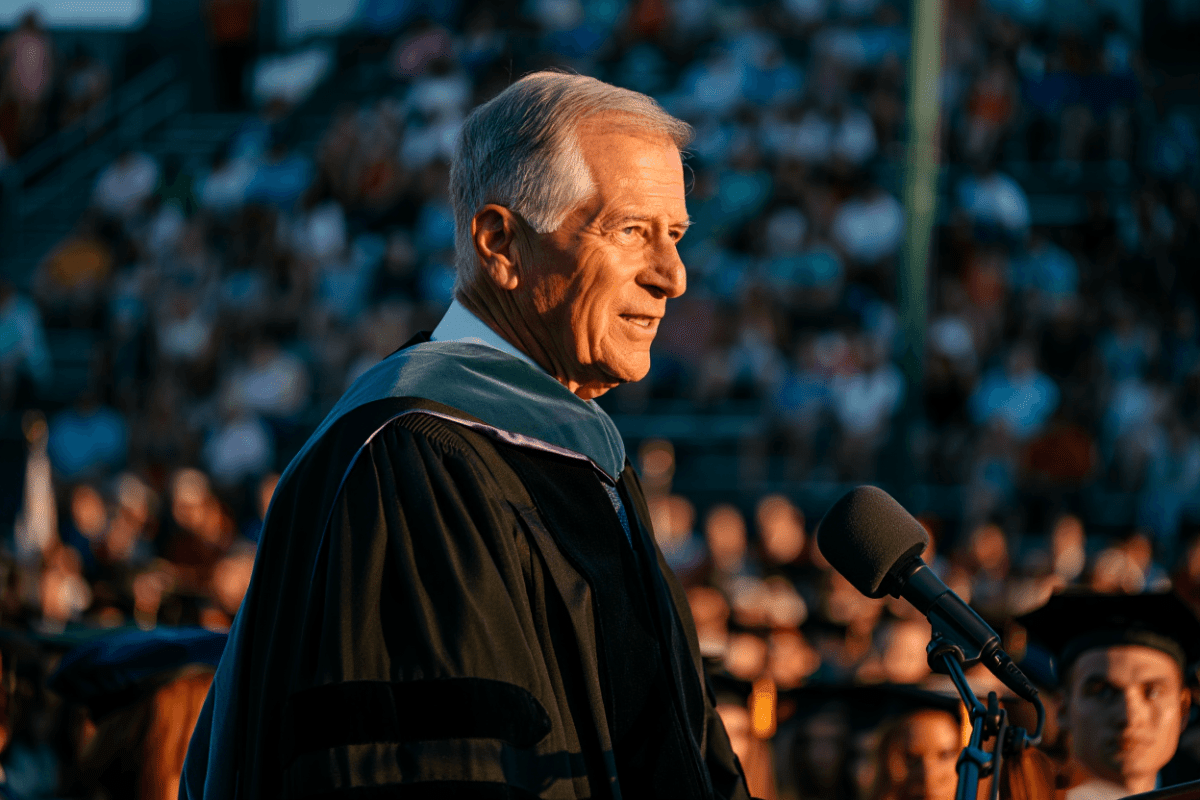
Harrison Ford, the 83-year-old iconic actor, delivered a powerful and unapologetic commencement address to Arizona State University’s Class of 2026 on May 11, 2026, telling the university’s largest graduating class ever — more than 14,000 undergraduate students — to embrace cultural change and go forth to repair the world their generation inherited. Ford’s speech stressed the imperative to extend social justice, respect indigenous peoples, and address environmental collapse, anchoring his message in both generational accountability and youthful possibility.
🔥 Quick Facts
- Date & Location: May 11, 2026, Mountain America Stadium, Arizona State University, Tempe, Arizona
- Class Size: More than 14,000 undergraduate graduates, representing the largest graduating class in ASU history
- Ford’s Honor: Received an honorary Doctor of Arts and Humane Letters degree from ASU
- Key Message: “Extend social justice”; address climate crisis, prevent human-caused mass extinction, respect indigenous peoples
- Ford’s Background: Attended ASU, studied philosophy and drama, became international film icon; established conservationist
A Generational Moment: Ford Confronts the Crisis His Generation Created
Harrison Ford opened his remarks with characteristic candor: he acknowledged that his generation — the Baby Boomer generation — has left the Class of 2026 with a fundamentally damaged world. Instead of sugar-coating the moment or reverting to generic commencement platitudes, Ford positioned himself as an elder willing to admit culpability while simultaneously insisting that the graduating class possesses the agency to transform the trajectory of human civilization.
The actor-turned-conservationist has spent decades advocating for environmental protection and indigenous rights, roles that informed the substance of his address. His willingness to address the generational reckoning head-on — rather than offering vague inspiration — reflects a deeper expertise in these domains and a commitment to authenticity over comfort.
The Three Pillars: Social Justice, Environmental Action, and Indigenous Sovereignty
Ford structured his message around three interconnected imperatives. First, he called on graduates to “extend social justice,” a phrase that reverberated across social platforms and news outlets within hours of delivery. This was not abstract rhetoric; Ford directly referenced the marginalization of indigenous peoples and urged young Americans to “respect and elevate the indigenous people that are being marginalized.”
Second, Ford tackled climate crisis and environmental collapse with scientific grounding. He emphasized that “humanity is a part of nature, not above it” — a philosophical positioning that rejects anthropocentric exceptionalism and demands recognition of human interdependence with the natural world. The phrase underscores Ford’s long history as Vice Chair of Conservation International, a position that grants him credibility when addressing environmental degradation at scale.
Third, he connected these threads to the immediate responsibility facing young people: preventing a human-caused mass extinction event. This framing elevates the stakes beyond social activism into existential territory, aligning with current climate science on biodiversity loss.
Context: Why Ford’s Message Resonates Now
The timing of Ford’s address coincided with a broader cultural conversation about generational responsibility in the face of climate change and social fragmentation. The Class of 2026 graduates into an economy, environment, and political landscape fundamentally shaped by decisions made decades earlier — a reality Ford refused to minimize.
Ford’s remarks also benefited from his unique status: not a politician seeking advantage, not an academic in an ivory tower, but an 84-year-old entertainer with seven decades of public visibility and a track record of environmental activism. This combination of celebrity platform, authentic advocacy, and generational distance creates asymmetrical credibility that politicians and corporate leaders often lack. As noted in similar coverage of entertainment figures leveraging influence for social causes, historical moments of entertainment figures addressing critical issues often define cultural memory, and Ford’s commencement address may become one such touchstone.
Core Speech Themes and Quoted Language
Throughout the address, Ford employed direct, active language designed to mobilize rather than pacify. Key phrases included:
- “Your generation has far more power than you may realize.” — An explicit assertion of agency against narratives of helplessness.
- “We need cultural change.” — Positioning systemic transformation, not incremental adjustment, as the necessary threshold.
- “The world my generation left you is a real mess.” — Unflinching acknowledgment of intergenerational harm.
- “Go change the world.” — Direct imperative framed as both responsibility and invitation.
These formulations avoid the abstract sentimentality typical of commencement rhetoric and instead anchor Ford’s message in material reality and collective action.
The Honorary Doctorate: Recognition of Conservation Expertise
Arizona State University conferred on Ford an honorary Doctor of Arts and Humane Letters degree, formally recognizing his contributions to environmental conservation and cultural advocacy. This credential, while ceremonial, reinforces the legitimacy of his platform. Ford’s own educational journey at ASU — where he initially studied philosophy before switching to drama and eventually leaving without completing his degree — adds another layer to the symbolic weight of the moment. He returned to the institution that shaped his intellectual formation not as an alumnus in the traditional sense, but as a recognized expert in fields that extend far beyond entertainment.
How This Moment Fits into Broader Cultural Conversations
Ford’s commencement address joins a growing chorus of public figures using high-visibility platforms to address climate crisis and social justice. Yet his specific approach — unfiltered, generationally self-critical, and grounded in decades of conservation work — distinguishes it from typical celebrity activism. The viral spread of his speech across social media, news outlets, and discussion forums suggests it resonated precisely because it refused the comfort of false hope while maintaining unwavering belief in the capacity for change.
The phrase “extend social justice” has become the dominant quotation driving discourse, perhaps because it elevates social justice beyond abstract aspiration and frames it as an active, deliberate project requiring sustained effort and courage.
What Comes Next: Implementation Over Inspiration?
Commencement speeches inevitably face a gap between rhetorical impact and behavioral change. Ford’s challenge to the Class of 2026 is concrete enough — address climate change, support indigenous rights, pursue systemic cultural transformation — but vague enough that graduates will interpret their obligations differently. Some may enter environmental science or policy. Others may pursue civil rights law or indigenous advocacy. Still others may apply these principles within business, technology, or academia.
The open question haunting Ford’s address is whether inspiration will translate into action at scale, or whether his words will join the vast archive of commencement rhetoric that fades into memory within months. The measurement of impact will not come in this moment, but in the specific choices the Class of 2026 makes over the next five, ten, and twenty years.
Will the Class of 2026 Actually Change the World, or Just Remember Being Told They Could?
Ford concluded his remarks with a call that transcends typical commencement tradition: not merely to succeed, but to transform. Yet success in Ford’s framework is not personal achievement or professional advancement — it is the reversal of ecological collapse and the expansion of justice. This is an aspirational but extraordinarily high bar. The coming years will reveal whether the 14,000-plus graduates who heard Ford speak that evening internalize his challenge as a personal mandate, or whether they file the memory alongside other inspiring-but-distant rhetoric from public figures.
What remains certain is that Harrison Ford, at 83 years old, refused to deliver the self-congratulatory speech his generation often reserves for younger generations. Instead, he modeled accountability, humility, and urgent moral conviction — qualities that may prove more valuable to the graduating class than any affirmation of their potential ever could.
Sources
- Arizona State University Official News — Harrison Ford commencement details, class size, honorary degree conferral
- Fox News — Harrison Ford’s quoted remarks on social justice and environmental action
- NPR — Ford’s educational background at ASU and detailed speech analysis
- C-SPAN — Full video documentation and transcript of commencement address
- PR Newswire — Official announcement of Ford’s role and the largest graduating class in ASU history