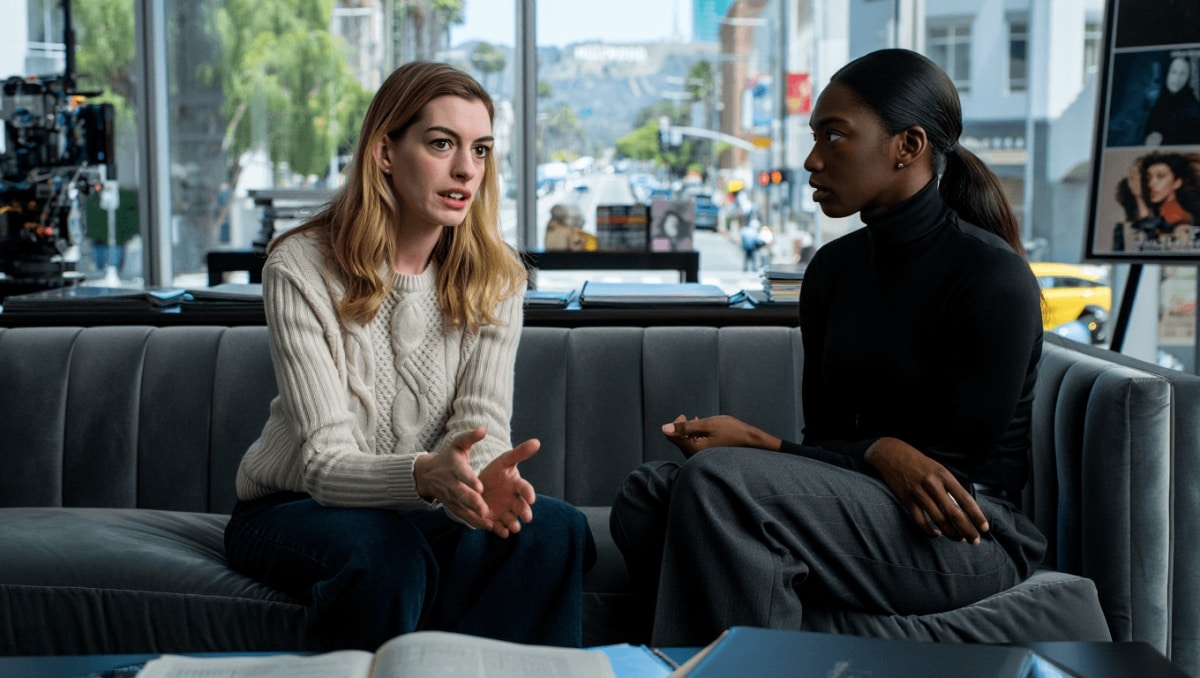
Pairing Anne Hathaway with Michaela Coel has produced one of this season’s most talked-about new films: a bold, unpredictable drama that critics and audiences are already parsing for its performances and formal risks. Beyond the headlines, the production behind “Mother Mary” reveals a number of creative choices and on-set practices that help explain why the film feels so immediate and unlike either actor’s recent work.
At first glance the movie arrives as a clash of temperaments: Hathaway’s controlled intensity meets Coel’s raw, spontaneous energy. That contrast was deliberately amplified by the creative team to make scenes feel electric without relying on obvious effects or spectacle.
Directoral approach and rehearsal methods set the tone early. Rather than shoot strictly to a storyboard, the director encouraged a hybrid process that balanced careful blocking with space for performers to explore. Cast members have described rehearsals that blended traditional table reads with movement workshops and late-night scene runs—methods intended to erase predictability and keep reactions fresh during takes.
- Performance strategy: Lead actors were invited to improvise within tightly defined emotional beats, letting dialogue shift organically so reactions register as lived-in rather than scripted.
- Practical effects: The production leaned heavily on practical solutions—props, makeup and set dressing—to achieve visceral moments, keeping visual effects to a minimum.
- Visual design: Cinematography favored long lenses and hand-held work in intimate scenes, while wider, static setups framed community moments to emphasize distance and scale.
- Music and sound: Score cues were developed in parallel with editing, allowing sound design to shape pacing and tension rather than simply underscore it.
- Collaborative editing: Editors were part of creative discussions from early cuts onward, giving the film a rhythm that emerged through iterative experimentation.
Those choices created an on-screen texture that reviewers say feels both immediate and carefully composed. Scenes that might have read as melodramatic on paper instead land as sharply observed because of how performance, camera and sound line up in real time.
Below is a quick reference to the film’s key production touchpoints:
| Title | Mother Mary |
| Leads | Anne Hathaway, Michaela Coel |
| Style | Character-driven drama with strong improvisational elements |
| Production focus | Practical effects, collaborative rehearsal, sound-led editing |
On set, costume and production designers pursued a restrained aesthetic. Rather than call attention to period detail or flashy wardrobes, look and color palettes were used to underline character psychology—small choices in fabric, fit and texture that register subtly on camera. Makeup and hair followed a similar logic: emotionally expressive rather than glamorized.
Both leads pushed into territory that feels new for them. Hathaway leans into controlled vulnerability, choosing restraint over showy beats. Coel, known for bracing directness, channels volatility into scenes that often pivot on a single, sharp reaction. The result is a dynamic where each actor amplifies the other’s choices.
Technically, the crew favored in-camera problem solving. The production’s minimal reliance on digital fixes meant more time on set to find the right angle and mood. Cinematographers and gaffers worked closely to craft light that could change character within a single setup—an approach that gave editors more organic material to shape.
The film’s soundscape deserves special mention. Sound editors and the composer reportedly worked in tandem, sometimes composing motifs to anchor a scene before final picture lock. That collaboration allowed sound to do heavy narrative lifting—creating tension or release without overt scoring.
What this means for audiences: “Mother Mary” is designed to reward prolonged attention. It’s a film that accumulates meaning through discreet choices rather than headline-grabbing twists. For viewers expecting traditional pacing or tidy resolutions, the movie may feel challenging; for others, it offers a textured, actor-driven experience that lingers.
As the film circulates through press screenings and public release windows, its reception will likely hinge on two elements: the chemistry between its stars and the appetite of viewers for films that trade spectacle for performance craft. Either way, the production’s emphasis on collaboration and practical filmmaking gives “Mother Mary” a distinct identity at a time when many studio pictures follow a predictable template.