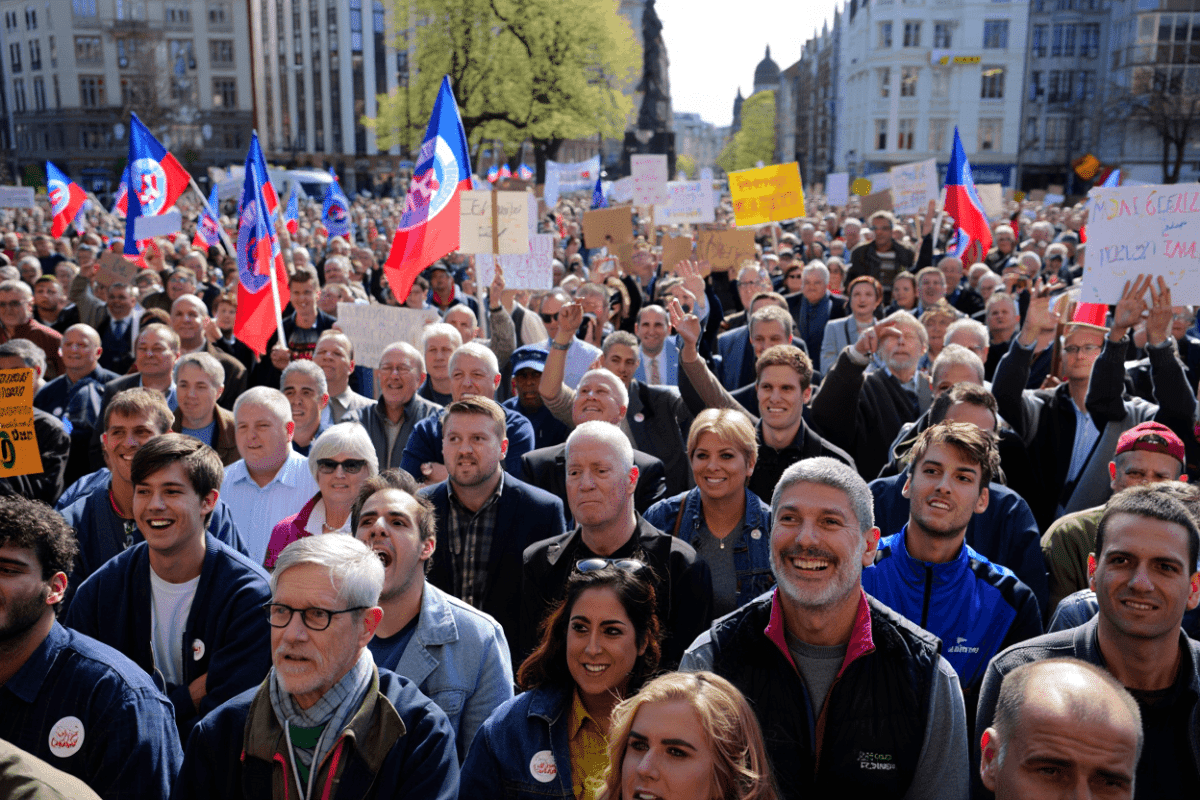
On May 1, 2026, millions of workers across the globe participate in International Workers’ Day—a global observance that honors the labor movement and celebrates worker solidarity worldwide. This year’s theme, “Ensuring a Healthy Psychosocial Working Environment,” reflects contemporary concerns about mental health and workplace dignity. The holiday commemorates the Haymarket Affair of 1886, a pivotal labor protest in Chicago that established May 1st as the symbolic date for workers’ rights advocacy globally.
🔥 Quick Facts
- Over 140 countries officially recognize International Workers’ Day on May 1st
- May 1, 1886: The first coordinated strike saw 300,000+ workers across the United States demand the eight-hour workday
- May 4, 1886: The Haymarket Riot in Chicago turned violent, becoming the catalyst for modern International Workers’ Day
- 2026 Theme: Focus on psychosocial well-being represents evolution beyond traditional labor issues to worker mental health
- US Exception: The United States observes Labor Day in September, not May 1st—a deliberate political distinction established in 1894
The Haymarket Affair: Foundation of a Global Movement
The origins of International Workers’ Day trace directly to the labor upheaval of 1886. In 1884, the Federation of Organized Trades and Labor Unions launched a coordinated campaign demanding an eight-hour workday—a radical shift from the typical 10-16 hour shifts that dominated industrial America. The federation declared that beginning May 1, 1886, workers nationwide would engage in strikes and demonstrations until employers agreed to the new standard.
The response was extraordinary. On May 1, 1886, more than 300,000 workers in approximately 13,000 businesses across the United States participated in coordinated walkouts. Chicago, the industrial heartland, became the epicenter of the movement. Labor groups, socialists, anarchists, and ordinary workers united around a single demand: shorter hours, better conditions, and recognition of workers’ dignity. The atmosphere was largely peaceful, with workers assembling in city squares and factory yards to assert their collective power.
However, tensions escalated on May 4, 1886, when Chicago police confronted a gathering of workers at Haymarket Square. During the confrontation, a bomb was detonated—its origin remains historically disputed—killing several police officers and workers. The ensuing chaos transformed a labor movement into a watershed moment for American history. Police arrested suspected anarchist leaders, and subsequent trials resulted in executions, intensifying public fear of radical labor organizations and immigrant workers.
Why May 1st Became the Global Symbol
The significance of May 1st crystallized through deliberate international activism. In 1889, the First International Congress of Socialists formally designated May 1st as International Workers’ Day to commemorate the Haymarket struggle and honor the workers’ movement. By the late 19th century, Europe, Australia, and Latin America had all adopted May 1st as a day for labor demonstrations, rallies, and public recognition of workers’ contributions to society.
Interestingly, the United States took a different political path. U.S. leaders in the late 1800s viewed May 1st as linked to leftist and revolutionary movements—a concern heightened by immigrant populations and anarchist rhetoric associated with radical labor action. To distance American labor recognition from these revolutionary connotations, President Grover Cleveland signed legislation in 1894 establishing Labor Day on the first Monday of September as the official federal holiday. This deliberate separation reflected Cold War anxieties and political ideology that persist to the present day.
Global Observances and Regional Variations
Today, over 140 countries observe some form of labor recognition on or near May 1st. However, the manner and intensity of celebration varies dramatically by region, reflecting different labor histories and political systems.
| Country/Region | Official Status | Typical Observance |
| France, Greece, Spain | National Public Holiday | Large-scale rallies, labor union marches, political demonstrations |
| China, Vietnam, Laos | Major State Holiday | Official state recognition, parades, worker celebrations |
| UK, Australia | Observed, not universal national holiday | Union-organized events, community activities |
| Mexico, Brazil | National Public Holiday | Government ceremonies, union marches, cultural festivities |
| United States | Not official; September Labor Day is federal holiday | Grassroots labor activism, union organizing efforts, May Day actions |
| Finland, Italy | Public Holiday with regional variation | Both labor recognition and spring celebrations combined |
In 2026, major coordinated rallies took place across New York City, Los Angeles, and dozens of American cities, with unions and workers’ organizations mobilizing for demonstrations on worker rights. Labor activists used the occasion to address contemporary issues: wage stagnation, precarious gig economy work, mental health support, and workplace safety.
“On May 1, workers around the world take to the streets to celebrate their collective power, defend their rights, and demand equity and justice in the workplace.”
— International Labour Organization (ILO) Position Statement, May Day 2026 Official Messaging
The Evolution of Worker Rights: From Eight Hours to Psychosocial Well-Being
The 2026 theme—“Ensuring a Healthy Psychosocial Working Environment”—represents a substantial shift in labor advocacy. When workers in 1886 demanded the eight-hour workday, the focus was on physical exhaustion and industrial injury prevention. A typical factory worker faced 12-16 hour shifts in dangerous conditions with minimal safety protections. The eight-hour movement represented a fundamental demand: workers deserve rest, family time, and personal development.
Modern labor movements have achieved many goals from that era. The eight-hour standard is now law in most developed nations. Workplace safety regulations exist. Child labor laws protect minors from exploitation. Yet contemporary workers face different pressures: burnout from constant connectivity, mental health crises, workplace discrimination, and the fragmenting of traditional employment relationships through gig work. The 2026 theme acknowledges that labor rights have evolved beyond physical safety to encompass emotional, mental, and psychological dignity in work environments.
This represents progress in labor consciousness—recognition that a worker cannot be truly free if their mental health is compromised by workplace stress, discrimination, or impossible demands. Major labor unions globally now prioritize mental health benefits, flexible scheduling, anti-harassment policies, and psychological workplace assessments as central demands, reflecting how labor movements adapt to generational concerns.
2026 Labor Movement: Continuity and Contemporary Challenges
In May 2026, the “May Day Strong” coordinated movement brought tens of thousands into American streets. Events occurred in hundreds of cities, organized by labor unions, immigrant rights groups, and worker advocacy organizations. The demonstrations connected historical labor struggles to current issues: healthcare access, wage floors, strike protections, and workplace dignity for gig workers and service employees.
Unlike the 1886 campaign narrowly focused on working hours, 2026 labor activism addressed intersectional concerns. Demonstrations highlighted how workers of color, immigrant workers, women, and LGBTQ+ workers face compounded discrimination and exploitation. The movement connected worker justice to broader social equity goals. Labor organizations used May Day to build power for contract negotiations, political advocacy, and public consciousness-raising about worker contributions during a period of economic inequality growth.
This evolution demonstrates how labor movements remain dynamic. The eight-hour day was radical in 1886; today it’s standard. The 2026 focus on psychosocial well-being will likewise become increasingly central as labor consciousness develops. Workers continue demanding a larger share of productivity gains, recognition of their human dignity beyond their output of labor, and conditions that allow full human flourishing.
Why Does May 1st Remain Significant in 2026?
In an era of fragmented work, remote employment, and gig economy disruption, one might ask: why is a shared May Day still relevant? The answer lies in the functioning of labor movements themselves. Workers maintain power through collective action and solidarity. A global observance like International Workers’ Day reaffirms the basic principle: workers everywhere share common interests and face common exploitations under different systems.
For U.S. workers specifically, May Day represents a space outside official national recognition to assert labor identity and demands. While Labor Day in September is officially recognized, it often becomes a date for cookouts and long weekends—depoliticized and commercialized. May 1st, by contrast, remains a day explicitly linked to labor mobilization, historical struggle, and worker power. Labor organizations view May Day demonstrations as opportunities to educate about labor history, recruit workers into organizations, and build momentum for contract fights and legislative advocacy.
Looking ahead, labor movements will likely continue expanding the May Day framework to address emerging challenges: artificial intelligence’s impact on employment, climate change and just transitions, the future of work after pandemic disruptions, and international labor solidarity across borders. The Haymarket Affair’s legacy endures not because the specific demands of 1886 remain unchanged, but because the fundamental principle—workers united for dignity and justice—remains as necessary today as it was 140 years ago.
Sources
- Wikipedia: International Workers’ Day – Comprehensive historical overview of May Day origins, global observances, and country-specific celebrations
- Gilder Lehrman Institute: The Haymarket Affair, 1886 – Historical analysis of the Chicago labor protest and its watershed significance for American labor history
- UCLA Institute for Research on Labor and Employment (IRLE) – Analysis of May Day significance, historical context, and contemporary labor perspectives
- International Labour Organization (ILO) – Official 2026 International Workers’ Day messaging and thematic guidance
- New York City Central Labor Council and AFL-CIO – Documentation of May Day 2026 events and contemporary labor activism in the United States