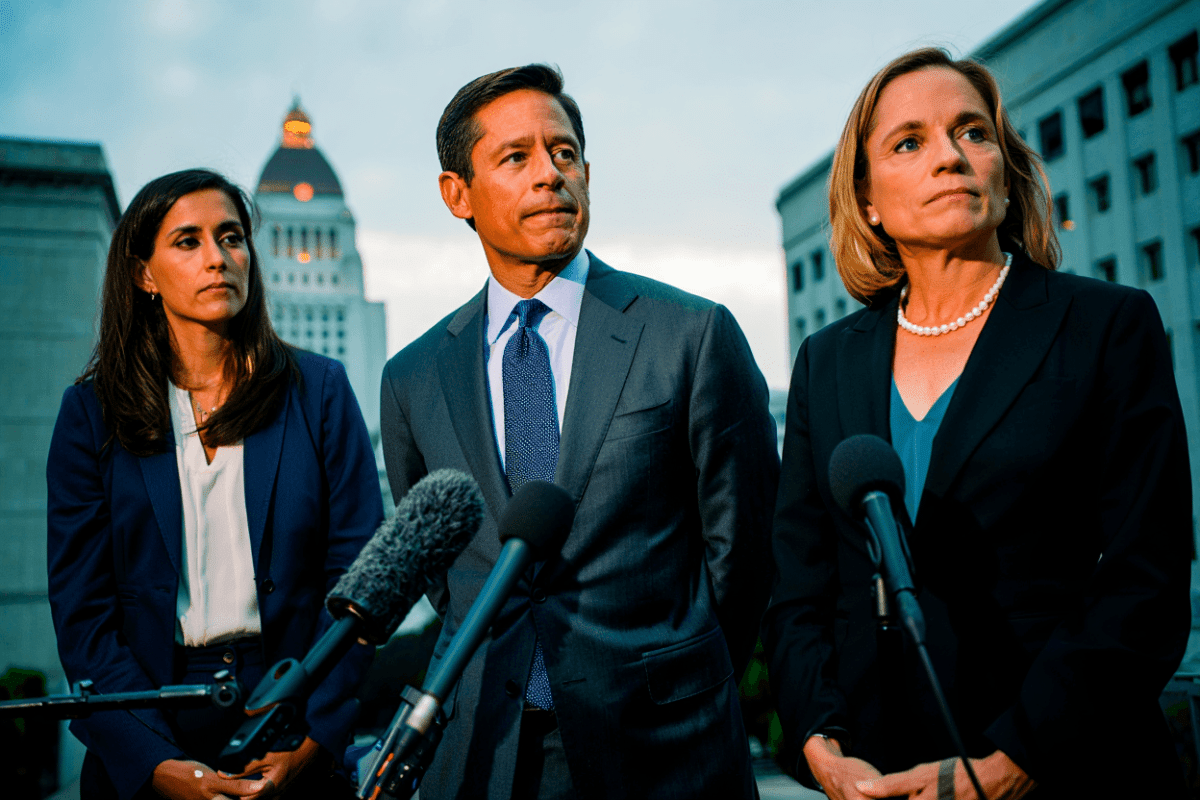
The Los Angeles mayor’s race entered a new phase on May 19 as three members of the City Council’s progressive bloc announced endorsements for Mayor Karen Bass, breaking ranks with their ideological ally Nithya Raman. The decision signals consolidation around the incumbent just 14 days before the June 2 primary, reshaping the political landscape in a race where the top two finishers advance to a November 3 runoff.
🔥 Quick Facts
- Three progressive City Council members endorsed Bass on May 19, 2026
- Bass leads with 30% support, ahead of Pratt (22%) and Raman (20%)
- Primary election is June 2; runoff scheduled for November 3
- Endorsers cited Bass’s immigration stance and homelessness work
- Democratic Socialists of America declined formal endorsement in mayoral race
Progressive Bloc Fractures Over Bass Candidacy
Eunisses Hernandez, Ysabel Jurado, and Hugo Soto-Martínez — all members of the Democratic Socialists of America alongside Raman — publicly backed the mayor’s reelection bid. This alignment represents a significant maneuver in a race defined by ideological and personality-driven factions. Hernandez stated that Bass demonstrated real leadership when immigrant communities faced Trump administration raids over the summer. Jurado, representing districts with large immigrant populations from Pico-Union to Highland Park, emphasized the mayor’s direct opposition to deportations during the raids. Soto-Martínez, who endorsed Bass earlier this year, expressed surprise at Raman’s last-minute entrance into the race, saying he never doubted Bass’s long-standing commitment to the community.
The endorsements land a tactical blow to Raman’s progressive credentials. Democratic consultant Mike Trujillo assessed the impact: if elected officials sitting inches away from Raman are rejecting her candidacy, that message resonates with voters. These are colleagues who know her legislative record intimately, making their choice carry weight beyond typical political endorsements. UCLA’s Zev Yaroslavsky offered a different perspective, suggesting the council members may prioritize maintaining working relationships with the front-runner rather than pure ideological alignment.
Raman’s Centrist Pivot Alienates Progressive Base
Raman announced her mayoral bid just before the filing deadline closed in February, a surprise move that came weeks after she herself endorsed Bass’s reelection. Her explanation—that the endorsement occurred months prior but wasn’t announced until two weeks before her campaign launch—raised questions about timing and political strategy. Since entering the race, Raman has repositioned herself closer to the political center than her council voting record suggests.
Her new positions diverge sharply from progressive orthodoxy. She now supports maintaining LAPD’s current sworn officer levels, reversing her earlier stance against expanding police ranks. During her first council campaign, she posted ‘Defund the police’ on social media and voted repeatedly against anti-encampment zones. Now, she states she would not block council members from implementing such zones in their districts. These shifts suggest a calculation that citywide office requires broader appeal than her district-based progressive stronghold. Critics argue this repositioning rings hollow to progressives who supported her earlier evolution on policing issues. Her campaign emphasizes denser housing in single-family neighborhoods, climate action, and her opposition to current Police Chief Jim McDonnell—platform elements designed to differentiate her from Bass while maintaining progressive credibility.
Bass Consolidates Support Among Diverse Voters
A May 13 Emerson College poll revealed Bass commanding 30% support among likely voters, a 10-point gain from March. Spencer Pratt moved to 22% (up 12 points), while Raman held 20% (up 10 points), all within or near the poll’s 5% margin of error. The polling showed meaningful demographic stratification. Bass dominated with women at 36%, Black voters at 42%, and seniors over 60 at 47%. Raman led among voters under 40 with 31% support but trailed dramatically with voters over 60 (just 6%). Pratt consolidated Republican support, receiving 61% of GOP voters surveyed and nearly 50% of independents—a consolidation that analysts view as predictable in a nonpartisan race with a single credible Republican candidate.
Latino voters, comprising approximately 37% of the Los Angeles electorate, showed Bass leading at 33% compared to Pratt’s 25% and Raman’s lower share. This demographic advantage may prove decisive, as Bass maintains strength with this crucial voting bloc through her administration’s response to immigration enforcement and homelessness—core concerns for Latino communities.
Decision Matrix: Path to Runoff and November
| Candidate | Poll Support | March 2026 Trend | Key Demographic Strength |
| Bass (Incumbent) | 30% | +10 points | Women, seniors, Black voters, Latinos |
| Pratt | 22% | +12 points | Republicans, independents, men |
| Raman | 20% | +10 points | Voters under 40, some progressives |
| Undecided | 16% | -34 points | May lean toward Raman by <1 point |
When undecided voters were pressed to indicate their preference, Raman leapfrogged Pratt by less than one percentage point. This numerical break suggests that mobilizing younger voters and undecideds represents Raman’s likeliest path to the runoff, though her lead among this group remains razor-thin and vulnerable to late developments.
“It’s really up for grabs who will be in the second spot. When undecided voters are asked to make a choice, Raman leapfrogs Pratt, though by less than a percentage point.”
— Spencer Kimball, Executive Director, Emerson College Polling
Political Implications and Strategic Calculations
Bass has consistently denied that she prefers Pratt as a runoff opponent, stating during a May 6 debate: “I don’t think he is preferable as a competitor. I don’t want any competitors, how about that?” This response addressed Raman’s suggestion that the mayor was strategically undermining her to face the Republican candidate in November. The dynamics of a Bass-Pratt runoff significantly favor the incumbent in a city where Republican registration remains below 15%. Conversely, a Bass-Raman runoff presents ideological clarity that might energize progressive turnout.
The Democratic Socialists of America’s decision to decline a formal endorsement in the mayoral race—while endorsing in five other local contests—reflects the organization’s internal fracture. DSA recommended voting for Raman in language that fell short of formal endorsement, suggesting organizational hesitation about backing a former ally who has tacked centrist. Former progressive councilmember Mike Bonin, now at Cal State LA’s Pat Brown Institute, characterized the progressive electorate as still dancing between Raman and community organizer Rae Huang, indicating genuine fragmentation rather than unified opposition to Bass.
Political volatility persists despite apparent consolidation. The UCLA Luskin poll from April found 40% of voters undecided, though the May 13 Emerson poll showed this compressed to 16%. The compressed timeline—with early voting underway and election day just two weeks away—limits time for major narrative shifts. However, progressives who view the council endorsements as organizational establishment moves against a grassroots outsider may counterbalance the message by boosting Raman’s volunteer networks and small-dollar fundraising.
What Happens If Bass Fails to Win Outright?
Unless Bass surpasses 50% of the primary vote—a threshold her 30% polling share suggests unlikely—Los Angeles will hold a November 3 general election runoff between the top two June finishers. Historical precedent in Los Angeles mayoral races shows incumbents typically advance to runoffs when facing multiple strong challengers. The scenario would pit Bass against either the conservative-leaning reality TV personality and property developer Pratt or the progressive-positioning City Council member Raman. Each matchup carries distinct turnout dynamics, particularly regarding young voters, Latino participation, and progressive mobilization. Bass’s current polling advantage coupled with favorable demographics among the most reliable voters (seniors, women, Black voters) suggests general election strength regardless of her June opponent.
Sources
- Los Angeles Times – Reporting on progressive endorsements and voter dynamics in the mayoral race
- Emerson College Polling/Inside California Politics – May 2026 mayoral primary polling data
- UCLA Luskin School of Public Affairs – April 2026 election volatility analysis
- Democratic Consultant Mike Trujillo – Strategic analysis of endorsement impact
- City Clerk of Los Angeles – Official election dates and procedures