Show summary Hide summary
- 🔥 Quick Facts
- A Fiery Opening Sets the Theatrical Tone
- Talking Heads Classics Meet Contemporary Resistance
- Political Imagery and ‘Life During Wartime’ Projection
- New Material from ‘Who Is the Sky?’ Prove Byrne’s Versatility
- Can David Byrne Continue Reinventing ‘Life During Wartime’ for New Generations?
David Byrne delivered a politically charged, theatrical masterclass at Coachella this past weekend, transforming the desert stage into an immersive experience of hope amid global darkness. The 73-year-old avant-garde musician commanded the Outdoor Theatre with dancers, projection art, and 13 carefully choreographed songs that proved his artistic vision remains uncompromising and visionary.
🔥 Quick Facts
- Performance Date: April 11, 2026 at Empire Polo Club, Indio, California
- Setlist Length: 13 songs blending Talking Heads classics with new material from ‘Who Is the Sky?’
- Visual Theme: Anti-ICE imagery projected during ‘Life During Wartime’; costume was signature orange jumpsuit
- Touring Status: Byrne continues European festival dates in June 2026 at Latitude, Open’er, Bilbao BBK, and more
A Fiery Opening Sets the Theatrical Tone
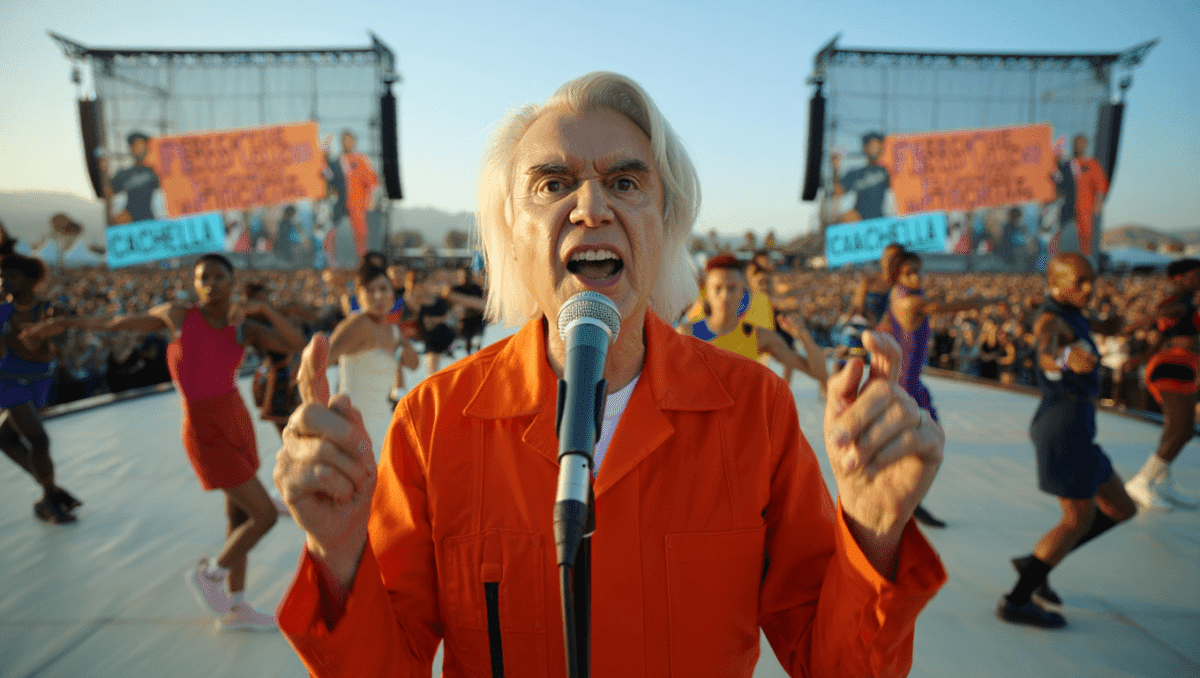
David Byrne emerged solo in his iconic orange jumpsuit, commanding the stage before launching into ‘Everybody Laughs’ from his recent solo album ‘Who Is the Sky?’. His full ensemble of musicians and dancers then joined the stage, transforming the performance into a choreographed spectacle. Each song received customized dance routines that elevated the experience beyond standard concert fare, turning Coachella into a work of performance art.
According to Rolling Stone, Byrne arrived with a late start but immediately commanded attention through his theatrical approach. The audience witnessed a renaissance man who refuses to simply play old hits; instead, he reimagines each moment with political consciousness and artistic precision.
David Byrne brings ‘Life During Wartime’ hope to Coachella crowd
Deepika Padukone announces second pregnancy with Ranveer Singh, adorable reveal with daughter Dua
Talking Heads Classics Meet Contemporary Resistance
Byrne leaned heavily into his Talking Heads back catalog, delivering iconic tracks like ‘Psycho Killer,’ ‘And She Was,’ ‘This Must Be the Place (Naive Melody),’ and ‘Once in a Lifetime’ that sent the crowd into singalongs. The performance also featured ‘Burning Down the House,’ ‘(Nothing But) Flowers,’ and ‘Slippery People,’ proving why these 1979-1983 classics remain culturally relevant.
Rolling Stone noted that Byrne shared an insight from actor-director John Cameron Mitchell, stating that ‘love and kindness are the most punk thing we can do right now,’ and framing such resistance as an act against despair. This philosophical anchor shaped the entire set’s emotional trajectory.
Political Imagery and ‘Life During Wartime’ Projection
| Song Title | Album Origin | Visual Element |
| Life During Wartime | Fear of Music (1979) | ICE and pro-Palestine protest footage |
| Psycho Killer | Talking Heads: 77 (1977) | Choreographed ensemble routines |
| Once In A Lifetime | Remain in Light (1980) | Theatrical staging and lighting |
| Strange Overtones | Everything That Happens (2008) | Dancer ensemble featuring singers |
The most striking moment came during ‘Life During Wartime,’ when screens projected footage of anti-ICE resistance and pro-Palestine demonstrations, according to Rolling Stone and Dork. The visual integration transformed the 1979 track into a contemporary political statement, drawing extensive cheers from the desert crowd. Byrne refused to let the song become a nostalgic relic, instead weaponizing it as an agent of social consciousness.
“Love and kindness are a form of resistance.”
— David Byrne, quoting actor-director John Cameron Mitchell at Coachella 2026
New Material from ‘Who Is the Sky?’ Prove Byrne’s Versatility
Byrne performed several tracks from his 2025 solo LP ‘Who Is the Sky?,’ including ‘Everybody Laughs,’ ‘When We Are Singing,’ and ‘What Is the Reason for It?’—the latter exploring philosophical dimensions of love. His Brian Eno collaboration ‘Strange Overtones’ from the 2008 album proved that Byrne remains creatively restless after five decades of experimentation. The mix of decades-old Talking Heads material with contemporary songwriting demonstrated an artist unafraid of growth or contradiction.
Vulture stated that Byrne’s performance was ‘so good’ it warranted immediate viewing, calling his orange jumpsuit presence ‘unforgettable.’ The publication emphasized that this 73-year-old outpaced performers ‘less than half his age’ in energy and innovation.
Can David Byrne Continue Reinventing ‘Life During Wartime’ for New Generations?
Byrne faces an interesting challenge moving forward: his Talking Heads catalog, written in the 1970s and early 1980s, continues sparking urgency when recontextualized through contemporary political crises. Songs like ‘Life During Wartime’ feel prescient rather than historical. His upcoming European festival dates at Latitude, Open’er, Bilbao BBK, Mad Cool, and Roskilde in June 2026 will test whether this theatrical approach resonates beyond Coachella’s desert landscape.
Beyond touring, Byrne recently collaborated with Brian Eno on the politically charged single ‘T-Shirt’—performed live with slogans like ‘Make America Gay Again’ and ‘No Kings.’ Meanwhile, he covered Olivia Rodrigo’s ‘Drivers License,’ prompting Rodrigo herself to praise Byrne as ‘one of her all-time heroes.’ The question remains: will Byrne’s artistic vision continue finding new contexts, or has he already defined the boundaries of his reinvention?
Watch the Performance

Sources
- Rolling Stone – Comprehensive coverage of David Byrne’s theatrical Coachella performance and political messaging
- Vulture – Critical review of ‘Life During Wartime’ performance and stagecraft
- Dork Magazine – Detailed setlist breakdown and career-spanning analysis of thirteen-song set