
Show summary Hide summary
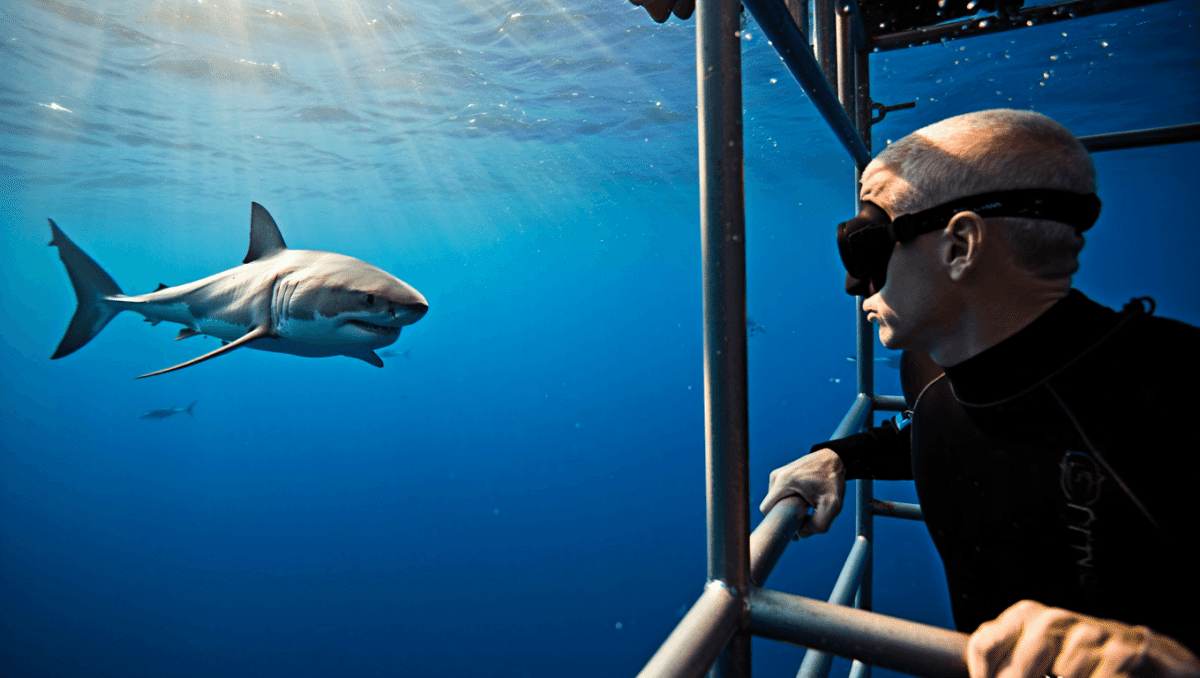
Anderson Cooper just uncovered a marine mystery that has shocked scientists off the coast of South Africa. In a 60 Minutes investigation that aired just hours ago, the legendary journalist reveals why great white sharks have mysteriously vanished from False Bay, one of the world’s most iconic shark habitats. The answer: a pair of orca killers named Port and Starboard are hunting them at an unprecedented scale, and scientists are bitterly divided over what it all means.
🔥 Quick Facts
- The Vanishing: Once abundant, great white sharks completely disappeared from Cape Town’s False Bay around 2018, with carcasses washing up with livers surgically removed
- The Culprits: Two distinctive male orcas, named for their collapsed dorsal fins bent Port and Starboard, have learned to hunt sharks specifically for their calorie-dense livers
- The Scale: Scientists documented five orcas working in coordination in 2022 drone footage, suggesting the killer whales are teaching each other this novel hunting technique
- The Impact: Shark tourism collapsed overnight, transforming Cape Town from the world’s best great white hotspot to a location where sightings are now nearly impossible
When Great White Sharks Meet Their Match
For decades, the waters off Cape Town were a paradise for apex predators. Wildlife photographer Chris Fallows documented seeing 250 to 300 different great white sharks each year, capturing some of the most breathtaking images ever taken of these magnificent creatures. Tourists from around the world paid for cage diving experiences, witnessing 15-foot predators circling in blood-chummed waters. Then, suddenly, everything changed.
Around 2015, something extraordinary began happening. Marine biologist Alison Kock started finding smaller shark carcasses on the sea floor with mysterious, surgical-looking incisions. The cuts were so precise that Kock initially assumed a fisherman was responsible. But tooth marks told a different story. When she and her research team encountered two orcas hunting in their study area, the lights came on. These killer whales, rare predators of great whites, had discovered a new food source.
Who did Karol G bring out at Coachella? Complete guest list from historic set
What stage is Big Bang performing Coachella? K-pop legends took Outdoor Theatre last night
Port and Starboard: The Infamous Orca Duo
David Hurwitz, a whale-watching tour operator, became the first to witness these two distinctive male orcas hunting and killing sharks. He named them Port and Starboard after their uniquely collapsed dorsal fins, each bent in opposite directions. Unlike typical orca pods, which hunt in large groups, Port and Starboard hunt together as a pair, targeting great whites specifically for their massive livers.
What makes this orca behavior genuinely revolutionary is not just the hunting itself. Scientists believe Port and Starboard are teaching other orcas this novel technique. In 2022, drone footage captured five orcas working in stunning coordination, stunning a great white and extracting its liver in one fluid motion. According to Kock, the killer whales are not trying to eat the entire shark, just targeting the most calorie-dense organ in the entire body, which comprises almost a third of the shark’s mass.
Why Scientists Are at War Over the Cause
Here’s where the mystery gets complicated. Alison Kock argues that just two orcas, plus orca predation behavior, created a “landscape of fear” that drove hundreds of great whites away from False Bay. Great whites never evolved to be predated on, she says, and when suddenly facing this novel threat, they fled to other coastlines. However, Italian marine biologist Enrico Gennari sharply disagrees. Gennari notes that great white sharks began disappearing years before Port and Starboard’s documented killing spree.
For Gennari and photographer Chris Fallows, the real culprits are humans. They point to commercial fishing boats using miles-long lined hooks that catch the smaller sharks that are great white staple prey. More damningly, South African nets and baited hooks designed to protect swimmers have killed over 20 great whites annually since the 1950s. In California and Australia, where orcas also hunt great whites, the sharks eventually return. But in South Africa? The great whites have never come back.
A Conservation Question Without Easy Answers
In 1991, South Africa became the first country in the world to legally protect the great white shark. Yet Gennari fears South Africa will also become the first country to lose them. He calls for replacing lethal shark nets with alternatives like underwater magnetic fields that interfere with shark senses, and smaller meshed nets that create barriers without entanglement. Fallows emphasizes a stark truth: humans can control fishing pressure and shark nets, but cannot control orca behavior.
When asked why people should care about protecting great white sharks, Fallows draws parallels to past whaling practices. Just as society once nearly wiped out humpback whales, only to protect them through enlightened policy, great whites deserve the same moral consideration. Since commercial whaling bans, humpback populations have made a “remarkable comeback,” proving that conservation can work if governments commit the resources.
What This Marine Mystery Tells Us About Our Oceans
The vanishing of False Bay’s great white sharks represents something unprecedented in marine science. Whether the cause is orca predation, human fishing pressure, or a combination of both, the result is catastrophic ecological disruption. Research published in 2025 documents a cascading ecosystem effect following the loss of white sharks, with Cape fur seal populations exploding in the absence of their natural predator.
The documentary evidence is stunning. 60 Minutes obtained drone footage of orcas hunting great whites with surgical precision, a behavior that shocked the maritime research community. Anderson Cooper’s investigation reveals how two dolphins fundamentally altered one of Earth’s most productive ecosystems. The question now is whether South Africa’s government will prioritize stronger protections, or whether the great white will vanish entirely from waters where it once reigned supreme. As Fallows concludes, “A balanced ocean is a healthy ocean. A healthy ocean is a healthy environment for us.”










What food chain shift has happened to the orcas and the GW’s. I agree human involve somewhere, but it is all about food chain – Right? Seeing this kid of change around Alaskan crabs and Krill populations. I just hope we havent destroyed this amazing web of life we call the oceans.