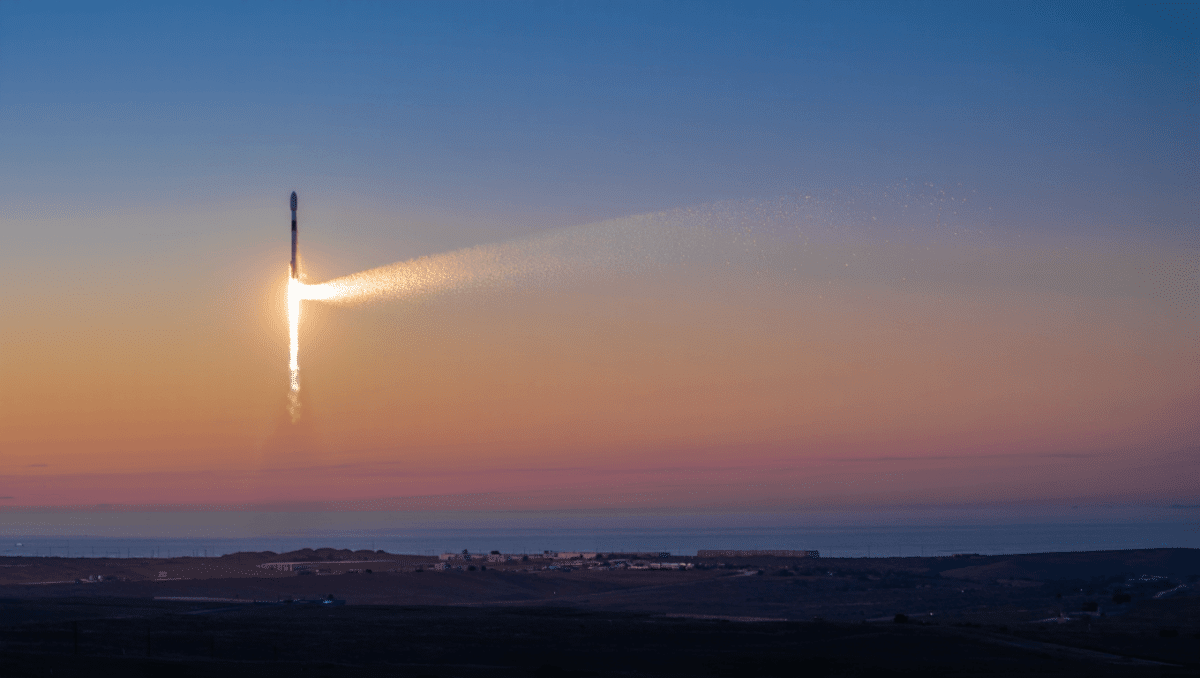
Thousands across California’s Central Valley witnessed a stunning cosmic display on April 6, 2026. A SpaceX Falcon 9 rocket lit up the evening sky with a rare twilight phenomenon that left residents asking, “What was that?” The 25-satellite Starlink mission created a breathtaking glowing plume visible across multiple counties.
🔥 Quick Facts
- Launch Time: Monday, April 6, 2026, approximately 7:50 PM PDT from California
- Location: Space Launch Complex 4E at Vandenberg Space Force Base near Lompoc, California
- Payload: 25 Starlink V2 Mini satellites for high-speed internet constellation
- Visibility Range: Clear skies meant the rocket plume reached Central Valley, Fresno, and surrounding regions
SpaceX Delivers Starlink Group 17-35 Mission from California Coast
The Falcon 9 rocket lifted off from Vandenberg Space Force Base, a U.S. Space Force installation located on the Central California coast near Santa Barbara County. The mission deployed 25 advanced Starlink V2 Mini satellites into low-Earth orbit. These satellites expand SpaceX’s global broadband network, providing high-speed internet coverage to underserved regions worldwide. The launch succeeded despite previous weather delays that had scrubbed earlier April attempts.
Approximately two and a half minutes after liftoff, the rocket’s first and second stages separated. The first stage successfully returned to Earth, executing a controlled landing on a drone ship positioned off the coast of Baja California, Mexico. This marked another successful booster recovery for SpaceX’s rapid-launch strategy on the West Coast.
Launch Details and Technical Specifications
SpaceX targets launches from Vandenberg approximately once per week, making California a critical hub for the company’s satellite deployment operations. Today’s mission represented the 22nd launch of 2026 from the U.S. Space Force’s West Coast Spaceport. Guardians and Airmen at Vandenberg provided critical ground support throughout countdown and recovery operations.
| Mission Detail | Information |
| Launch Vehicle | Falcon 9 Block 5 Booster |
| Satellites | 25 Starlink V2 Mini |
| Orbit Destination | Low-Earth Orbit (LEO) |
| Booster Landing | Drone Ship, Baja California |
Exactly Why This Rocket Launch Lit Up the Sky
The twilight phenomenon created one of nature’s most spectacular light shows. This rare optical effect occurs 30 to 60 minutes after sunset when a rocket ascends into the upper atmosphere. At these high altitudes, the rocket still catches direct sunlight while ground observers sit in darkness. The rocket exhaust particles condense and freeze in the less dense upper atmosphere, expanding dramatically.
Monday evening’s conditions proved ideal for maximum visibility. Clear skies over the Central Valley meant no cloud cover blocked the view. The rocket plume reflected sunlight like a massive, glowing jellyfish spreading across the sky. Many residents reported seeing a towering plume of white smoke dotted with luminous bright spots. Social media erupted with videos and photos from Fresno, Visalia, and surrounding communities, all asking the same question: “What’s happening in our sky?”
“Clear skies, combined with a twilight launch just after sunset, meant the rocket was still catching sunlight at higher elevations, making it especially visible across much of the Valley.”
— ABC30 Fresno, News Coverage Report
How SpaceX’s Rapid Launch Program Transforms California Skies
SpaceX has established Vandenberg Space Force Base as America’s premier West Coast launch facility. The company maintains an aggressive launch cadence, deploying multiple Starlink batches weekly. This intense operational tempo makes California skies a regular stage for these spectacular displays. Each twilight phenomenon teaches observers about atmospheric science, orbital mechanics, and the realities of modern space transportation.
Starlink’s mission addresses global broadband gaps through satellite-based internet. These 25 satellites join thousands already in orbit, forming an interconnected mesh that circles Earth. Communities from rural America to remote islands depend on these deployments. Future launches will continue illuminating California skies as SpaceX expands its constellation toward 30,000+ satellites within the next decade.
Did You Miss This Stunning Display, or Want to Catch the Next One?
Thousands of residents captured photos and videos of Monday’s twilight phenomenon, with imagery circulating across social media platforms instantly. The April 6, 2026 launch demonstrated why space enthusiasts and casual observers alike monitor Vandenberg launch schedules closely. Clear evening skies plus a rocket launch approximately 30-60 minutes before full darkness equals guaranteed visual magic across Southern California and beyond.
SpaceX continues targeting multiple April launches from California. Residents interested in witnessing future twilight phenomena should monitor weather forecasts and launch schedules. A simple equation creates these displays: rocket ascent + high altitude + timing + clear skies = unforgettable celestial event. Will you catch the next one lighting up the Central Valley sky?