Show summary Hide summary
Mina Kimes just exposed why Ty Simpson represents the biggest physical outlier in the 2026 NFL Draft. The Alabama quarterback has just 15 college starts under his belt. His measurements paint an alarming picture for teams considering him in round one.
🔥 Quick Facts
- Simpson’s Size: Listed at 6-foot-1, 211 pounds at the combine, putting him in rare historical company for NFL quarterbacks
- College Experience: Only 15 starting games, far fewer than typical first-round quarterback prospects
- 2024 Stats: 3,567 passing yards, 28 touchdowns, 64.5% completion while dealing with injuries late in the season
- Analyst Consensus: Widely regarded as QB2 after Fernando Mendoza, despite rare physical limitations
Simpson Measurements Trigger Major Red Flags
Mina Kimes created an alarming historical list on her recent podcast episode. She examined NFL quarterbacks since 2000 who stood under 6-foot-2 and weighed under 215 pounds with more than 16 college starts. The list was shockingly short: Drew Brees, Russell Wilson, Michael Vick, Kyler Murray, Doug Flutie, and Bryce Young.
Simpson would become even smaller than most of these outliers. Co-host Nate Tice went further, analyzing quarterbacks listed sub-205 pounds who threw for 5,000-plus career yards. His list included Kirk Cousins, Lamar Jackson, Jeff Garcia, Aaron Brooks, and Bryce Young. Only Jackson and Young were drafted in the first round.
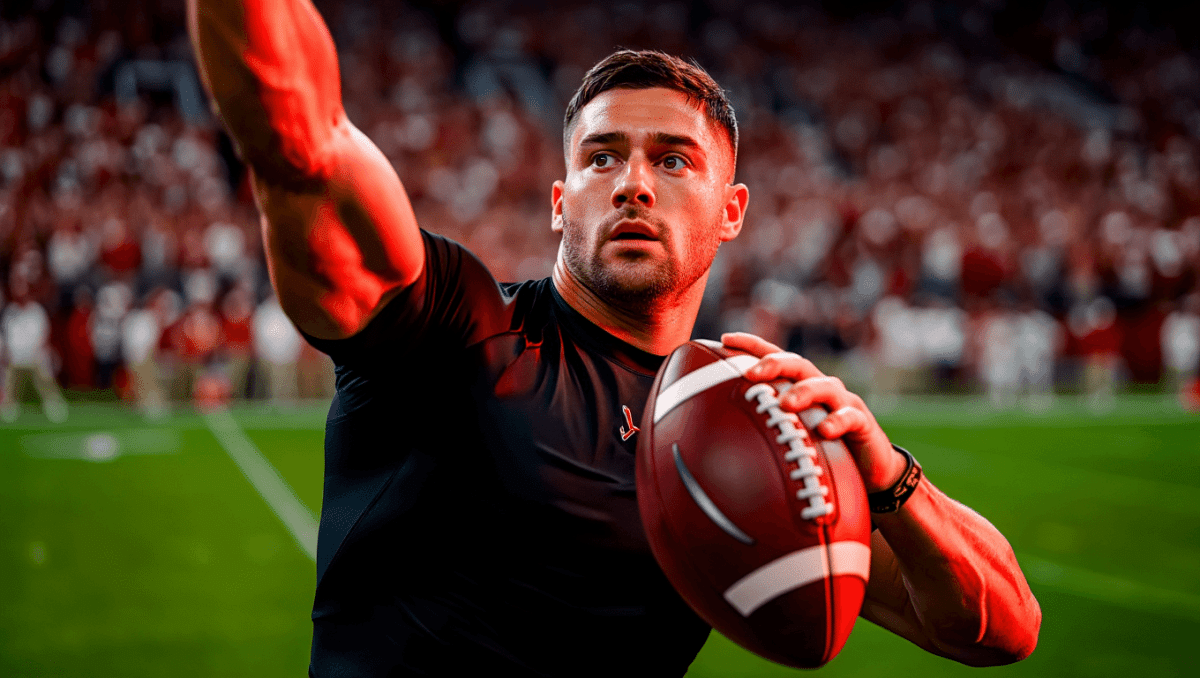
Mina Kimes breaks down why Ty Simpson is a shocking 2026 draft outlier
Jay Cutler announces strongman debut at 2027 Arnold, shifting sports focus
Physical Limitations Define the Draft Debate
Simpson hasn’t undergone full combine testing, raising questions about speed and athletic measurement accuracy. His playing weight likely dipped below the listed 211 pounds, creating serious durability concerns. The question becomes whether he can absorb punishment from NFL defensive linemen over a full 17-game season.
His willingness to operate in the middle of the field and deliver into high-traffic zones is elite. That aggression requires standing in the pocket and absorbing hits. Simpson’s lack of elite athleticism compounds the problem. Adding weight compromises quickness and mobility. Staying light forces him to operate from the pocket where his height disadvantage becomes more pronounced.
How Simpson Compares to NFL Success Stories
| Quarterback | Height/Weight | College Starts | Draft Round |
| Ty Simpson | 6’1″, 211 lbs | 15 | Projected Round 1 |
| Kyler Murray | 5’10”, 207 lbs | 13 | 1st Overall (2019) |
| Brock Purdy | 6’1″, 225+ lbs | 30+ | 7th Round (2022) |
| Bryce Young | 6’0″, 204 lbs | 27 | 1st Overall (2023) |
“Simpson is a prominent outlier if he succeeds in the NFL. Most of those outliers were either freak athletes or were drafted in later rounds because they were viewed as major risks.”
— Mina Kimes, ESPN Analyst and Podcast Host
The Experience Question Compounds the Risk
Simpson has just one season as a starting quarterback in college football. During that stretch, he completed 64.5% of his passes for 3,734 yards across 15 starts. While he started strong, throwing 21 touchdowns in his first nine games, his production dipped significantly. In his final five games, he averaged just 156 passing yards with six touchdowns and three interceptions.
Injuries contributed to the decline. Simpson fractured his rib on one play and battled multiple nagging injuries late in the season. The limited sample size compounds the physical concerns, forcing evaluators to project his NFL potential based on incomplete college data. Historically, quarterbacks with fewer than 16 starts rarely succeed at first-round expectations.
Could Simpson Actually Belong in the Second Round?
The debate among top draft analysts reveals sharp disagreement on Simpson’s placement. Some mock drafts project him as high as the mid-first round, while others suggest the second round better reflects the risk. Matt Miller recently stated he doesn’t have Simpson going in the first round at all. Other evaluators, like Dan Orlovsky, champion him as QB1, arguing he possesses elite arm talent and NFL-ready processing.
The truth lies somewhere between these poles. Simpson is a talented prospect with genuine NFL upside. Yet his combination of size limitations, minimal starting experience, injury history, and physical outlier status creates legitimate risk. Teams historically pass on players matching this profile in early rounds, reserving first-round picks for prospects with clearer physical ceilings and deeper resume credentials.