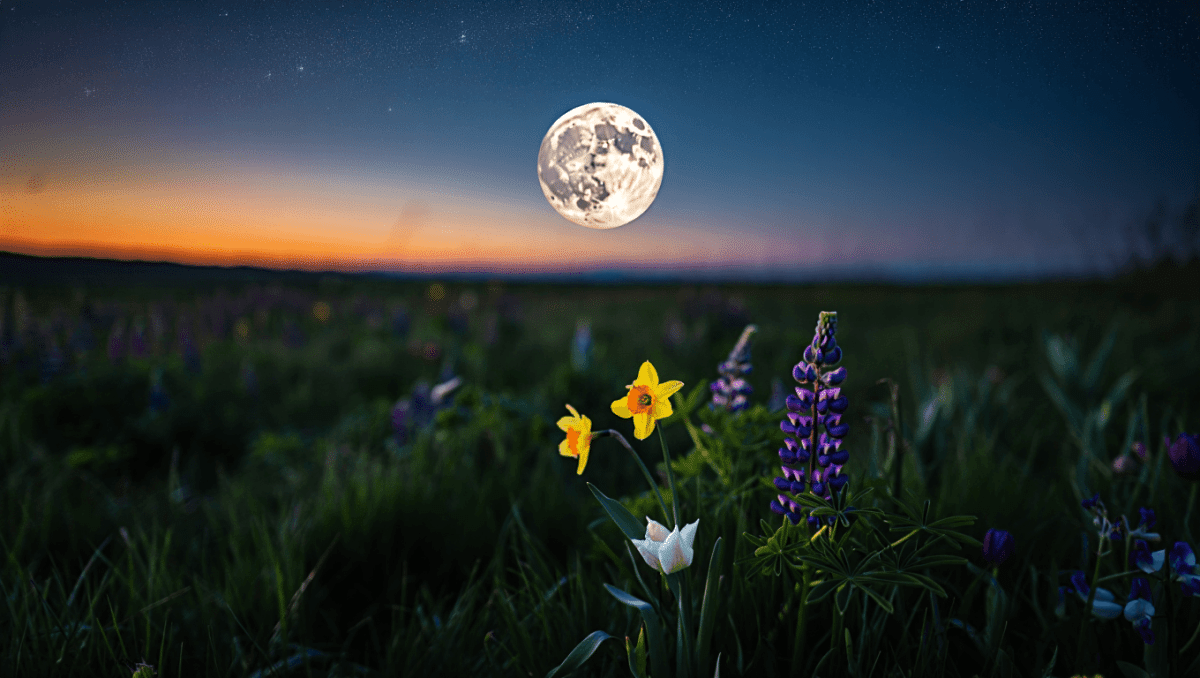
April 2026 serves up a celestial show that will light up your calendar. This month features three astronomical events that align perfectly with spiritual holidays, creating a rare convergence of science and tradition. From the Pink Moon to Passover and Easter, April delivers something special for everyone watching the skies.
🔥 Quick Facts
- Pink Moon Peak: April 1, 2026 at 10:12 p.m. ET (and surprisingly, it lands on April Fools’ Day)
- Easter Sunday: April 5, 2026 for Western Christian churches worldwide
- Passover Begins: April 1-9, 2026, overlapping directly with the full moon
- Lyrids Meteor Shower: Peaks April 21-22, one of the oldest recorded meteor showers in history
Why is April 1st the Pink Moon (And It’s Not Actually Pink)
April’s full moon earned its poetic name from the creeping phlox flower, scientifically known as Phlox subulata. This wildflower blooms in early spring across eastern North America, displaying soft pink hues across fields and gardens. Despite the romantic name, the moon itself won’t appear pink. The full moon will reach peak brightness at 10:12 p.m. EDT on Wednesday, April 1.
What makes this timing particularly remarkable is that the Pink Moon occurs on April Fools’ Day, making tonight’s phenomenon the subject of countless jokes online. However, the astronomical event is completely real. The full moon is also known as the Paschal Moon in Christian tradition because it determines when Easter falls each year. This 2026 Pink Moon is especially significant because it’s the first full moon after the spring equinox.
To view the Pink Moon at its best, find an elevated location, an open field, or an east-facing coastline with a clear view of the horizon. The moon rises in the east and will be visible throughout the night. Best viewing happens within a few hours of peak illumination.
Easter and Passover Converge for a Rare Religious Moment
Easter 2026 falls on Sunday, April 5, just four days after the Pink Moon rises. This date specifically because Easter is calculated as the first Sunday following the first full moon after March 21, the date Christians mark as the spring equinox. The Pink Moon directly determines Easter’s date, creating an astronomical-religious connection that has guided Christians for centuries.
Remarkably, Passover begins the evening of April 1 and continues through April 9, overlapping entirely with Holy Week and Easter. This convergence is rare but not unprecedented. Passover commemorates the exodus of the Jewish people from Egypt, celebrated with seders, unleavened bread, and family gatherings. When these two major religious holidays align, it creates a meaningful moment for interfaith communities and anyone observing both traditions this April.
According to Chabad, the first Passover seder occurs at nightfall on April 1, with the holiday concluding at nightfall on April 9. The overlap means Christians preparing for Easter and Jews observing Passover share the same spiritual season in 2026, amplifying the season’s emphasis on renewal, freedom, and rebirth.
What to Watch in April’s Night Sky
| Event | Date | Best Time to View |
| Pink Moon (Full Moon) | April 1 | 10:12 p.m. ET / All night |
| Lyrids Meteor Shower Active | April 16-25 | After midnight, before dawn |
| Lyrids Peak | April 21-22 | 2 a.m. to 6 a.m. local time |
| Mercury Greatest Elongation | April 4 | Before sunrise, low on horizon |
April’s astronomical calendar offers multiple opportunities for stargazers. Beyond the famous Pink Moon and Lyrids, Mercury reaches greatest elongation on April 4, appearing at its farthest from the sun and becoming easier to spot in the pre-dawn sky. For the best viewing experience, escape light pollution by traveling to areas away from city lights.
The Lyrids: One of the Oldest Meteor Showers
Later in April, skywatchers should turn their attention upward for the Lyrids meteor shower, active from April 16-25 with peak activity on the nights of April 21-22. This ancient meteor shower has been observed and recorded for over 2,700 years, making it one of the oldest documented celestial events. The debris comes from Comet Thatcher, whose particles enter Earth’s atmosphere each spring.
A typical Lyrid display produces between 5 and 20 meteors per hour during peak nights, though occasionally the shower surprises observers with rare outbursts. The best viewing happens after midnight and continues until just before dawn. For April 2026 specifically, a waxing crescent moon will set early in the evening, leaving dark skies for prime meteor watching.
“The Lyrid meteor shower comes from debris left behind by Comet Thatcher, with this meteor shower coming from some of the oldest material in the solar system.”
— NASA, Solar System Exploration
How Solar and Lunar Events Shape Human Calendars
April 2026 demonstrates how astronomical events create the foundation for religious and cultural calendars. Easter’s date has been determined by the Paschal Full Moon since the Council of Nicaea in 325 CE. Passover’s dates, based on the Hebrew lunar calendar, sometimes align with Western astronomy, creating these rare convergent moments. Mercury’s visibility, moon phases, and meteor shower peaks all influenced ancient and modern civilizations’ understanding of time.
Understanding these connections reveals how science and spirituality intersected throughout human history. Ancient peoples used celestial observations to plant crops, observe holy days, and navigate by the stars. Today, April 2026 offers modern observers a chance to reconnect with that tradition. Whether you’re watching for spiritual significance, scientific interest, or pure wonder at the cosmos, April rewards attention with multiple opportunities.
What Will You See in April’s Cosmic April Calendar?
Whether you observe the Pink Moon’s peak glow from your backyard, attend Passover seder gatherings, celebrate Easter Sunday on April 5, or wake before dawn to chase Lyrid meteors, April 2026 offers a month of profound celestial and spiritual moments. Mark your calendar, set phone reminders for peak viewing times, and look up. The cosmos is putting on a show that blends science, history, and tradition into one remarkable month that won’t repeat this exact way for centuries.
Sources
- USA Today – Comprehensive April 2026 calendar featuring holidays, lunar events, and astronomical phenomena
- Space.com – Detailed guide to how the Pink Moon determines Easter’s date and mythology behind full moon names
- NASA Solar System Exploration – Scientific information on meteor shower origins and comet debris composition