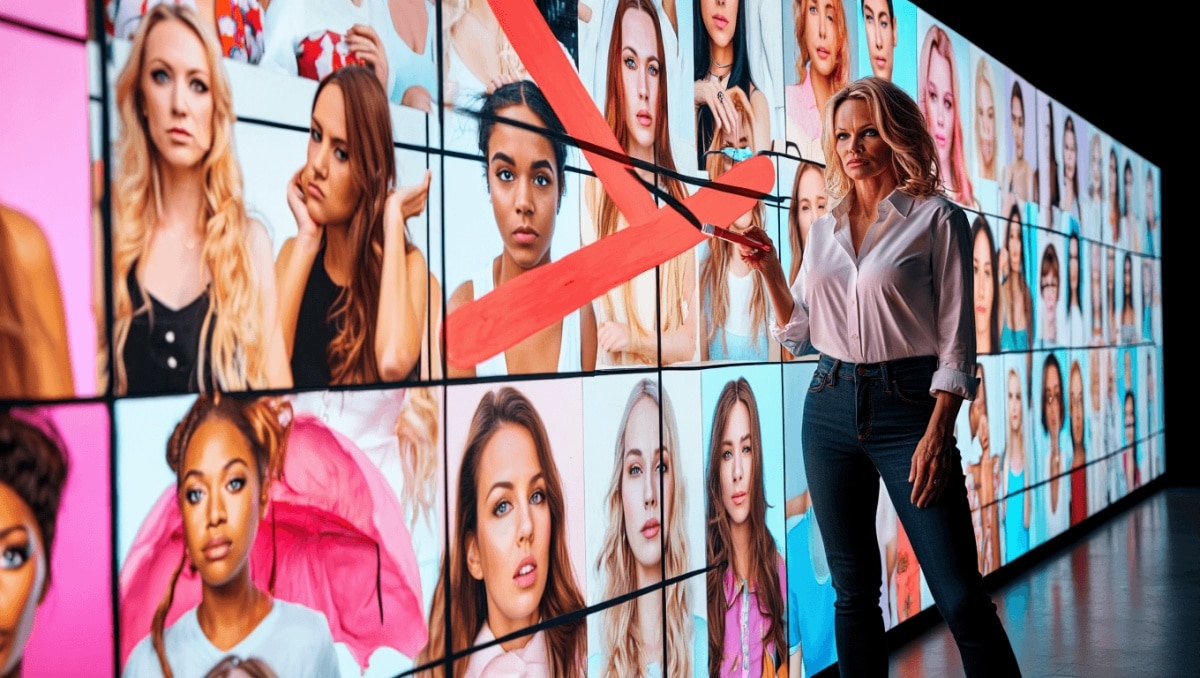
Pamela Anderson is fronting a new ad push for Aerie that takes a clear stance against AI-generated people — a timely declaration as the fashion world wrestles with synthetic imagery. The campaign, which casts Anderson as both participant and critic, reinforces the brand’s promise to use only human models and aims to reopen the conversation about authenticity in advertising.
The short film opens on a behind-the-scenes moment: Anderson speaks into a voice prompt, directing an AI to create a “more joyful” female model — but the results feel off. As digital renderings cycle through, she grows increasingly dissatisfied, eventually rejecting the artificial options in favor of flesh-and-blood performers who arrive on set.
For Aerie, the spot builds on a pledge announced last fall to keep its imagery free from synthetic people. The brand framed the partnership with Anderson as a natural fit: she has long curated a very public image that emphasizes honesty and simplicity, traits Aerie now points to as central to its marketing identity.
Why this matters now
The item lands amid heightened scrutiny of AI in creative work. Luxury houses, including Gucci, recently released AI-generated campaign images that provoked backlash online, prompting fresh debate over where to draw the line between creative experimentation and misleading representation.
Anderson, speaking with People to promote the campaign, argued that machines cannot replicate the unpredictable depth of a live performance. She emphasized that imperfection — the small, human variations — gives art its emotional pull and that technology lacks the same intuitive spark.
- Aerie’s promise: the company says it will not use AI-generated bodies or AI-generated people in its imagery.
- Creative transparency: the campaign highlights the importance of telling audiences when images are manufactured.
- Consumer trust: brands that eschew synthetic models hope to preserve credibility with shoppers wary of doctored visuals.
The collaboration also underscores a broader cultural shift: a number of brands and public figures are staking reputations on claims of authenticity as AI tools become more sophisticated and widely available.
What this could mean for advertising
Marketers face a fast-moving choice between speed, cost and honesty. AI can produce imagery quickly and cheaply, but as Aerie’s campaign suggests, there is reputational risk in presenting synthetic people as real models.
For consumers, the stakes are practical and emotional. Real-model campaigns can influence expectations about size, movement and diversity; AI-driven imagery can shift those norms — intentionally or not. A brand’s stated policy on AI therefore becomes a signal about its priorities: cost-cutting, innovation, or transparency.
Not every company will follow Aerie’s lead, but the debate is likely to shape creative guidelines and disclosure practices across fashion and media in the months ahead.
For now, Aerie has released several campaign images and a short film starring Anderson — the brand is promoting the content across its channels. Whether other labels will adopt similar limits on synthetic people remains to be seen, but the controversy over recent AI-generated fashion imagery makes Aerie’s position immediately relevant to readers tracking the future of advertising and representation.