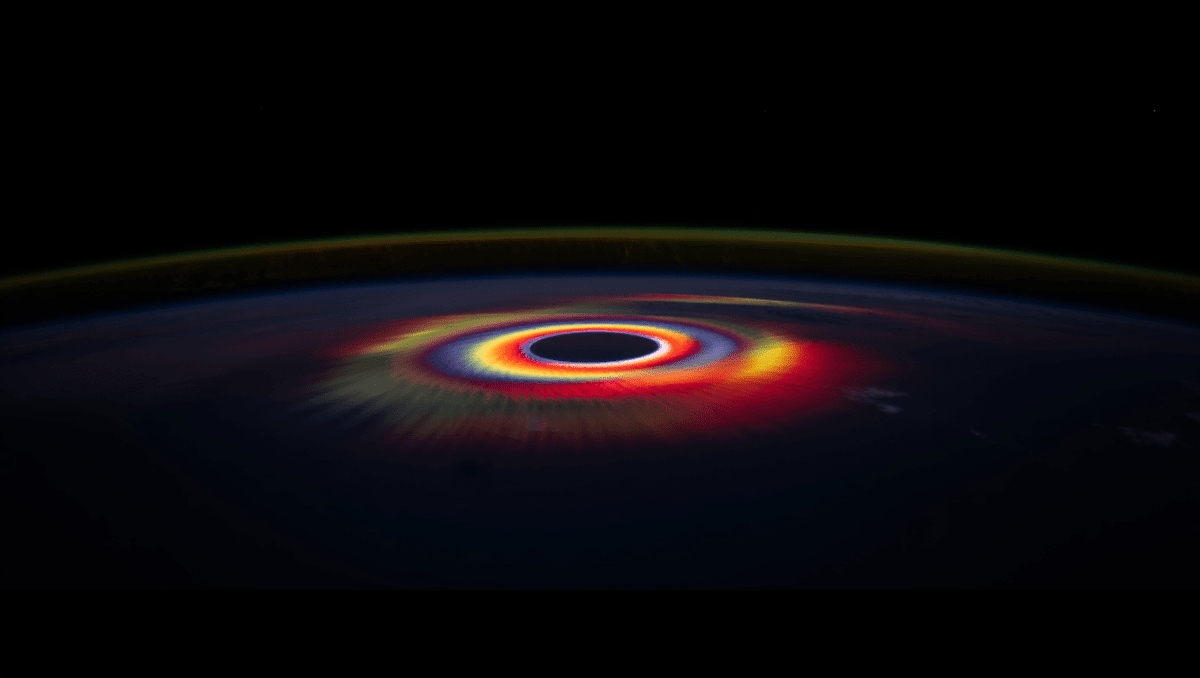
Hurricane Helene unleashed a hidden force 55 miles above Earth that scientists barely saw coming. On September 26, 2024, the massive storm didn’t just batter Florida’s coast with devastating winds and rain. It also created spectacular atmospheric ripples that rippled through the upper atmosphere, revealing nature’s invisible power over space itself.
🔥 Quick Facts
- The Discovery: NASA’s Atmospheric Waves Experiment (AWE) detected enormous atmospheric gravity waves 55 miles above Earth
- The Location: Concentric ripples extended westward from Florida’s northwest coast, spreading far beyond the hurricane’s main zone
- The Altitude: Waves appeared in the mesosphere, a cold atmospheric layer between 31 and 55 miles up with temperatures around -150 degrees Fahrenheit
- The Impact: First-ever space-based observation proving terrestrial storms can disturb satellites and communications systems in the upper atmosphere
Never Before Seen From Space
Hurricane Helene made history on September 26, 2024, when it slammed the Gulf Coast of Florida as a devastating category 4 storm. But while scientists watched the weather system ravage the ground below, something extraordinary was unfolding far above. The International Space Station, orbiting 250 miles overhead, carried a groundbreaking instrument that captured what no space mission had ever witnessed before.
The AWE instrument, mounted on the ISS exterior and launched in November 2023, was designed specifically to detect atmospheric gravity waves. When Hurricane Helene struck, the sensor suite captured spectacular images of expanding rings of atmospheric disturbance. Ludger Scherliess, principal investigator at Utah State University, described the phenomenon perfectly: “Like rings of water spreading from a drop in a pond, circular waves from Helene are seen billowing westward from Florida’s northwest coast.”
Ripples in the Sky, Threats Below
Atmospheric gravity waves are ripple-like patterns triggered by violent disturbances. Violent thunderstorms trigger them, tornadoes spawn them, and now scientists know hurricanes generate enormous ones. The mesosphere, where these waves appeared, seems impossibly remote from daily life. Yet this thin layer controls critical elements of space weather affecting communications and navigation.
The Advanced Mesospheric Temperature Mapper (AMTM) aboard AWE observes infrared light emitted by airglow, a faint luminescence produced by chemical reactions in Earth’s upper atmosphere. When Hurricane Helene’s energy propagated upward, the sensor captured brightness fluctuations in infrared wavelengths. The resulting images showed concentric bands of energy, artificially colored in red, yellow, and blue for clarity, expanding like ripples away from the storm’s impact zone.
Why Space Weather Matters to Satellites
Communication satellites, GPS networks, and the International Space Station itself depend on stable atmospheric conditions for safety. When atmospheric density shifts unexpectedly at high altitudes, satellites experience increased drag that can knock them out of orbit. The mesosphere’s subtle variations, invisible to traditional weather radar, now become trackable thanks to AWE’s revolutionary approach.
| Instrument | Details |
| Full Name | Atmospheric Waves Experiment (AWE) |
| Launched | November 2023 on International Space Station |
| Detection Method | Infrared airglow brightness variations in mesosphere |
| Key Advantage | First space-based global view of atmospheric gravity waves |
Michael Taylor from NASA emphasized that this unexpected observation reshapes how scientists think about storm impacts. Previously, researchers could only study these waves through ground-based instruments with severe limitations. The AWE mission revealed that surface weather disturbances compress and propagate energy 55 miles upward, disrupting the very space environment surrounding our planet.
“These views of gravity waves from Hurricane Helene are among the first publicly released images from AWE, confirming that the instrument has the sensitivity to reveal the impacts hurricanes have on Earth’s upper atmosphere.”
— Vanessa Thomas, NASA Goddard Space Flight Center
A Scientific Breakthrough for Space Safety
Ludger Scherliess called the discovery “a scientific breakthrough.” For decades, scientists could only theorize about how terrestrial weather affects space weather. Now, AWE’s observations provide concrete evidence. When Hurricane Helene’s energy rocketed upward through stable atmospheric layers, it created visible disturbances in the mesosphere’s structure. These disturbances influence where and how electromagnetic waves propagate, directly affecting radio communications and satellite operations.
Engineers worry about atmospheric density changes because even minuscule shifts alter satellite orbits. GPS satellites depend on precise positioning. Weather satellites must maintain stable altitudes. The International Space Station occasionally needs altitude adjustments to counteract atmospheric drag. By observing gravity waves from Hurricane Helene, scientists now understand how extreme weather events can ripple through space environments thousands of miles away.
What comes next for atmospheric science from space?
The AWE Science Team is rapidly analyzing hundreds of images captured by the mission’s four separate telescopes. They’re removing reflections from clouds, Earth’s surface, moonlight, and ISS solar panels to ensure clarity. This process, never before attempted, takes meticulous work but promises unprecedented data. Scientists plan to release comprehensive datasets that will allow researchers worldwide to study how hurricanes, tornadoes, and other violent storms affect the upper atmosphere.
Future tropical cyclones may trigger even more detailed observations. Each new storm studied provides another data point about how Earth’s surface weather connects to space weather above. Ludger Scherliess noted that AWE’s global perspective opens “a whole new chapter of knowledge.” For the first time, humanity has space-based eyes watching how ordinary weather evolves into extraordinary atmospheric events far beyond our sight.