Show summary Hide summary
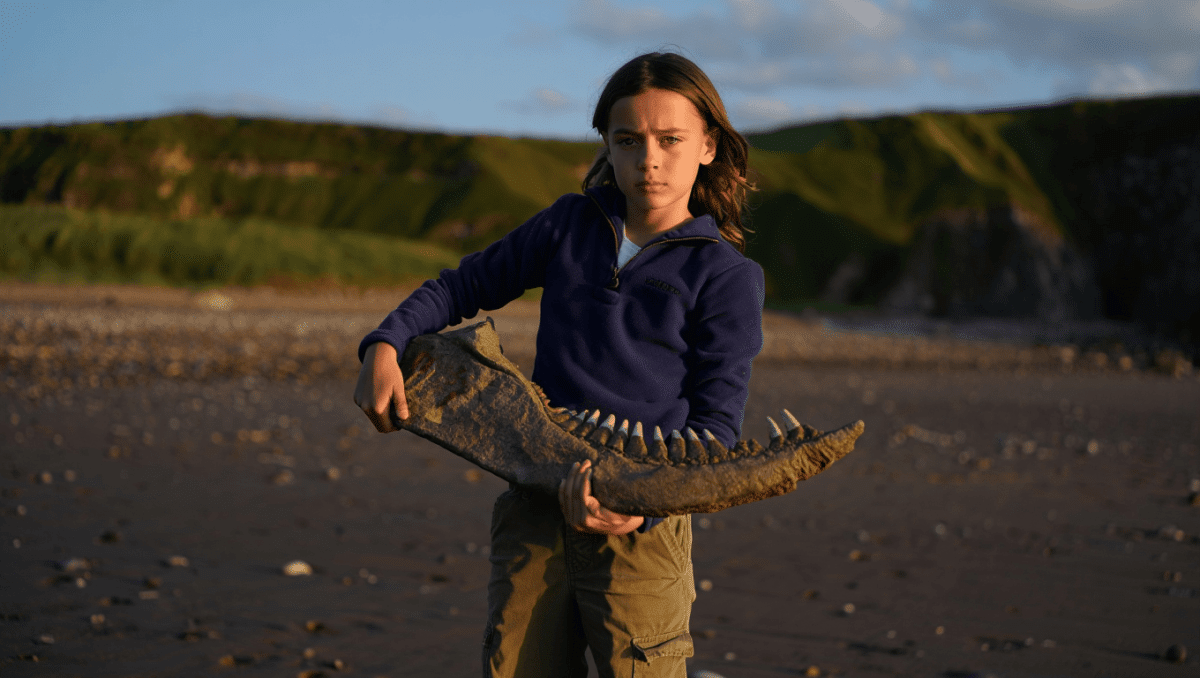
Ichthyotitan severnensis just shattered every ocean record in the book. An 11-year-old girl and her father stumbled onto a 6.5-foot jawbone in Somerset, England, that point to a creature so massive it rivals a blue whale. This prehistoric leviathan changes everything we know.
🔥 Quick Facts
- Discovery: Ruby Reynolds, age 11, found fossil jawbones in May 2020 on a Somerset beach in England
- Size: Estimated 82 feet long, comparable to a modern-day blue whale, dwarfing even the Megalodon
- Age: Fossils date to 202 million years ago during the Late Triassic period
- Species Name: Ichthyotitan severnensis, meaning giant fish lizard of the Severn Estuary
A Child’s Beachside Discovery Changes Paleontology Forever
What started as a casual family fossil hunt became the scientific discovery of the century. Ruby Reynolds, just 11 years old, was walking a beach in Blue Anchor, Somerset when she spotted something extraordinary. Her father Justin had already found a 4-inch bone fragment, but Ruby’s discovery was even more impressive. The specimen sat nearly exposed on the muddy shore, waiting for curious eyes. The father-daughter team photographed their find and reached out to paleontologist Dean Lomax at the University of Bristol. Within days, research teams descended on Somerset to carefully extract the precious fossil. What they uncovered would rewrite marine history.
The jawbone proved so significant because it matched a specimen discovered in 2016. When Lomax and his team compared the two, they realized they’d found fossils from the same species. The second specimen was far more complete, giving scientists their first real look at what may be Earth’s largest marine reptile ever.
Ichthyotitan severnensis shatters records as largest marine reptile ever found
John Travolta celebrates 72nd birthday by earning Bombardier jet license
How Scientists Identified This Ancient Behemoth
The fossil jaw alone measured more than six and a half feet long, nearly the height of a tall human. Paleontologists scaled up the bones using comparisons with other ichthyosaur species like Shonisaurus. These calculations suggested the full animal stretched roughly 82 feet from head to tail. To put that in perspective, a modern blue whale averages about 100 feet, but this Triassic creature competed in the same size class. Scientists also examined microscopic bone structures, discovering patterns that matched other giant ichthyosaurs. The team published their findings in PLOS ONE, formally naming the creature Ichthyotitan severnensis. Internal bone textures revealed the animal was still growing when it died, meaning some specimens may have reached even more staggering dimensions.
| Characteristic | Details |
| Estimated Length | 82 feet, comparable to blue whale |
| Jaw Length | Over 6.5 feet long fossil fragments found |
| Time Period | Late Triassic, around 202 million years ago |
| Location Found | Somerset, England (Blue Anchor mudflats) |
“These jawbones provide tantalizing evidence that perhaps one day a complete skull or skeleton of one of these giants might be found. You never know.”
— Dean Lomax, Paleontologist, University of Bristol
How Ichthyotitan Dominated the Ancient Oceans
Picture an apex predator patrolling warm Triassic seas around what is now Britain. Ichthyotitan severnensis was the orca of its time, hunting everything smaller than itself. Its massive jawbone, with teeth designed for crushing, likely snapped up fish, squid-like cephalopods, and smaller marine reptiles. Scientists discovered evidence on the fossil jaw showing it had been nibbled by scavengers after the creature died. The enormous size required tremendous food intake, suggesting Triassic oceans teemed with life. New forms of plankton were evolving during this era, creating productive food webs capable of supporting giants. The animal’s streamlined, lightweight frame suited long-distance ocean travels. Unlike the bulky dinosaurs on land, ichthyosaurs gave birth to live young and hunted with intelligence and speed matching modern marine predators.
Why This Find Rewrites Everything We Know About Ocean Giants
Ichthyotitan severnensis emerged near the end of the Triassic period, just as the oceans faced catastrophic change. A devastating mass extinction 201 million years ago wiped out these marine giants forever. What’s remarkable is that Ichthyotitan represents not a declining species, but a thriving one at the peak of its dominance. After this extinction, later ichthyosaurs never again reached such staggering proportions. The oceans then remained without giant marine reptile apex predators until whales evolved 50 million years ago. This ancient giant’s existence proves that evolutionary success repeated itself, with different species filling the same ecological role across millions of years. Finding Ichthyotitan severnensis answers a critical question in paleontology about when oceanic giants first dominated Earth’s waters.
Will Beaches Reveal More Ancient Secrets About This Monster?
Somerset’s eroding cliffs continue crumbling each winter, exposing fossils long buried in ancient mud. The research team credits Ruby Reynolds and countless other beachcombers for their vigilance. More expeditions are planned to hunt for additional Ichthyotitan severnensis remains along the English coastline. A complete skull or skeleton could finally answer lingering questions about the animal’s exact size, hunting behavior, and relationships to other giant ichthyosaurs. Paleontologists remain optimistic that future discoveries will emerge. The fact that a young girl stumbled upon such a monumental find suggests countless more treasures await discovery. Will the next explorer unearth a complete skeleton?
Sources
- Earth.com – Investigation of the 11-year-old girl’s discovery of Ichthyotitan severnensis fossil in Somerset
- National Geographic – Scientific analysis of jawbone fossils and ichthyosaur behavior by Dean Lomax
- PLOS ONE – Peer-reviewed research paper formally describing Ichthyotitan severnensis discovery