Show summary Hide summary
After 25 years in the shadows, Reuters investigators just unmasked the world’s most famous anonymous artist. A groundbreaking investigation published March 13, 2026, reveals that Banksy is actually Robin Gunningham, a 51-year-old Bristol native who legally changed his name to hide in plain sight. What Reuters discovered shocked the art world.
🔥 Quick Facts
- Real Name: Robin Gunningham, born in Bristol, England in 1973, later changed to David Jones
- Evidence: Court records from September 2000 New York arrest for defacing a Marc Jacobs billboard
- Investigation: Reuters spent over a year tracing Ukraine murals, police documents, and immigration records
- Impact: One Banksy painting sold for $1.4 million, then shredded and resold for $25 million
How Reuters Finally Cracked the Code
In late 2022, Banksy appeared in Ukraine to paint seven murals supporting victims of Russian aggression. Three people arrived in an ambulance at Horenka, a village near Kyiv. Two wore masks. Reuters journalists later showed locals a photo lineup of suspected Banksys. Residents’ reactions to one image proved crucial. The mystery deepened when immigration sources revealed the masked painter wasn’t Gunningham at all. Instead, it was David Jones, crossing the border on the same day as another familiar name.
That other name was Robert Del Naja, frontman of trip-hop band Massive Attack and a legendary graffiti artist known as 3D. Del Naja had long been rumored to be Banksy. But Reuters found Del Naja entered Ukraine on October 28, 2022, alongside documentary photographer Giles Duley. The second painter was someone else entirely.
Who is Banksy? Reuters investigation reveals artist’s long-secret identity
Reese Witherspoon turns 50 today, ‘Legally Blonde’ star reflects on career
The Smoking Gun Never Went Away
The breakthrough came from a routine arrest. In September 2000, police caught a man defacing a Marc Jacobs fashion billboard atop a building at 675 Hudson Street in Manhattan. The billboard showed a young man with the words “Boys Love Marc Jacobs.” Banksy altered it with goofy teeth and a speech bubble, inspired by a scene from the movie Jaws. Authorities took a handwritten confession signed by the perpetrator. The signature revealed one crucial detail: the artist’s given name. His handwritten statement was signed Robin Gunningham.
Court documents show it all. Gunningham was released after a female judge heard his case. He paid $310 in fines and completed five days of community service on a misdemeanor charge of disorderly conduct. The bail form listed his address as the Carlton Arms Hotel in Manhattan, where Banksy had famously painted rooms in the 1990s. Almost nobody knew this name existed.
| Event | Details |
| Birth Name | Robin Gunningham (Bristol, 1973) |
| 2000 Arrest | Billboard vandalism, paid $310 fine |
| 2008 Name Change | Legally changed to David Jones |
| 2022 Ukraine Visit | Painted 7 murals supporting war victims |
“I don’t know why people are so keen to put the details of their private life in public; they forget that invisibility is a superpower.”
— Banksy, Time Out NY (2010)
The Mastermind Behind the Mystique
Steve Lazarides, Banksy’s manager from the 1990s to 2008, finally confirmed Reuters’ theory. When asked about Robin Gunningham, Lazarides told journalists: “There is no Robin Gunningham. The name you’ve got I killed years ago.” He revealed that in 2008, after the Mail on Sunday identified Gunningham as Banksy in an exposé, he and the artist made a strategic decision. Lazarides arranged a legal name change, transforming Robin Gunningham into someone entirely new. “It’s just another name,” Lazarides said cryptically. That name was David Jones, one of the most common names in Britain, almost designed for invisibility.
The identity change was brilliant strategy. Gunningham spent roughly half of Lazarides’ time managing Banksy’s anonymity, which had become what the manager called “a disease.” After 2008, the artist vanished from British public records almost entirely. Immigration documents, property records, and corporate filings under David Jones prove the rebirth worked. When Banksy traveled to Ukraine in October 2022, he traveled as David Jones. The secret survived 17 more years.
Why Anonymity Made Banksy a Billionaire
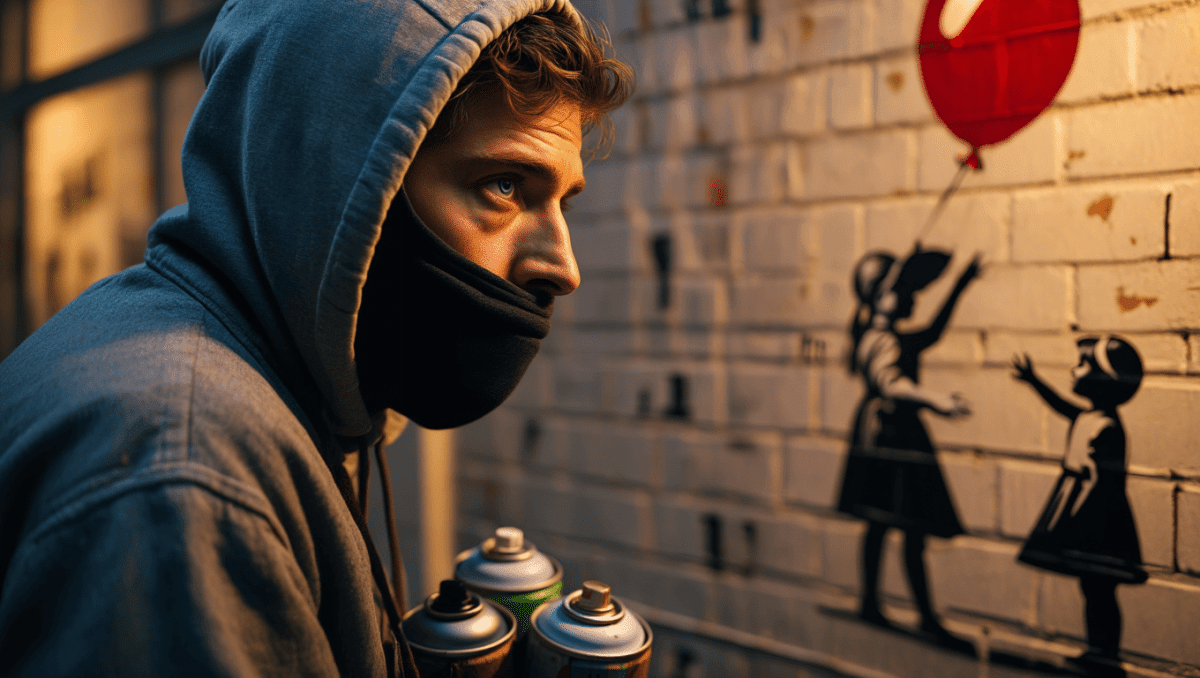
Banksy has never confirmed his identity, and his lawyer Mark Stephens urged Reuters not to publish the findings, warning that exposure would “put him in danger.” Yet the art market didn’t collapse. One dealer predicted that viewers judge the art itself, “not because he’s masked, not because he’s a Robin Hood-character.” The evidence tells another story entirely. In 2018, “Girl with Balloon” sold at Sotheby’s for $1.4 million. Moments later, a hidden shredder activated inside the frame, partially destroying the masterpiece. The now-renamed “Love is in the Bin” sold three years later for $25 million, nearly 18 times the original price. Street interventions maintain “visibility and authorship,” analysts wrote, keeping collector demand at peak levels.
Museums remain silent about Banksy. Britain’s National Portrait Gallery holds a photograph of the artist in a hooded coat wearing a chimpanzee mask. It sits in storage, never displayed, despite the subject being designated of “cultural and social significance.” Some artists wonder whether Banksy gets special legal treatment. In September 2025, he stenciled a provocative piece on the Royal Courts of Justice showing a judge bashing an unarmed protester. The Metropolitan Police investigated for criminal damage. The government spent £23,690 power-washing it off but hasn’t disclosed whether he faced charges or paid compensation.
Can His Art Survive the Truth?
Anonymous artists throughout history have relied on secrecy as a creative shield. Banksy once said, “Nobody ever listened to me until they didn’t know who I was.” Now the world knows Robin Gunningham is the man. Does revealing the person behind the myth change what millions of fans feel when they see a stenciled rat or a child sneezing away wisdom? Art historians debate whether anonymity was integral to Banksy’s message or merely a marketing tool. Some collectors worry the revelation might diminish the brand’s mystique. Others insist great art transcends the name. The 2026 Reuters investigation handed fans a choice: does knowing the artist’s identity make struggling street art more human, or does it steal the magic?